
Holiday apartment in Polignano a Mare: Cliffs, caves and old town
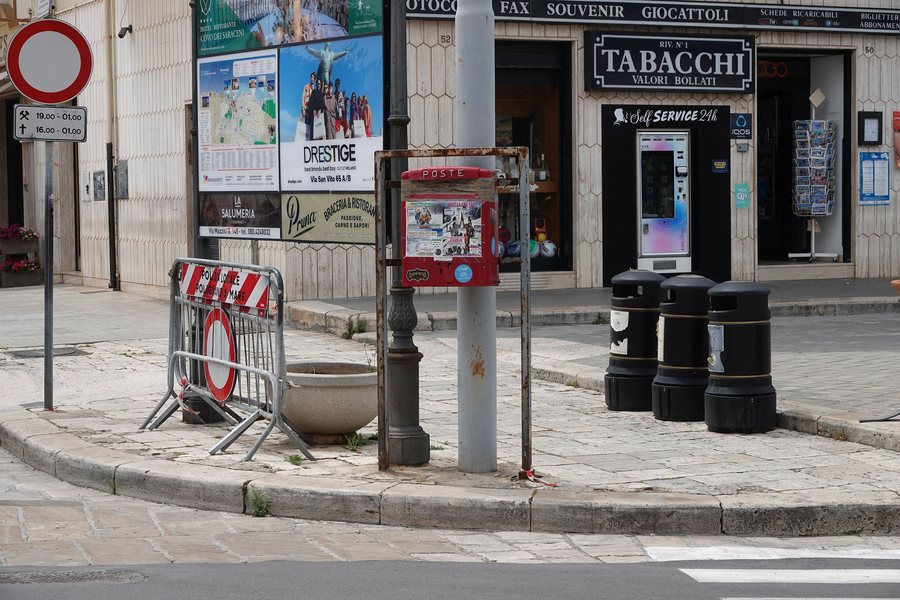 File:Post box in Polignano a Mare, Italy.01.jpg
Photo: Nenea hartia via Wikimedia Commons, CC BY-SA 4.0
File:Post box in Polignano a Mare, Italy.01.jpg
Photo: Nenea hartia via Wikimedia Commons, CC BY-SA 4.0
White houses and sea caves above the sea
Polignano a Mare reveals its character through the connection between its historic center and the coast. The historic center of Polignano a Mare consists of white medieval houses closely packed together along the sea cliff. Around twenty sea caves were formed by the force of the waves in the cliff on which Polignano a Mare stands. The dense row of white façades and the openings in the cliff created by the waves give the landscape two clearly different perspectives. From land, houses and historic buildings shape the view, while the coast is defined by rock faces, pebbles, water and caves. The white coloring of the houses and the light-colored pebbles by the water create a visible contrast with the high rock faces.
Lama Monachile and two entrances to Grotta Palazzese
Lama Monachile is a freely accessible beach between two high rock faces. Smooth, white pebbles lie there beside crystal-clear water. Grotta Palazzese is the largest of Polignano a Mare’s sea caves. It can be accessed from the sea by boat and from land via a narrow staircase carved into the rock. The two entrances are clearly different: the boat reaches the cave from the seaward side, while the narrow staircase leads through the rock from land. Grotta Ardito contains a natural column that fishermen once climbed to reach the town.
Arco Marchesale, church and Roman bridge
The entrance to the historic center is through the 16th-century Arco Marchesale, also known as Porta Grande. The historic center includes the Chiesa di Santa Maria Assunta, the town’s former cathedral. A Roman bridge crosses Lama Monachile and meets the route of the ancient Via Traiana. This places a 16th-century gateway, a religious building that formerly served as a cathedral, and a Roman transport route alongside one another in the historic center.
Fondazione Pino Pascali above the sea
The Fondazione Pino Pascali is located in a restored former municipal slaughterhouse situated above the sea. It displays works by Pino Pascali, important artists from Apulia and the winners of the Premio Pino Pascali. The exhibition venue thus combines the restored former municipal slaughterhouse with works by Pino Pascali, important artists from Apulia and the winners of the Premio Pino Pascali.
Caffè Speciale and boat trips along the caves
Caffè Speciale is a coffee specialty developed in Polignano a Mare, made with sweetened coffee, lemon zest, cream and amaretto. It is served in a small glass. Organized boat trips in Polignano a Mare take visitors to explore the most beautiful sea caves. During organized boat trips, tastings of local products may be offered on board. Alongside the caves, the local cuisine can therefore also be part of the possible excursion theme.
Traveling by the Trenitalia Salento line
The Trenitalia Salento line offers regional connections between Bari and Lecce and stops in Polignano a Mare. This provides a regional rail connection with a stop directly in Polignano a Mare.
More places for orientation
For further orientation, you can also discover Adelfia, Santo Spirito, Casamassima, Spinazzola, Santa Lucia, Gioia Del Colle, San Giorgio and Grumo Appula.
For the higher-level travel overview: Bari.
Check prices, availability and amenities for your travel dates directly on Booking.com.
View accommodations and offersAdvertisement · Affiliate link to Booking.com
