
Nagykapornak: Forest, Pilgrimage and History
Accommodation in Nagykapornak
In Nagykapornak, the Ciklámen Nature Trail in Balaton Uplands National Park runs through Remetekert, a consecrated pilgrimage site. Here, forest themes and religious traditions sit side by side, and the area's history goes back to an earlier settlement. If you choose a holiday apartment based on the interests you want to shape your stay, Remetekert offers a concrete starting point for nature and culture.
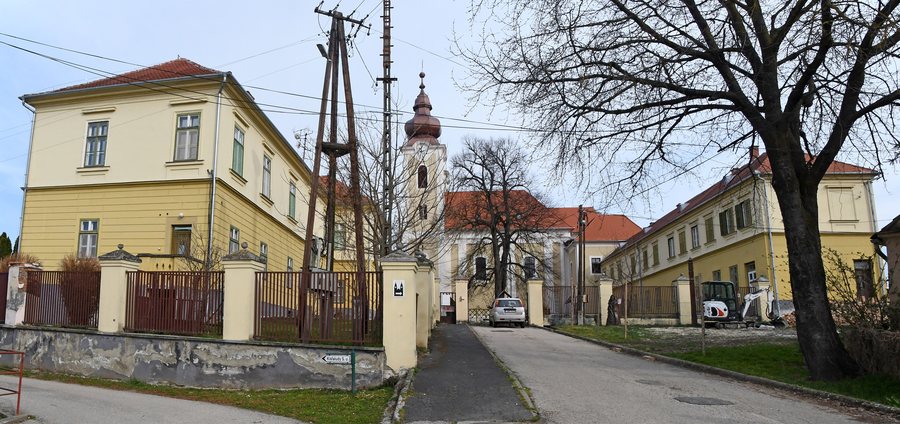 File:Nagykapornak, római katolikus templom 2023 03.jpg
Photo: Pasztilla aka Attila Terbócs via Wikimedia Commons, CC BY-SA 4.0
Remetekert: Forest and Pilgrimage
The Ciklámen Nature Trail runs through Remetekert. Its stations present a forest reserve as well as areas that illustrate selection and clear-cut forestry. In this way, the trail makes the forest itself its subject: as well as passing through the garden, it explores different forms of forest management. If you are interested in forests and how they are used, you will find a clear focus here for planning your trip.
Remetekert is also a consecrated pilgrimage site. A 2026 report describes how an increasing number of pilgrims come there each year to celebrate the Assumption of Mary together in prayer, under the protection of the Virgin Mary. This recurring celebration gives the site a religious character alongside its forest themes. Nagykapornak can thus be explored through a range of interests, without its landscape history and pilgrimage history needing to be treated as separate subjects.
A description from 2020 mentions a bell tower and several woodcarvers’ sculptures that were visible in Remetekert at the time. It also mentions the Mária-forrás, a spring in the forest below the pilgrimage site. These details add named features of the landscape and religious setting to the place to visit; the description of the sculptures refers to how things stood at the time.
Local and Architectural History
The village of Boldogasszonyháza once stood on the site of today's Remetekert; it was destroyed during the Ottoman period. Remetekert remained a pilgrimage site. Hermits lived there until the 18th century, when Joseph II prohibited hermit life in Remetekert. These historical layers place the site's religious character in a long historical context.
The church of the Benedictine Abbey of Nagykapornak is also part of the area's architectural history: in the 18th century, it was converted into a single-nave Baroque church. Together with the earlier settlement and the history of the hermits, this conversion offers another way to explore Nagykapornak—through the development of its religious sites and buildings.
Zala as a Wider Travel Horizon
The wider travel destination of Zala adds further landscape and cultural themes. The Zalai Borvidék wine region developed on the slopes and plateaus of the Zalai-dombság hills, as well as on the northwestern slopes of the Keszthelyi-hegység. It comprises two wine-growing districts and 38 settlements. This regional wine landscape provides a broader context for travel planning, while Remetekert in Nagykapornak is distinguished in particular by its forests and pilgrimage traditions.
Other examples at the Zala destination level include the Kotsy-vízimalom in Zalaszántó, where a 390-centimeter overshot waterwheel mechanism can be seen in operation. Kis-Balaton, meanwhile, is Zala's largest body of water, strictly protected and covering 14,745 hectares. It is also the setting for István Fekete's classic novels Tüskevár and Téli berek. The three themes—wine country, a watermill, and a protected body of water with a literary connection—broaden the regional perspective without replacing Remetekert's local history.
When choosing a holiday apartment, you can first consider whether Remetekert's pilgrimage and forest history should be the main focus, or whether you would prefer to base your travel plans more on Zala's broader range of themes. This keeps the specific connection to the place distinct from the wider regional context.
Discover more destinations: Zalaszentmihály, Pölöske, Zalaigrice, Misefa
Go to the wider travel overview: Pacsai.

