
Farkasgyepű: Church History and Nature
Accommodation in Farkasgyepű
You can get to know Farkasgyepű through two specific features: a church with a clearly traceable building history and the Farkasgyepűi Kísérleti Erdő nature reserve south of the village. Cultural history and protected woodland give the place two distinct points of interest. When looking for a holiday apartment, you can consider whether to focus primarily on these local themes or include other destinations in the broader Plattensee - Nord travel region.
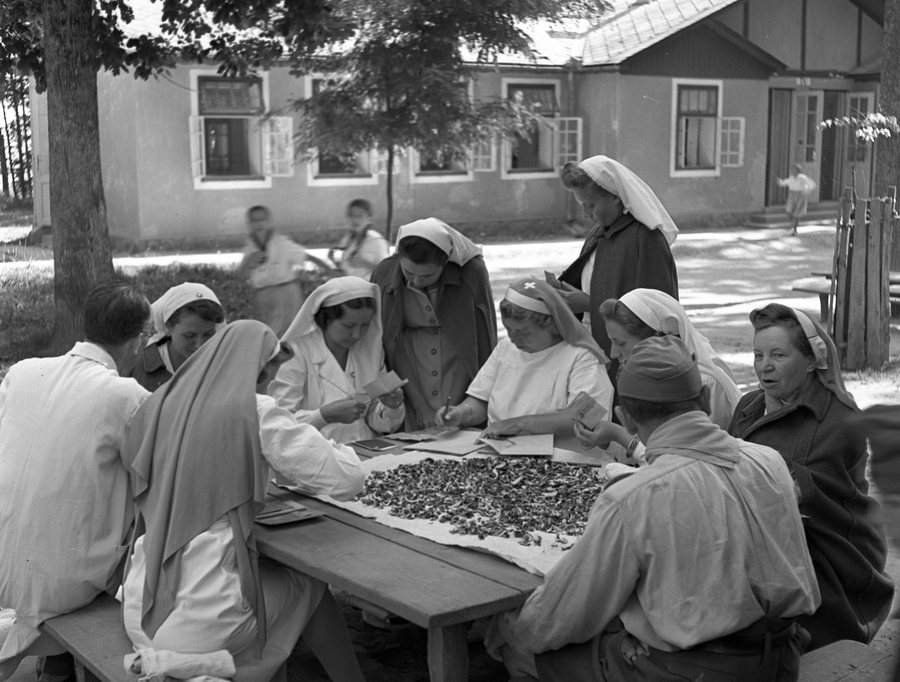 File:Az erdei iskola nevelőnői, 1943 Farkasgyepű. Fortepan 72393.jpg
Photo: FOTO:Fortepan — ID 72393 : Adományozó/Donor: Lissák Tivadar. via Source, CC BY-SA 3.0
Church, Building History and Altarpiece
Baron Károly Hornig, Bishop of Veszprém and lord of the estate, had the church in Farkasgyepű built. The design was by Adolf Wojta; the church was built by the brothers József and Károly Gerle, master stonemasons from Kardosrét. On 1 July 1909, Bishop Hornig consecrated the church. The named roles—from the person who commissioned the building to the architect and the stonemasons—make its history concrete and offer several points of interest for travelers interested in culture.
The painting also provides a distinctive feature: the altarpiece was painted by Rudolf Steiner and depicts Mary, expecting a child, visiting her sister Elizabeth. Alongside the building’s history, there is a specific work of art and its subject. Visitors interested in church architecture and art can consider both themes as part of the village’s character.
A protected natural area south of the village
The Farkasgyepűi Kísérleti Erdő nature reserve lies south of Farkasgyepű and has been protected since 1977. It adds a natural highlight to the focused history of the church and its art. This gives you two distinct interests to consider when planning your trip: the history of the church’s construction in the village and a designated natural area to the south. Which one matters more to you may influence the focus of your stay.
More to explore in the broader Plattensee - Nord travel region
In the broader Plattensee - Nord travel region, the Tapolcai-tavasbarlang offers a different way to experience the landscape. Boat trips are available there, along with the guided exhibition “Csodálatos karszt” (“Wonderful Karst”). The cave is part of an underground system beneath Tapolca that has so far been explored for 14.6 kilometres. Together, the boat trip, exhibition and cave system offer a distinct geological experience.
Hegyestű is another distinctive landscape highlight in the broader Plattensee - Nord travel region: the 337-metre-high mountain lies between Zánka and Monoszló. Its inner face reveals the structure of a basalt volcano that was active around eight million years ago. At the viewpoint on the western edge of the quarry grounds, visitors can use a panoramic information board to identify the surrounding hills. A rock garden featuring characteristic rock types of Transdanubia adds to the geological insight. For families weighing up different themes, this offers a different focus from the village church or the Farkasgyepű nature reserve to the south.
Culture and hands-on activities are also part of the broader Plattensee - Nord travel region. The Pannon Csillagda in Bakonybél has an interactive exhibition on spaceflight and astronomy. The Herend Porcelain Museum features a permanent exhibition and changing exhibitions on the history of the manufactory; the visitor centre introduces porcelain production, techniques and the traditions of applied arts. In workshops, visitors can handle porcelain clay and a brush for painting. The Levendula Ház presents an interactive exhibition on the formation of the Tihany Peninsula and lavender cultivation, as well as a craft workshop and an experience garden. At the Veszprém Zoo’s Dinosaur Park, children have the opportunity to take part in a real archaeological excavation.
The landscape and its produce are another regional highlight: distinctive grapes are grown on the slopes of Badacsony and used to make Badacsony wine. The broader Plattensee - Nord travel region offers a range of interests, from geology and astronomy to crafts and viticulture.
Explore more destinations: Ganna, Pápakovácsi, Bakonyszücs, Lovászpatona, Döbrönte, Marcalgergelyi, Takácsi, Bakonyság.
Back to the broader travel overview: Pápai.

