
Bakonyság
Accommodation in Bakonyság
Two religious buildings give Bakonyság a distinct cultural and historical focus: the chapel in Csárda-puszta and the Szent László király templom. Baroque origins, Rococo details and a 19th-century reconstruction tell the story of different building phases. This gives you a clear point of reference when choosing where to stay if you are interested in architecture and local history.
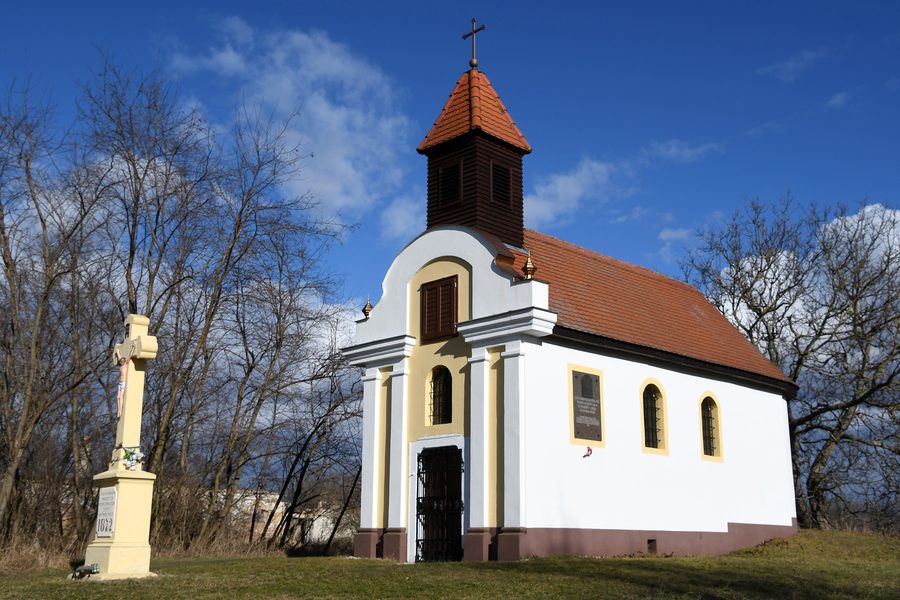 Roman Catholic chapel in Csárdapuszta, Bakonyság.
Photo: Pasztilla aka Attila Terbócs via Wikimedia Commons, CC BY-SA 4.0
The chapel in Csárda-puszta
The chapel in Csárda-puszta near Bakonyság was built in the 18th century in the Baroque style. Its furnishings, however, are in the Rococo style: the sanctuary contains a framed altar, and wooden sculptures stand against the walls. Different stylistic features thus come together in one building, visible in specific elements.
The façade is also richly detailed. The curved gable of the main façade has ball ornaments along its edges, with a small wooden tower rising above it. The stone-framed entrance and the window above it are flanked by wall piers. Török János had the chapel built. Because of the large crypt beneath the building, it was probably intended as a funerary chapel—so this purpose remains a likely interpretation.
The site’s history also includes its direct connection with a property complex that belonged in the last century to Meszlényi János, Kossuth Lajos’s father-in-law. A 2021 report notes that Földing Ernő had the chapel renovated with donations in 1994; the occasion was the 250th anniversary of the settlement in Bakonyszentiván. The memorial plaque created by Raffay Béla at the Szentháromság-kápolna in Csárda-puszta commemorates the church wedding of Kossuth Lajos and Meszlényi Terézia there. The report distinguishes this commemoration from local tradition, according to which their engagement also took place there.
The Szent László király templom
The Szent László király templom in Bakonyság tells a different architectural story. It has Baroque origins and is designed in the Historicist style. The church acquired its present form through a reconstruction from 1853 to 1855, funded by its patron, Pál Esterházy. Its history therefore cannot be reduced to a single era: Baroque origins and Historicist design sit alongside the specific story of its reconstruction. Together with the chapel, the church offers a second, distinct perspective on the town’s religious architecture.
If you are looking for a holiday apartment and want to take cultural history into account when choosing where to stay, these local buildings can help you get to know Bakonyság. The wider North Balaton destination has its own focus on geology, nature and crafts; the examples that follow are regional themes, not features of Bakonyság.
More topics in the wider North Balaton destination
Boat trips are available in the Tapolcai-tavasbarlang, which also features the guided exhibition “Csodálatos karszt” (“Wonderful Karst”). The cave is part of a cave system beneath the town that has so far been explored over a length of 14.6 kilometres. Hegyestű, the 337-metre-high mountain between Zánka and Monoszló, offers a different geological perspective. There, the inner side of a basalt volcano that was active about eight million years ago reveals its structure. From the viewpoint on the western edge of the quarry site, visitors can identify the surrounding hills with the help of a panoramic information board; Hegyestű also has a rock garden featuring characteristic rock types of Transdanubia.
Those more interested in crafts and applied arts will find another regional highlight in Herend. The Herend Porcelain Museum features a permanent exhibition and changing exhibitions on the history of the manufactory. The visitor centre presents porcelain production, the associated techniques and the traditions of applied art. In workshops, visitors can handle porcelain clay and a brush for painting—a different way to experience culture from the architectural history of the churches and chapels in Bakonyság.
The landscape and local produce can also be explored together in North Balaton: the volcanic mountain Badacsony offers hiking trails and panoramic views for hikers. Its distinctive geological formations include the structures known as basalt organ pipes. Grapes are also grown on its slopes and used to make Badacsony wine. Compare these distinct regional themes with Bakonyság’s architectural focus when deciding which aspects matter for your trip and choice of holiday destination.
Discover more destinations: Pápa, Marcalgergelyi, Döbrönte, Pápakovácsi, Homokbödöge, Lovászpatona, Bakonyszücs, Takácsi.
To the overview of the wider destination: Pápai.

