
Dörgicse: Press Houses and Church Ruins
Accommodation in Dörgicse
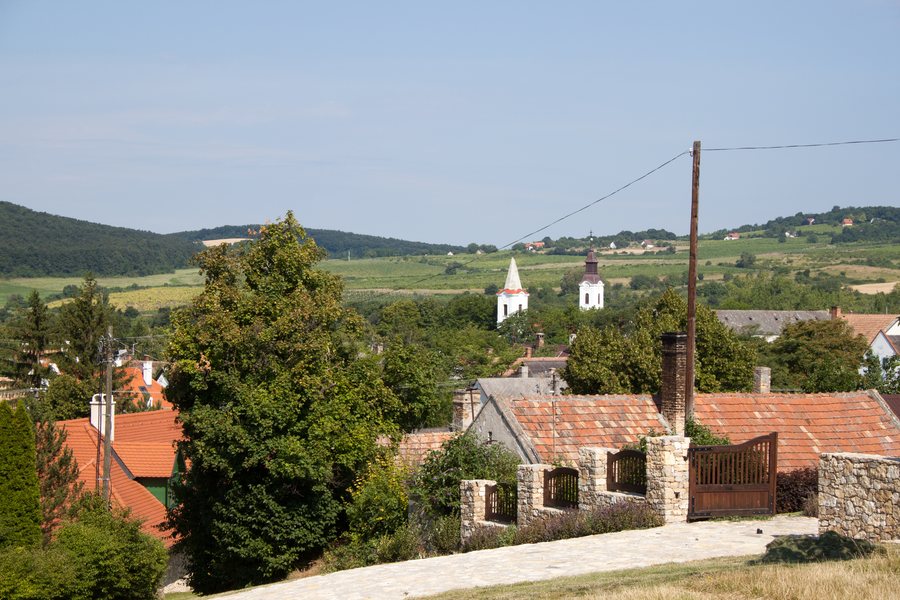
Discover Dörgicse through its historic buildings and wine tradition. On Becce-hegy, which belongs to Dörgicse, and in Agyaglik, there are several listed press houses that are hundreds of years old. They recall the former reputation of Dörgicse wines and connect preserved historic buildings with the history of this wine-growing village.
Church Ruins and Historic Façades
The Boldogasszony church ruin dates back to the 13th century: it was built as the patronal church of the Fehérvár collegiate chapter in honour of the Hungarian Mother of God. The Szent-Péter church ruin is Dörgicse’s oldest church and is dedicated to Saint Peter. These two sites offer different perspectives on the village’s church history.
The listed houses are also part of Dörgicse’s historic heritage. Their Baroque and Neoclassical façades date from the 18th and 19th centuries. In terms of chronology, the history of the buildings thus spans from the 13th-century church to the façades of later centuries. Those interested in architecture will find several different historical highlights here, rather than just a single building.
Acoustics, Vehicles and Distinctive Planting
The acoustics of the Boldogasszony church ruin are considered excellent, making it suitable for musical events and performances. This is a distinctive feature of the ruin for travellers interested in music and historic sites. If you are looking for a specific event date, check the latest announcements.
The Kaáli Autó-Motor Múzeum in Dörgicse offers a different focus with its collection of Hungarian motorcycles. In September 2020, it became possible to visit the exhibition of 130 vehicles in groups. The Levendula Major in Dörgicse is also known for its distinctive planting. Cultural and historical themes sit alongside attractions in their own right, so Dörgicse cannot be reduced to a single sight.
More Themes in the Wider Balaton - North Destination
The wider Balaton - North destination offers other, distinct themes. Boat trips are available in the Tapolcai-tavasbarlang in Tapolca, which also has a guided exhibition, “Csodálatos karszt” (“Wonderful Karst”). The cave is part of a cave system beneath the town, which has so far been explored over a length of 14.6 kilometres. The cave system and exhibition thus offer a different focus from Dörgicse’s architectural and local history.
Hegyestű offers its own geological perspective. The 337-metre-high mountain lies between Zánka and Monoszló and reveals the inside of a basalt volcano that was active around eight million years ago. From the viewpoint on the western edge of the quarry site, visitors can identify the surrounding hills with the help of a panorama board. Hegyestű also has a rock garden featuring characteristic rock types from Transdanubia, the western half of Hungary. At Badacsony, distinctive geological formations are known as basalt organ pipes; grapes used to make Badacsony wine also grow on its slopes.
Choose the Right Focus for Your Holiday Apartment
When searching for a holiday apartment, it may help to first decide what kind of holiday you want. Should Dörgicse—with its press houses, church ruins, historic façades and cultural themes—be the deciding factor? Or would you prefer to base your search on the broader range of landscape and geological themes in the wider Balaton - North destination? This distinction can help you weigh the town itself and broader regional interests separately.
Discover More Destinations
Discover more destinations: Monoszló, Pecsely, Balatonszolos, Balatonudvari, Balatoncsicsó, Balatonakali, Lovas, Balatonfüred.
Go to the wider travel overview: Balatonfüredi.

