
Kisar: Tisza floodplain, orchards and cultural heritage
Accommodation in Kisar
Kisar combines a distinctive landscape in the Tisza floodplain with nature and cultural themes rooted in the village. Old fruit trees, a nature trail, a visitor centre and a Gothic Reformed church each add a different dimension. If you are looking for a holiday rental, you can consider whether nature, regional exhibitions or architectural history should shape your stay.
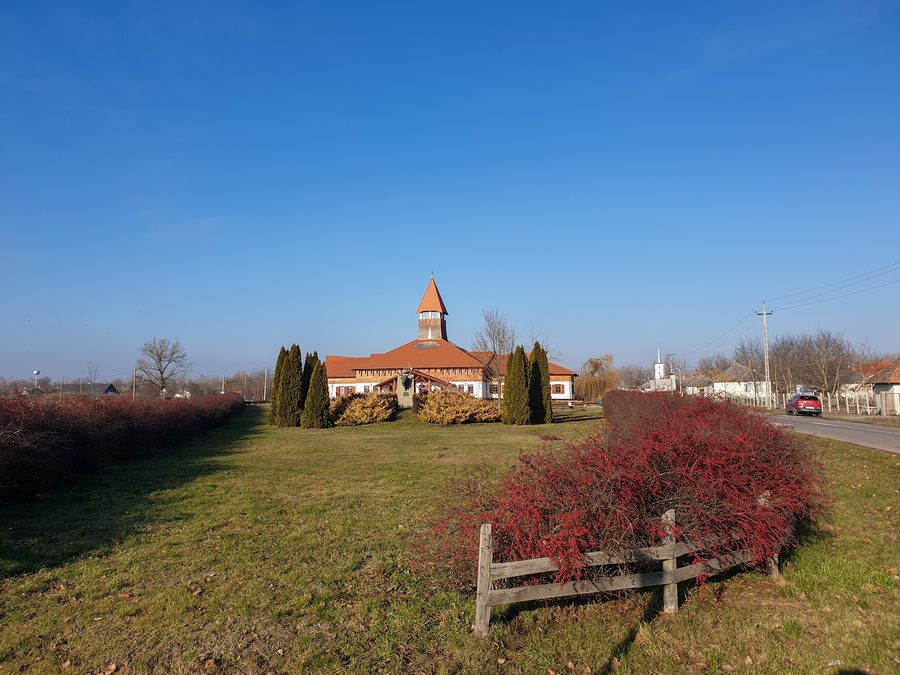
Tisza floodplain and traditional orchards
Kisar lies entirely within the Szatmár-Beregi Landscape Protection Area. Kisar’s Tisza floodplain features a traditional forest-orchard landscape, with old walnut and plum trees as well as protected old apple varieties. The floodplain landscape and the distinctive orchard culture sit side by side in the village.
Nature trail and visitor centre
The Jégmadár Nature Trail runs between Kisar and Panyola; its starting point in Kisar is the Ökoház. Part of the trail follows the cycle path along the top of the flood protection levee. The route therefore connects the two villages, while the levee cycle path accounts for only part of it.
The visitor centre of the Szatmár-Bereg Nature Park is located directly beside the Tisza levee and is surrounded by a spacious green area covered with trees and grass. Its themed permanent exhibition presents the cultural and natural heritage of the Upper Tisza region. Visits are possible by prior arrangement. The exhibition theme and location beside the levee give the centre a different focus from the route through the floodplain landscape.
Gothic architectural history in Kisar
Kisar’s Reformed church was built in the Gothic style in the 15th century. This adds a tangible historic building to the landscape and exhibition. Anyone wishing to combine nature and culture will find both in Kisar: the Tisza floodplain and a church with a medieval architectural history.
More nature and cultural attractions in Szabolcs-Szatmár-Bereg
The wider destination of Szabolcs-Szatmár-Bereg also has distinctive natural landscapes and cultural sites. Near Csaroda are the remarkable peat bogs of Nyíres-tó and Báb tava, whose origins date back to the Ice Age. The strictly protected Bátorliget Primeval Marsh in Bátorliget covers about 53 hectares and preserves the various stages in the vegetation and landscape history of the Alföld Plain particularly completely. The Cégénydányád Park Nature Reserve currently covers 14.28 hectares.
Near Tiszadob, a 1,000-hectare nature reserve extends across oxbow lakes, floodplain forests and grassland. A large heron colony of 80 to 90 pairs nests in the Tölgyes Forest. The 77-hectare Vajai Reservoir is near Vaja. It is fed by the Vajai Main Ditch and is suitable for fishing and irrigation.
The region’s cultural sites also offer different highlights: In Vaja, the Vay Ádám Museum Collection of the Hungarian National Museum is housed in Vay Renaissance Castle. The Báthori Castle in Nyírbátor has a permanent exhibition and a tableau depicting members of the Báthori family in period surroundings. In Tiszadob, Andrássy Castle was built between 1880 and 1885 in the French Gothic style by former Prime Minister Gyula Andrássy, to designs by Ignác Alpár. The northern Hungarian section of the Route of Medieval Churches connects 37 places of worship in the medieval church landscape of Szabolcs-Szatmár-Bereg.
Choose accommodation based on your travel interests
When looking for a holiday rental, it helps to decide on your preferred focus first. Kisar offers the Tisza floodplain, the Jégmadár Nature Trail, the visitor centre and the Reformed church. If these are the themes you want to shape your stay, focus your search on a holiday rental in Kisar. For individual nature or cultural sites elsewhere in the wider Szabolcs-Szatmár-Bereg region, the respective villages can be a useful starting point for your search.
Discover more destinations: Szatmárcseke, Tunyogmatolcs, Fehérgyarmat, Panyola, Tiszabecs, Túristvándi.
Back to the wider travel overview: Fehérgyarmat.

