
Bihartorda: Late Baroque Church and Székely Gate
Accommodation in Bihartorda
Bihartorda’s history unfolds through its architecture and commemorative heritage. The Late Baroque Reformed Church combines a dated start of construction with later changes; the Székely Gate serves as a symbol for all Hungarians, and a memorial to the heroes of two world wars was added beside the Kossuth Statue. In this way, different historical perspectives stand side by side in Bihartorda.
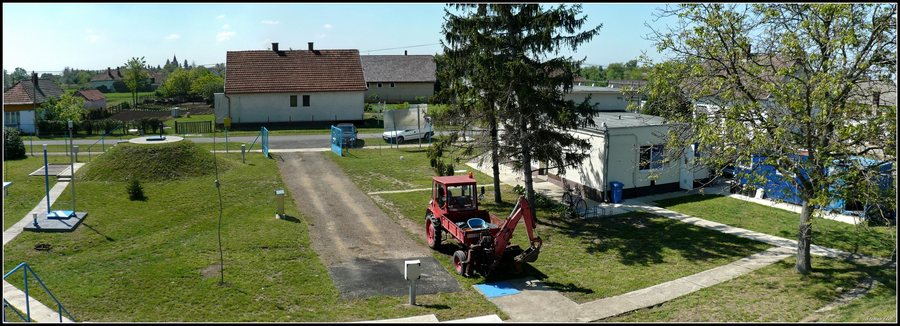 File:Bihartorda, 4174 Hungary - panoramio (37).jpg
Photo: Szemes Elek via Wikimedia Commons, CC BY-SA 3.0
The building history of the Reformed Church
Construction of the Late Baroque Reformed Church in Bihartorda began in 1793; the nave was completed in 1797. The church also has a carefully designed wooden coffered ceiling, whose panels divide the ceiling structure. The architectural term refers to a ceiling with individual panels; here, this design feature is made of wood. The building history is thus connected with a specific detail of the interior design.
The tower was destroyed during the Second World War; a new tower spire was not completed until 1974. The dates refer to different parts of the building: 1797 marks the completion of the nave, while 1974 marks the completion of the new tower spire. Together, they show that the church’s building history comprises several clearly distinguishable periods.
The gate and memorial as places of remembrance
The Székely Gate was erected on 22 August 2009 as a symbol for all Hungarians. Its explicitly far-reaching symbolism differs from the church’s building history. In 1959, a memorial to the heroes of the First and Second World Wars was added beside the Kossuth Statue. This commemoration of war heroes complements an existing statue. This creates a contrast between architectural history, symbolic meaning and remembrance of two wars.
Hajdú-Bihar: Cultural landscape and nature experiences
In the wider travel destination of Hajdú-Bihar, the perspective expands from individual architectural and commemorative sites to a vast cultural landscape. The Hortobágyi Nemzeti Park – the Puszta World Heritage Site covers almost 75,000 hectares in the Great Hungarian Plain in eastern Hungary. Visible evidence of more than 2,000 years of traditional pastoralism shapes this cultural landscape. In the Bihari-sík landscape unit, semi-natural saline grasslands, temporary bodies of water, wet meadows and smaller marsh meadows characterize the landscape in connection with the drainage of a former marshland.
The Hortobágyi-halastó nature trail offers walks of 3.6, 5.4 or 10 kilometres; the routes have no difficult sections. This range makes the desired distance a clear point of distinction. The crane migration offers a different nature experience: about 1,500 visitors watch the birds at feeding grounds during the day and at their roosting sites at sunset; the number can vary by season.
The exhibition The World of Cranes is designed for all age groups and combines experiential learning with entertainment. It includes a diorama, tactile objects, quiz questions, a magnetic puzzle and a digital drawing board. This interactive exhibition adds another way of interpreting the wider destination’s landscape and nature themes.
Choosing the right place to stay
If you are looking for a holiday apartment, first decide whether Bihartorda’s architectural and commemorative history is your main focus or whether you want to include other places in Hajdú-Bihar in your plans. Then choose where to stay based on the destinations you actually want to include in your trip.
Discover more destinations: Báránd, Nádudvar, Földes, Sárrétudvari, Kaba, Püspökladány
Go to the overview of the wider destination: Püspökladányi.

