
Discover Ebes
Accommodation in Ebes
Ebes reveals its local history through tangible traces: a neoclassical manor house, the painted gallery of the Reformed Church, a memorial cross and a listed railway station building. Together, they offer different perspectives on the town, from architectural history and religious art to remembrance of a destroyed medieval village.
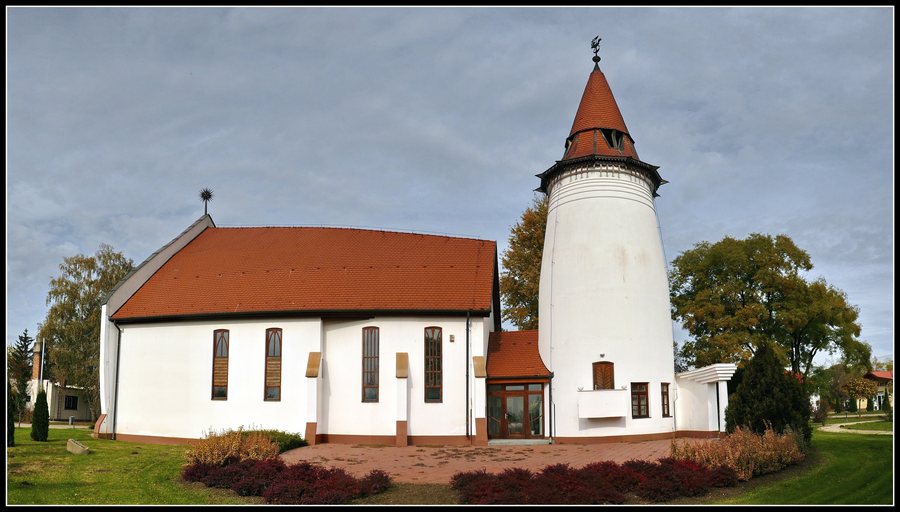 File:Ebes ReformátusTemploma Délről - panoramio.jpg
Photo: Szemes Elek via Wikimedia Commons, CC BY-SA 3.0
Local history and art in Ebes
The Görbe-Balogh manor house was built in 1922 in the neoclassical style and now houses a seniors’ club. Its year of construction, style and present-day use mark different layers of the town’s history. The painted panels of the gallery in the Reformed Church in Ebes add a distinctive cultural touch. They depict biblical themes and Reformed symbols, and were created by the painter Buka László. Here, imagery and artistic design come together in a specific detail of local history.
At the community’s initiative, a wooden cross was erected in Szent-István Park on 18 August 2011. It commemorates the destruction of the medieval village in 1594. The two dates connect the memorial with a much earlier chapter in the town’s history. The railway station building, still visible today, also tells the story of Ebes’ architectural heritage: it was built in 1920 and is listed as a protected monument. Its history can be considered independently of whether train services are available.
Parks and playgrounds
Ebes has two playgrounds with play equipment. Nagy Park also offers play equipment, as well as a large lawn and a fire pit for day-trippers. This means the town’s named outdoor amenities include both play facilities and a larger green space. As facilities can change, it is a good idea to check their current condition before visiting.
Nature and culture in the wider destination of Hajdú-Bihar
In the wider destination of Hajdú-Bihar, the Hortobágyi Nemzeti Park – the Puszta World Heritage Site offers a different perspective on the landscape. The area covers almost 75,000 hectares in the Great Hungarian Plain in eastern Hungary. As a cultural landscape, it preserves visible evidence of more than 2,000 years of traditional pastoralism. The Hortobágyi-halastó pond system is also an important part of this landscape: it is a Ramsar site, an Important Bird Area, part of the World Heritage Site and a Natura 2000 site.
For walks, the Hortobágyi-halastó nature trail offers routes of 3.6, 5.4 or 10 kilometres, with no difficult sections. You can choose according to the distance you want to cover, with a 10-kilometre route alongside the shorter options. If you prefer a guided experience to a walk, you can book a Land Rover safari at Hortobágy Wildlife Park, with an expert guide and visits to see wild horses and aurochs. Check the booking conditions in advance, as they may change.
Another way to explore the history of the landscape is to visit the Shepherds’ Museum. It presents the life of shepherds, along with handmade clothing, tools and decorated personal belongings. The museum is housed in a former carriage depot that was part of the Hortobágyi-Csárda complex. In the wider destination, nature experiences such as walks of varying lengths are complemented by cultural history centred on everyday objects and traditional crafts.
If you are looking for a holiday apartment, your preferred focus can guide your choice: would you like to explore Ebes’ architectural and local history, or also include the landscape and cultural themes of the wider destination of Hajdú-Bihar? This distinction can help you plan your trip around the experiences that interest you.
Discover more destinations
Discover more destinations: Hajdúszoboszló, Nagyhegyes.
Return to the wider travel overview: Hajdúszoboszló.

