
Discover Tass: Sculptures, Churches and a Lock
Accommodation in Tass
In Tass, the Szigetfői Őrfa, protected churches and the Tassi Lock each offer a different focus. There are also nearly a thousand holiday properties along the Danube and the Kiskunsági Canal.
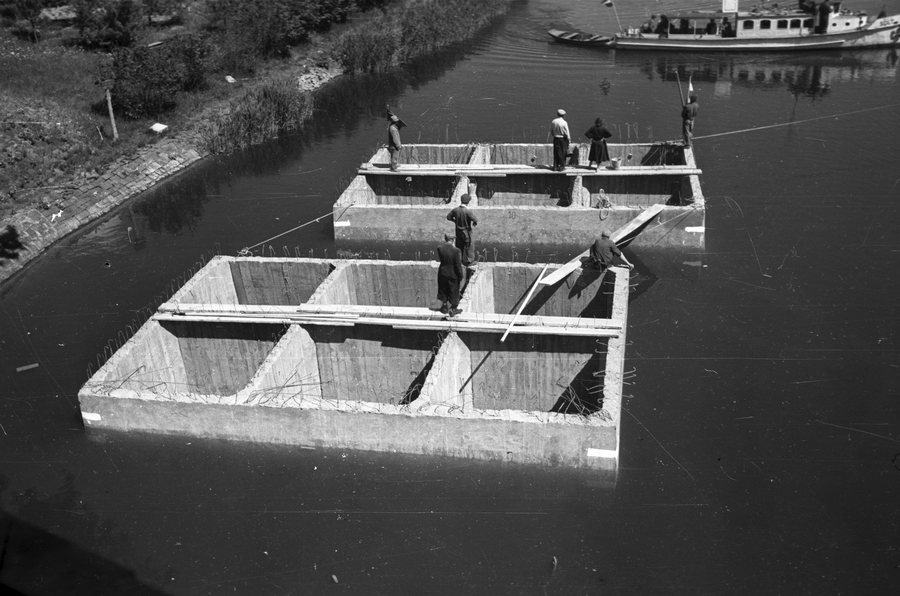 Floating concrete caissons on Ráckeve-Soroksár Danube close to Rózsa Island in Tass
Photo: Photo: FOTO:Fortepan — ID 79932 : Adományozó/Donor: UVATERV. archive copy at the Wayback Machine
Waterside setting and choice of accommodation
Nearly a thousand holiday properties are located in Tass along the Danube and the Kiskunsági Canal. This approximate figure makes the waterways a practical point of reference when choosing where to stay. If you are looking for holiday accommodation, you can take the proximity to the water into account when planning your trip; the cultural landmarks offer a different focus. This means Tass can be understood not only through individual buildings, but also through the location of its holiday properties.
The Szigetfői Őrfa: a tree trunk with its roots pointing upwards
The Szigetfői Őrfa stands on the part of Csepel Island belonging to Tass. This approximately five-metre-high sculpture is made from a debarked, carved acacia trunk. Its roots point upwards, and a symbolically carved figure of Neptune crowns the trunk. The inverted tree form and figurative motif give the monument an unusual appearance.
The Tassi Helytörténeti Egyesület commissioned the Szigetfői Őrfa; the monument was unveiled on 30 June 2012. The work thus combines a distinctive form with a clear historical connection. It is a concrete example of local culture, alongside churches and protected buildings.
Churches, cemetery and historic preservation
The Roman Catholic church in Tass is a protected Neoclassical building, also known as the Church of the Three Kings. Darányi kastély is also protected. These buildings give the town’s history a visible architectural dimension.
The organ in the Reformed Church, which is still in working order, dates from 1888 and was built by Sándor Országh. Numerous concerts have been held there in recent years. The organ thus connects a precisely dated instrument with the church’s more recent history of use.
The Jewish cemetery is located on Kossuth körút in Tass. Rows of preserved gravestones, several centuries old, stand there in parallel lines and bear Hebrew inscriptions. They are made of red limestone, and later examples are also made of black marble. Their arrangement and the change in materials make the gravestones a distinctive part of Tass’s historical heritage.
Well and lock operation
The Dr. Szelecsényi Zsigmond kút is in the centre of Tass. Its drinking water is rich in beneficial minerals. Another water-related attraction is the Tassi Lock: watching the lock operation is considered a tourist attraction. Alongside the architectural and cultural landmarks, this technical process is a point of interest in its own right.
More to explore in the wider destination of Bács-Kiskun
In the wider destination of Bács-Kiskun, the Tiszaalpár, Földvár educational trail presents the history of the Bronze Age fortification of Tiszaalpári Földvár and the way of life of people in the Bronze Age. In Tiszaalpár, a reconstruction of an Árpád-era village, built to mark the millennium, also depicts the settlement layout discovered during local excavations. Both topics offer a distinct insight into past ways of life.
In Kiskunhalas, visitors can learn about the history of Halas lace, which began in 1902, at the Kiskunhalasi Csipkeház and Csipkemúzeum. They can admire centuries-old lacework and watch the lace-making process. The Boróka educational trail in Bugac offers a different way to experience nature and the landscape: it is 1,100 metres long and features information boards and interactive stations, including a forest xylophone and a play telescope.
Discover more destinations
Discover more destinations: Szalkszentmárton, Szabadszallas, Apostag
Go to the wider travel overview: Kunszentmiklósi.
