
Tiszaalpár: Earthwork Fort, Árpád Era and Willow Weaving
Accommodation in Tiszaalpár
Tiszaalpár brings together cultural history and landscape: a 300-metre educational trail explores a Bronze Age earthwork fort, alongside a reconstructed village from the Árpád era and a long tradition of willow weaving. The loess slopes of Templomdomb and Várdomb are also part of the local landscape. Here, different eras and a traditional craft reveal different facets of the place.
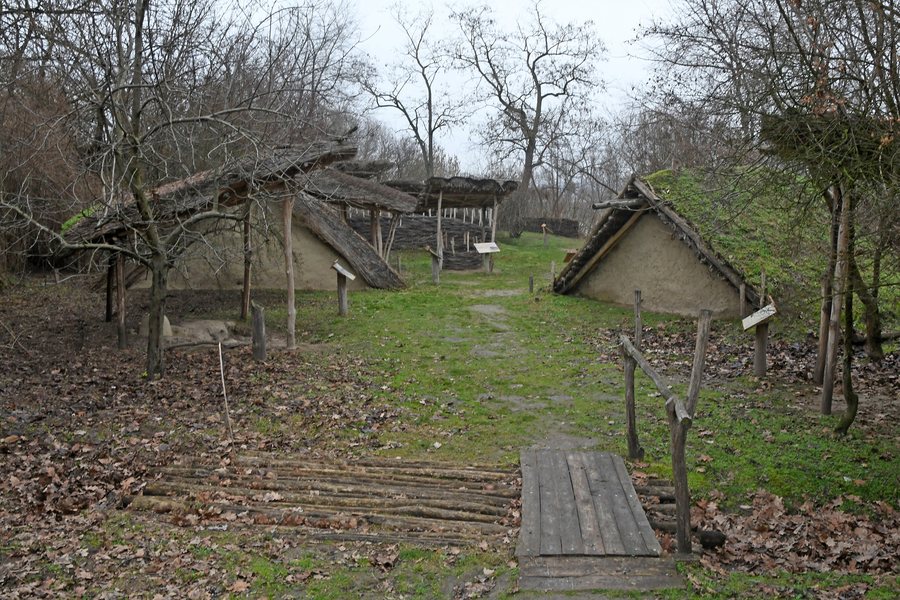 File:Tiszaalpár, Árpád-kori falurekonstrukció 2021 01.jpg
Photo: Pasztilla aka Attila Terbócs via Wikimedia Commons, CC BY-SA 4.0
The Bronze Age and the Árpád Era
The Várdomb tanösvény educational trail tells the story of the earthwork fort. People of the Vatya culture built and inhabited the site during the Middle Bronze Age. At 300 metres, the trail is short, but its subject reaches far back into local history. Visitors interested in archaeological traces will find a specific point of reference here: the focus is not a general overview of the Bronze Age, but the history of a particular fortification.
The reconstructed village from the Árpád era brings another period to life. Its traditional buildings illustrate aspects of everyday life and animal husbandry. The reconstruction thus complements the Bronze Age history with a later settlement and way of life. The two subjects differ both in their time period and in their focus: the trail explores a fortification and its history, while the village presents buildings and everyday aspects of life.
A description published in 2024 of the green-marked hiking route passes the Árpád-era archaeological site beside Templomdomb. It identifies another historical point of interest in Tiszaalpár. The loess slopes of Templomdomb and Várdomb are part of the local landscape; their names link the landscape to the historical themes, without implying that they form a single circular route.
Willow Weaving and Basket-Weavers’ Gathering
Willow weaving has a long tradition in Tiszaalpár. This craft offers a different perspective on local history from the archaeological sites: it is a local cultural practice that has been passed down over time. A national basket-weavers’ gathering is also held in Tiszaalpár every year, bringing together master craftspeople. If you would like to plan your trip around the gathering, check the exact date and visitor information in advance.
The wider travel destination of Bács-Kiskun also has an archaeological connection to Tiszaalpár: Tiszaalpári Földvár is classified there as a specially protected archaeological site. The classification is based on Regulation 3/2003. (I. 25.) NKÖM. This protected status adds a distinct dimension to the local themes: alongside learning about history, archaeological sites and their classification in the region also play a role.
Which themes would you like to shape your stay?
When looking for a holiday apartment in Tiszaalpár, you could first consider which aspect interests you most: the history of the earthwork fort, life in the reconstructed buildings, the landscape or willow weaving. Information about the educational trail and hiking route offers different ways to explore history and the landscape; the annual gathering adds a distinctive craft-focused element. This lets you choose a destination that suits your interests without turning the different themes into a fixed itinerary.
Discover more destinations
Discover more destinations: Pálmonostora, Kunszállás, Petőfiszállás, Fülöpjakab, Bugac.
Back to the main travel overview: Kiskunfélegyházi.

