
Kromsdorf: Palace Park, Busts and Paths Along the Ilm
Accommodation in Kromsdorf
Kromsdorf combines the history of a Renaissance palace with an unusual park wall and routes along the Ilm. Kromsdorf Palace and its park offer different perspectives: on the building dating from the late 16th century, on the sandstone busts and on public events held throughout the year. When planning a holiday apartment stay in Kromsdorf, it is worth deciding on your main focus first: would you mainly like to explore cultural history or plan your days around one of the described Ilm routes? Both themes can be linked to specific stops.
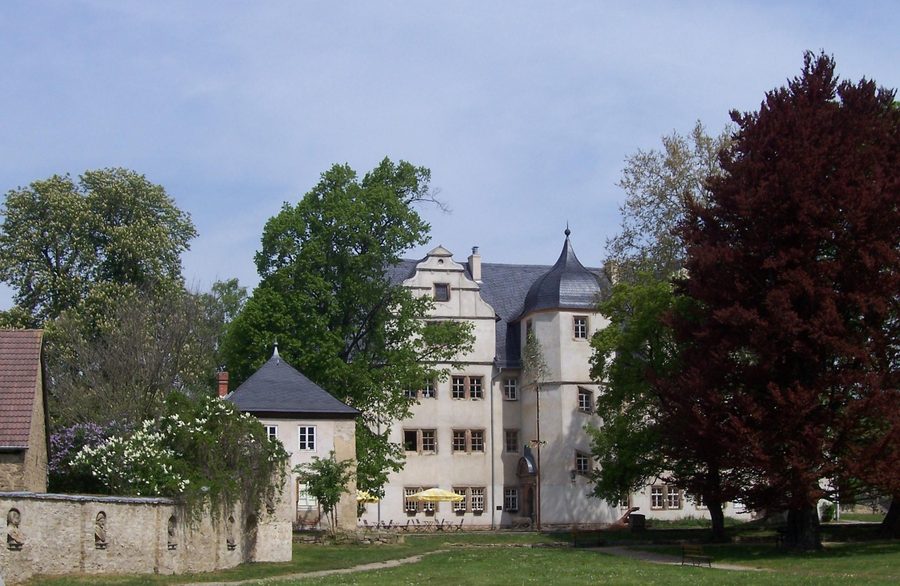 Schloss Kromsdorf mit seiner Parkmauer aus dem 17. Jahrhundert und 64 Nischen für Sandsteinbüsten.
Photo: Elsewieland via Wikimedia Commons, CC BY-SA 4.0
Schloss Kromsdorf mit seiner Parkmauer aus dem 17. Jahrhundert und 64 Nischen für Sandsteinbüsten.
Photo: Elsewieland via Wikimedia Commons, CC BY-SA 4.0
Renaissance History and the Park Wall
Kromsdorf Palace is a Renaissance palace commissioned around 1580 by Georg Albrecht von Kromsdorf, a chamberlain to the courts of Weimar and Altenburg. Another historical layer was added from 1664 onwards: Baron Johan Theodor de Mortaigne had the wall of the palace park redesigned with 64 sandstone busts of historical and exotic figures.
The 64 busts can be viewed along the park walls. They depict famous contemporaries and historical figures from nearly all the countries known at the time. The park thus shifts the focus from the palace building to the wall’s later design. The dates mark two distinct periods in the history of the town; together, they give a visit a cultural and historical focus.
Events and Local Culture
Public events are held throughout the year at Kromsdorf Palace and in its park. Individual dates may change; if you would like to plan your trip around an event, check the specific date in advance. The palace park is freely accessible except during private events and is located on the Ilmtal Cycle Route. Free access is therefore subject to there being no private event.
The church and churchyard in Kromsdorf-Süd are also part of the town’s history. The church is listed as a protected individual monument at Bei der Kirche 6. The palace, park wall and church represent different aspects of the local cultural heritage; the church adds to the picture of Kromsdorf without being part of the palace grounds.
Routes Along the Ilm
The Weimarer Land Classics Loop starts at the entrance to Kromsdorf Palace and goes via Oßmannstedt, Ulrichshalben, Denstedt and Tiefurt before returning to Kromsdorf. Its first section follows the banks of the Ilm from Kromsdorf to Wieland Park in Oßmannstedt. On the section towards Oßmannstedt, the well-signposted, well-maintained Ilmtal Cycle Route follows the left bank of the Ilm shortly after the town sign; there is no car traffic there. Check current route conditions before setting off.
The Maria Pawlowna Promenade takes a different route. It runs along the Ilm from Tiefurt Palace Park to Kromsdorf Palace Park. In its present form, it was inaugurated during Weimar’s European Capital of Culture year in 1999. The two routes offer different options: the Classics Loop passes through several towns and returns to Kromsdorf, while the Promenade connects two palace parks along the Ilm.
A Holiday Apartment in Kromsdorf as a Starting Point
When looking for a holiday apartment in Kromsdorf, it helps to decide what you want to focus on during your stay. The palace, wall of busts and events suit a cultural and historical itinerary; the routes offer a clear choice between a loop returning to Kromsdorf and a path connecting two palace parks. This allows you to choose your destination based on whether local history or the paths along the Ilm will shape your trip. If an event date is important, plan for it specifically; for a cycling tour, it is worth checking the current route conditions.
For the wider travel overview: Ilmtal-Weinstraße.

