
Discover Seebergen
Accommodation in Seebergen
St. George’s Church, a historical and tourist walking tour, and nearby Seeberg each give Seebergen a different character: architecture and local connections sit alongside a nature reserve in the surrounding area. Seeberg sandstone also opens up a regional theme. This offers a range of interests to consider when planning your trip—from a specific building to the walking tour and connections with nature and stone. If you’re looking for a holiday apartment, you can think in advance about which of these perspectives you’d like to shape your stay.
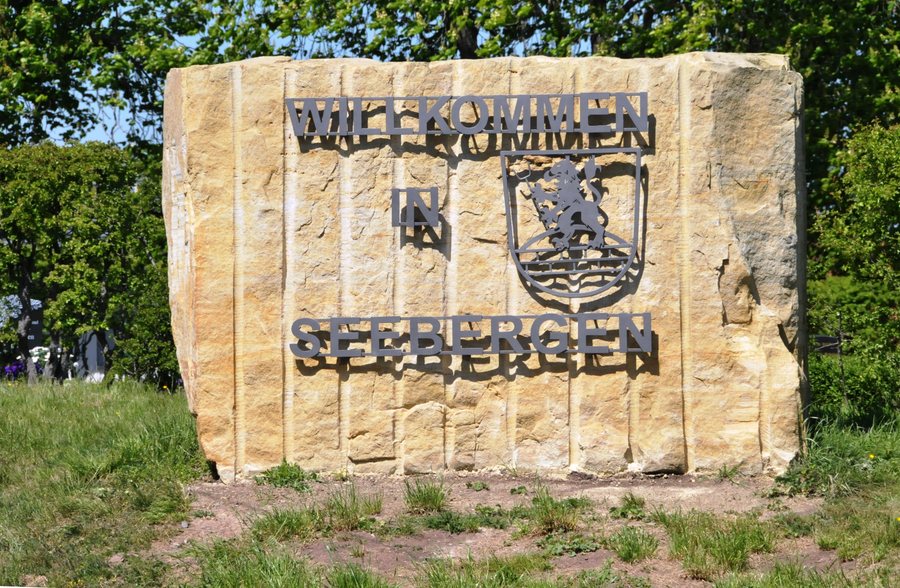 Sandstone welcome block at the entrance to Seebergen
Photo: CTHOE via Wikimedia Commons, CC BY-SA 4.0
Sandstone welcome block at the entrance to Seebergen
Photo: CTHOE via Wikimedia Commons, CC BY-SA 4.0
Church and architectural history
The tower of St. George’s Church is over 40 metres high. The church was built between 1511 and 1587. This brings two easily grasped questions together in one building: How tall is the tower, and over what period was it built? The dates span several decades of the 16th century. For those interested in architecture and history, the church offers a specific point of interest in Seebergen. Rather than exploring churches in general, you can focus on the height of the tower and the long construction period of this particular building.
Walking tour and nature nearby
The historical and tourist walking tour offers a different focus from the church building itself. It connects the local area with a historical and tourist perspective. If you’re organising your days around particular themes, you can consider the walking tour as a separate option alongside St. George’s Church: one focuses on a building and its construction period, the other on the experience of a walking tour. This makes it possible to weigh up different interests without assuming that both offer the same kind of experience. This distinction can help with planning if you’d prefer to focus on architectural history or the walking tour.
Seeberg, designated as a nature reserve, lies in the immediate vicinity of Seebergen. This provides a nature-focused option nearby, alongside the local perspective offered by the church and walking tour. When planning, you can consider whether architectural history and local connections should shape your trip, or whether nature in the surrounding area is also of interest. Seeberg is a distinct nearby point of interest.
Seeberg sandstone in its regional context
Seeberg sandstone broadens the focus to the surrounding region. The stone is still quarried at the quarries on Maikopf and at Kammerbruch; Seeberg sandstone was used as a building material for Erfurt Cathedral. Extraction and use are two different aspects of the same material: the quarries represent ongoing extraction, while the cathedral is a specific example of its use in construction. Anyone interested in building materials and architecture will find a regional connection here that differs from focusing on the church in Seebergen.
Dates to help plan your trip
The Seebergen Lettuce Fair also offers a specific date to plan around. The 31st Seebergen Lettuce Fair took place from 3 to 5 July 2026; the 32nd fair was announced for 2 to 4 July 2027. If you’re planning your trip around the announced event, check the dates again before booking.
Choose a holiday apartment to suit your travel interests
When looking for a holiday apartment in Seebergen, your reason for travelling can help you decide. If you’re particularly interested in the church and its architectural history, your focus will differ from that of someone who prioritises the walking tour or the nature reserve nearby. The sandstone theme adds a regional perspective to these local interests.
Discover more destinations
Discover more destinations: Hohenkirchen, Tambach-Dietharz, Ballstädt, Emsetal, Finsterbergen, Hörselgau, Gamstädt, Apfelstädt.
Back to the main travel overview: Gotha.

