
Discover Hamminkeln: Nature Trails and Local History in Dingden
Accommodation in Hamminkeln
If you are planning a trip to Hamminkeln, Dingden offers nature experiences and a tangible sense of local history. Circular trails lead through a landscape whose use in different eras is explored along the way; historic buildings and the Humberghaus tell further chapters of the town’s story. This lets you plan around specific interests: time outdoors, architectural history, or a closer look at Dingden’s past.
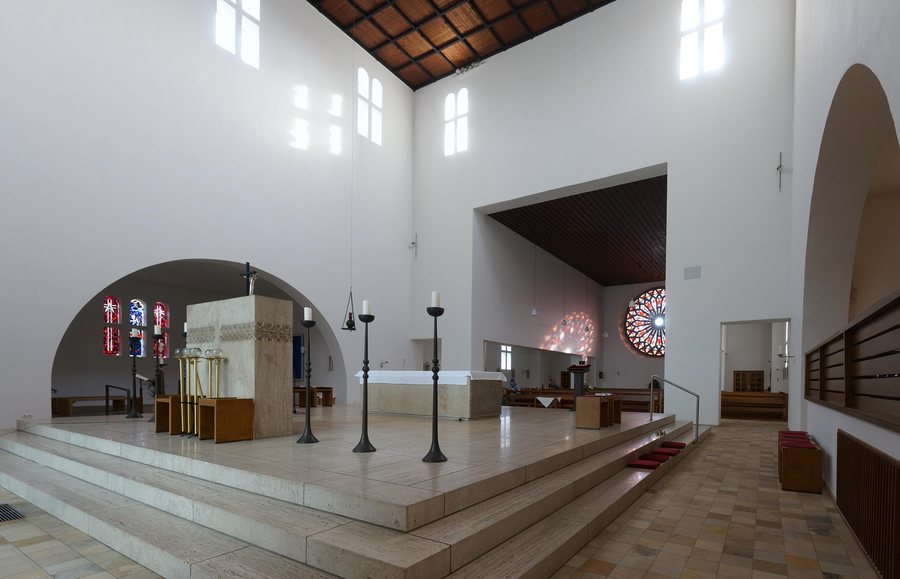 Christ-König-Kirche (Hamminkeln-Ringenberg) - Altarraum
Photo: Börste via Wikimedia Commons, CC BY-SA 4.0
Christ-König-Kirche (Hamminkeln-Ringenberg) - Altarraum
Photo: Börste via Wikimedia Commons, CC BY-SA 4.0
Circular Trails with Different Themes
An approximately five-kilometre circular trail through Dingden Heath passes five “windows into the past.” These illustrate typical land use in different eras at sample sites. The route combines exercise with a historical perspective on the landscape, focusing on how people used the land at different times.
Another hiking option in Dingden is the eastern LandStreifer circular trail, which is approximately six kilometres long. It forms part of the Hohe Mark Trail and is classified as a premium trail. At around six kilometres, it is a little longer than the approximately five-kilometre heath loop. The trails also differ in focus: the heath loop explores land use in different eras, while the LandStreifer is notable for its connection to the Hohe Mark Trail and its premium classification. You can take both the length and theme of each route into account when planning your hike.
Dingden’s History Through Its Buildings
The Jewish Humberg family lived at Hohe Straße 13 until 1941. The Dingden Local History Association (Heimatverein Dingden e. V.) restored the house from 2001 onward; it opened as a memorial and museum in 2010. The Humberghaus also preserves a rare surviving private mikveh, a Jewish ritual bath. As a result, visitors can explore both the family’s history and distinctive testimonies to Jewish life in Dingden.
The Romanesque defensive tower of St. Pankratius Parish Church was built toward the end of the 12th century and is the town’s oldest surviving historic monument. The Dingden Local History Association’s local history house at Hohe Straße 1 is a centre for preserving local heritage and cultural work. It safeguards the town’s historical heritage and also hosts exhibitions and events. The current programme may vary.
The local history association offers guided walks through the historic town centre. Members with local knowledge and a grounding in history explain the historic buildings and their former residents. These walks complement the exploration of individual buildings with stories about the people connected to them.
When looking for a holiday apartment in Hamminkeln, a practical place to start is how you want to spend your days: will your trip focus mainly on hikes, or would you like to explore local history through buildings and guided tours? If your travel companions have different interests, these themes can provide a good basis for planning your holiday together.
More Themes in the Wider Wesel Destination
The wider Wesel destination offers other distinct highlights. In Xanten, the LVR Archaeological Park Xanten, Germany’s largest archaeological open-air museum, is located on the site of the Roman city of Colonia Ulpia Traiana. The LVR Roman Museum displays numerous original finds from the Roman city and the two legionary camps. They tell the story of the city’s founding, heyday and decline. A tour takes you through the centuries of Roman history in a spectacular building. Demonstrations, festivals and activities to watch and take part in are held regularly. Dates and offerings may change, so it is worth checking the latest event schedule when planning your visit.
The Bislicher Insel in Xanten offers another distinct natural highlight in the wider Wesel destination. It is one of the last near-natural floodplain landscapes on the Lower Rhine, and large areas are protected. In winter, the nature reserve provides a habitat for several thousand Arctic geese, especially greylag and barnacle geese. Three observation huts along the path offer views over the water; with a little luck, you can spot numerous bird species there.
Another way to explore the region is the ADFC-certified route “Sustainability Along the Way.” It passes through Wesel and Hamminkeln and runs mainly through Hohe Mark Nature Park.
Discover More Destinations
Discover more destinations: Hünxe, Xanten, Sonsbeck, Neukirchen-Vluyn, Wesel, Voshövel, Rheinberg, Voerde.
Back to the overview of the wider destination: Wesel.

_-_Altarraum.jpg)