
Bandelin between the manor park and village history
Accommodation in Bandelin
Bandelin tells its story through more than individual dates: the Landarbeiterwohnsiedlung, manor house and park represent different chapters in the village’s history. The contrast between village history and the landscaped manor grounds is particularly appealing. If you are looking for a historical focus for your holiday, you will find tangible points of interest here—from an unusual residential complex to preserved details in the manor house.
From the first recorded mention to the Landarbeiterburg
Bandelin was first documented in 1321 in a deed of sale by the Lords of Behr. This early entry provides a starting point for dating the village’s history. The Landarbeiterwohnsiedlung offers a more vivid picture of village life: in 1865, it was expanded with clay cottages to form a quadrangle with several dwellings. The complex was given the name “Landarbeiterburg”. Remains have survived to this day and are still inhabited—a remarkable testament to Bandelin’s housing and settlement history.
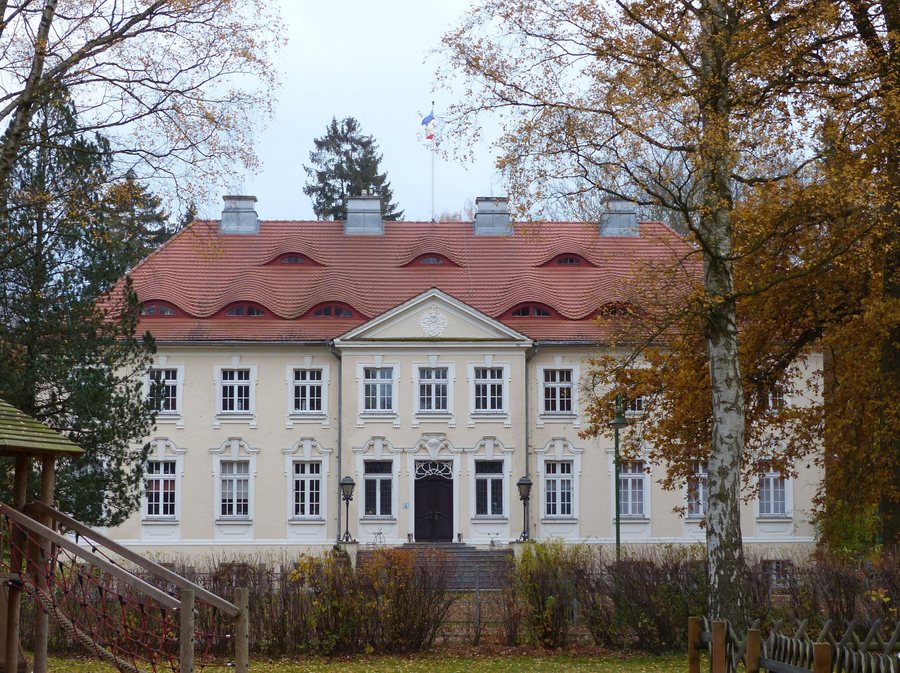
Another leap through time takes us to 1737. That was when the old castle was built south of the village in a park, on the site of a former fortress-like building. This is distinct from the neo-Baroque Bandelin manor house and its estate, which is among the village’s architectural sights. In Bandelin, you will encounter different forms of building and living that cannot be reduced to a single structure.
Manor house and places of remembrance
Several special details have been preserved inside the manor house: the hunting room features corbels and heraldic reliefs; the staircase and stucco ceilings are also among the surviving features. Architecture enthusiasts will appreciate these different elements, which make the house’s design more tangible than a simple description of its neo-Baroque form.
Another historic site is the von Behr family burial vault in Bandelin cemetery. The building was erected in 1922 as a granite ashlar structure with a temple façade and now serves as a funeral hall. Its present-day function is as much a part of its history as the design of its façade. Bandelin’s places of remembrance thus complement one another in character: the imposing manor house and a building that now serves a practical purpose.
Manor park and landscaped water features
The manor park was laid out in 1750 and transformed into a landscape garden with a pond and a small island in the 19th century. The old trees in the manor park and the adjoining fountain pond also contribute to the village’s appearance. The park behind the old aristocratic residence has a water parterre more than 200 metres long. Together, these features show how strongly the design of the water and trees shapes the manor landscape.
If you are travelling with children, the different sites can prompt conversations about life in earlier times: How did housing for agricultural workers differ from a manor estate? And what distinguishes a landscape garden from a place of residence? The settlement, manor house and park offer a range of topics to make room for in your travel plans, without having to focus your stay on just one historical perspective.
Planning your stay in Bandelin
When looking for a holiday apartment, your personal travel interests may help you decide: Bandelin offers points of interest for travellers interested in village history, manor-house architecture or park design. Consider which of these aspects you would particularly like to include in your holiday plans. Bandelin is accessible via the L35 regional road and the A20; you can take both routes into account when planning your journey.
If you would like to discover other places, the page overview also features Lühmannsdorf, Gützkow, Gribow, Ziethen, Groß Kiesow, Murchin, Schmatzin and Karlsburg.
For the broader travel overview: Amt Züssow.

