
Bröbberow
Accommodation in Bröbberow
Bröbberow combines a river landscape with a specific destination for cycle tourists: the municipality lies directly on the Copenhagen–Berlin European Cycle Route. The village itself is situated on the Beke, a tributary of the Warnow. If you would like to focus your trip on cycling, the location on this long-distance route provides a clear starting point for your search for a holiday apartment. At the same time, water, nature and historic places shape the character of the municipality—a different focus for travellers who would rather spend their time enjoying the landscape and culture.
Kettle holes, river lowlands and birdlife
The kettle holes are among the landscape’s distinctive features: these water-filled depressions were formed during the Ice Age. In November 2002, ten kettle holes on the agricultural land of the municipality of Bröbberow were successfully restored to a natural state. All ten now hold water again. Many rare plants and animals live in and around these near-natural kettle holes. They thus connect a geological history with today’s habitats for plants and animals, giving a nature trip to Bröbberow a distinctive focus of its own.
The Beke river lowlands are also part of the natural landscape and are maintained as a natural habitat. Between Klein Grenz and Groß Grenz, Grenzer See has been restored as a special site for birdlife. Bröbberow is also home to a variety of birds: two pairs of storks nest there, and various protected birds of prey can also be found. If nature is an important consideration when choosing a holiday destination, you can take these different landscape and wildlife features into account without limiting your stay to a single activity.
History and culture in Groß Grenz and Bröbberow
The church in Groß Grenz is originally a Gothic brick building dating from the 14th century. A bell tower still stands beside it. The church’s fittings also include a restored organ and restored Baroque pews. Several specific historical features thus come together in this building: the Gothic brickwork, the bell tower beside the church, and the restored organ and pews. Since its founding in 2009, the association at the village church has regularly organised concerts, exhibitions and other cultural events.
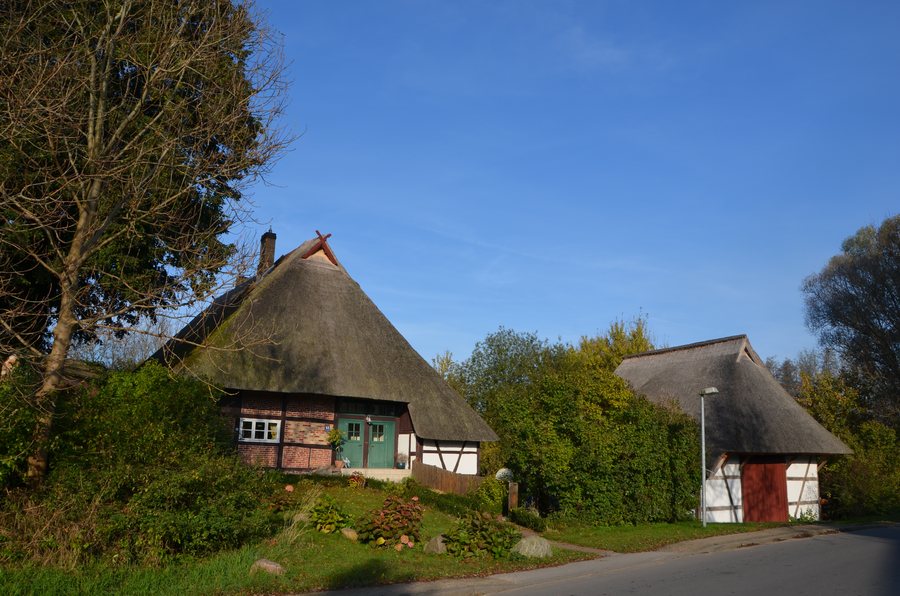
Another historic site in Groß Grenz is the former dairy. It was built in 1891 and expanded over the following years. The “Atelier im Milchhaus” (Studio in the Dairy) was established on its grounds as an open project offering courses and workshops. In Bröbberow itself, the historic Alte Pferdestall (Old Stable) dates from 1881; its exterior was restored based on historical references. Travellers interested in architectural history and cultural projects will find different points of interest here, without these needing to be combined into a single attraction.
Walks in Klein Grenz and Groß Grenz
For a walk, consider the well-preserved, picturesque farmsteads in Klein Grenz and the old centre of Groß Grenz. The two options have different points of focus: in Klein Grenz, the farmsteads take centre stage; in Groß Grenz, it is the old village centre. You can therefore choose based on which of these village scenes interests you most. Together with the nature and culture on offer, this gives you the option of planning a trip focused on cycling, the landscape, birdlife or historic places.
For more information about nearby places, you can also visit the pages for Kassow, Benitz, Wiendorf, Rukieten and Vorbeck.
For the broader travel overview: Amt Schwaan.

