
Kuhlen-Wendorf: Churches, Manor Houses and Waterside Landscapes
Accommodation in Kuhlen-Wendorf
Churches and manor houses in a variety of architectural styles
In Kuhlen-Wendorf, distinctive village churches and historic manor houses meet Mickowsee and a stretch of the Warnow River. The buildings tell stories of different centuries and architectural styles; the landscape adds a protected body of water to this cultural heritage. When planning your trip, it may help to ask yourself one simple question: are you especially interested in architecture and local history, or would you rather focus on the lake and river scenery?
The church in Müsselmow dates from the late 15th century and is a Gothic brick building. Its outer walls are made of brick, while the tower’s base is made of fieldstone. The village church also has a half-timbered tower and fragments of 18th-century wall paintings. Several materials and historical layers can be distinguished in this building: brick characterizes the church, fieldstone the tower base, half-timbering the tower, and the painted fragments point to a later historical layer. Those interested in church architecture will find more here than a single architectural label.
The church in Holzendorf is also made of brick, but dates from the 14th century. Opposite it stands a lime tree with a circumference of 7.5 metres. The rectory belonging to the church dates from 1779. The church, tree, and rectory offer different points of interest for exploring the village: the medieval building, the strikingly large tree, and an 18th-century rectory. These historical landmarks are distinct, and do not all date from the same century.
Zaschendorf is home to a half-timbered church dating from the 17th century. The manor house there was built around 1820, stands on elevated ground, and is surrounded by a park. Its history also includes a later transformation: the manor house fell into ruin and has now been partly rebuilt and is inhabited. For those interested in cultural history, Zaschendorf offers a distinct point of interest alongside the churches in Müsselmow and Holzendorf.
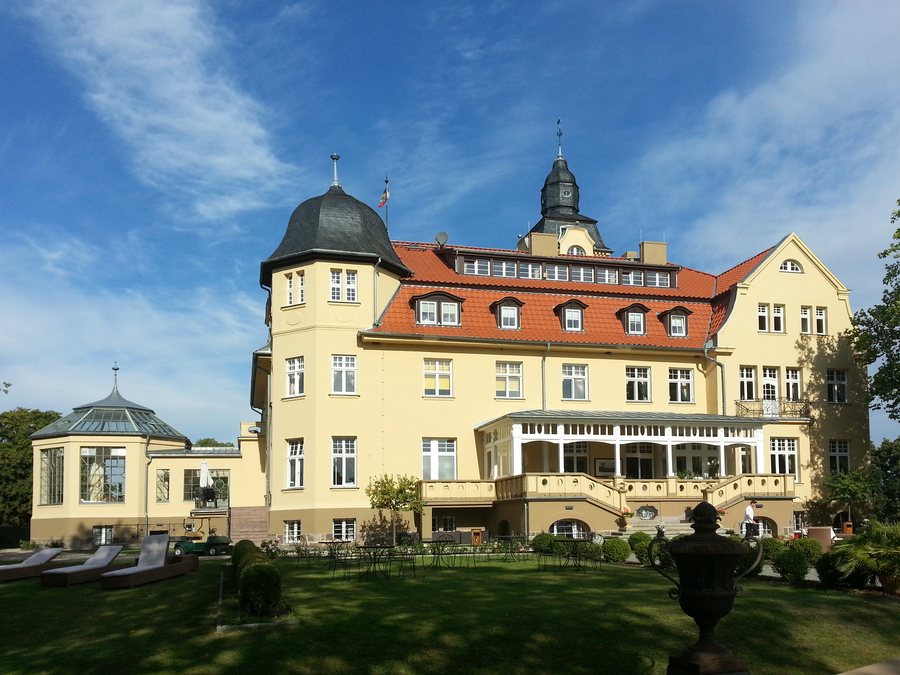
Other manor houses offer different historical and architectural highlights. The Tessin manor house dates from the 18th century. Nutteln Manor is a historic, single-storey brick building with a small tower, built in the late 19th century on Mickowsee. Wendorf Hunting Lodge was built between 1904 and 1906 in the Art Nouveau style, also known as Historicism; today it is Schlosshotel Wendorf. The buildings mentioned differ in their dates and forms: from an 18th-century manor house to a single-storey brick building and a hunting lodge from the early 20th century.
Mickowsee and the Warnow River
Mickowsee is part of the Warnowseen Nature Reserve. A stretch of the Warnow River is also connected to the lake: it runs from the fixed-bed ramp at Zaschendorf-Müsselmow to about 350 metres before the river flows into Mickowsee, and is 2.3 kilometres long. The precise route and endpoint make clear which stretch of the river this information refers to. Wading while fishing is prohibited year-round along this stretch of the Warnow to protect the freshwater pearl mussel. The ban applies to wading while fishing; it should not be understood as a general fishing ban on the entire Warnow or Mickowsee.
This gives you two clearly distinct interests to choose between for your trip: historic buildings spanning different materials and periods, and the protected landscape around Mickowsee and the stretch of river described above.
More local pages: Dabel, Borkow, Sternberg, Kobrow, Mustin, Brüel, Blankenberg, Witzin.
For the broader travel overview: Sternberger Seenlandschaft district.

