
Gottesgabe: Manor House, Körner and Local History
Accommodation in Gottesgabe
In Gottesgabe, architectural history and memories of Theodor Körner come together; the municipality also has its own connections to rivers. Those interested in historical stories will find both a specific poem and a local legend here. When looking for a holiday apartment, start by deciding what you want to focus on: should Gottesgabe and its local stories take centre stage, or would you also like to explore the landscapes and cultural themes of the wider travel destination of Northwest Mecklenburg?
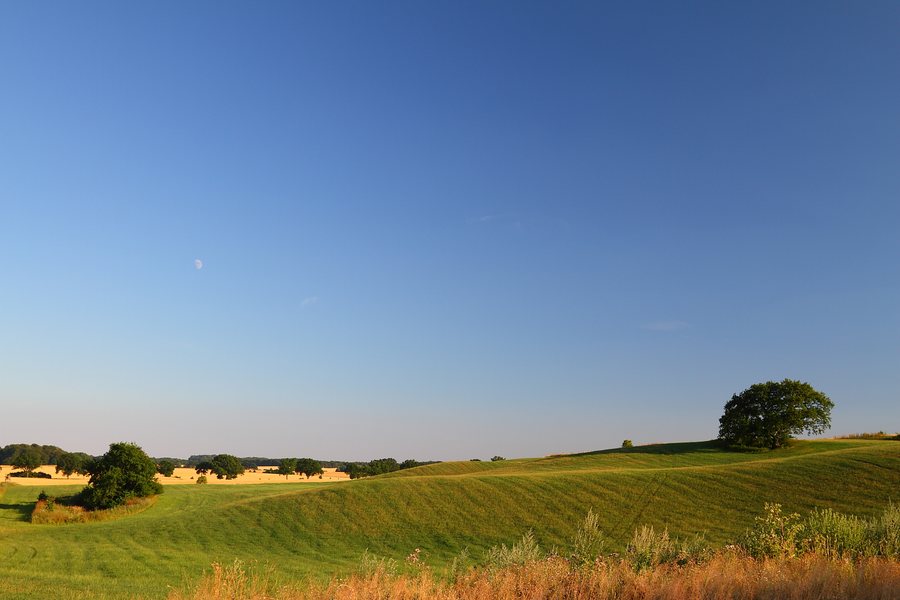 File:Gottesgabe (4814379247).jpg
Photo: Harald Hoyer from Schwerin, Germany via Wikimedia Commons, CC BY-SA 2.0
Manor House History and Körner
The singer, poet and freedom fighter Theodor Körner spent the last night before his death at Gottesgabe Castle. On the evening before his death, he recited his final poem, “Schwertlied,” in the company of his comrades at the Gottesgabe manor house. The two episodes capture different moments: his final stay at Gottesgabe Castle and the recitation of the poem at the manor house. A specific work and an evening in the company of his comrades are thus among the memories associated with Gottesgabe.
The manor house’s architectural history reaches back to a medieval building, parts of whose cellar foundation remain. The manor house was built around 1700. It originally had three wings arranged in a triangular formation. Its architectural history therefore brings together two different points of reference: parts of an older cellar foundation and the original layout of the manor house built later.
Another story belongs to local tradition: Klaus Störtebeker is said to have been held captive in the manor house’s very old, vaulted cellars. This remains a local legend, not a certainty. It contrasts with the architectural details and adds a legendary figure to the history of the manor house.
Other Historic Buildings
The former school building at Kastanienallee 28 in Gottesgabe is also a listed monument. The monument list dated 28 February 2025 includes it, as well as the manor house at Eichenweg 2. This extends the story beyond the manor house to a former school building. The different addresses help distinguish these two historic buildings in the village.
Rivers and Landscape in the Municipality
The source of the Sude lies within the municipality of Gottesgabe. From its source, the Sude flows south towards the Elbe. The Zare is a tributary of the Sude and runs along Gottesgabe’s eastern municipal boundary. The rivers offer two distinct geographical points of reference: the Sude, with its source and direction of flow, and the Zare, with its course along the eastern municipal boundary.
The localities within the municipality also have notable landmarks. Klein Welzin is home to a castle with a large park and rare trees; the castle is now used by the AWO as a care and nursing home for older people. In Groß Welzin, the historic Blüchenallee still adorns the manor estate. The castle and park are therefore associated with Klein Welzin, and the avenue with the manor estate in Groß Welzin.
Northwest Mecklenburg as a Wider Setting
Beyond Gottesgabe, Northwest Mecklenburg offers a broader landscape setting. In the north, the district encompasses the Northwest Mecklenburg Hills with Wismar Bay; in the south, the West Mecklenburg Lake District with Lake Schwerin. Terminal moraine ridges, gently undulating ground moraine plateaus, steep and flat coastal stretches, meltwater channels and outwash plains shape the district’s landscape. The two named landscape regions show that the area is not defined by just one type of landscape.
The district’s cultural attractions include Gadebusch Castle in Gadebusch. Built in 1573, the Renaissance castle is a rare example of Mecklenburg—or North German—Brick Gothic Renaissance architecture; its design includes reliefs in the regional Johann-Albrecht style. Another example at the regional level is the “Radegasttal” landscape protection area. It covers about 600 hectares between the southern edge of Rehna and Neddersee near Gadebusch. The area includes the Radegast’s strongly meandering, natural course, as well as adjoining grassland, reed beds, groves and swamp forests.
When looking for a holiday apartment, you can first decide on the scope of your trip: will Gottesgabe’s architectural history and stories be the main focus, or would you also like to explore other landscape and cultural themes in Northwest Mecklenburg?
Discover more destinations: Zickhusen, Dalberg-Wendelstorf, Brüsewitz, Grambow, Cramonshagen, Perlin, Seehof, Alt Meteln.
View the wider travel overview: Lützow-Lübstorf Office.

