
Discover Stuer: Church Art, Nature and Village History
Accommodation in Stuer
Stuer brings together a range of interests to explore: animal welfare, church art and visible traces of the village’s earlier history. At St. Peter’s Church, you can discover a late Gothic altar and historical records of the von Flotow family. In the Kingfisher Valley, the remains of a fieldstone structure and a Urdolmen take centre stage; east of the church, a motte recalls the village’s earliest fortification. You can plan your trip around the interests that matter most to you.
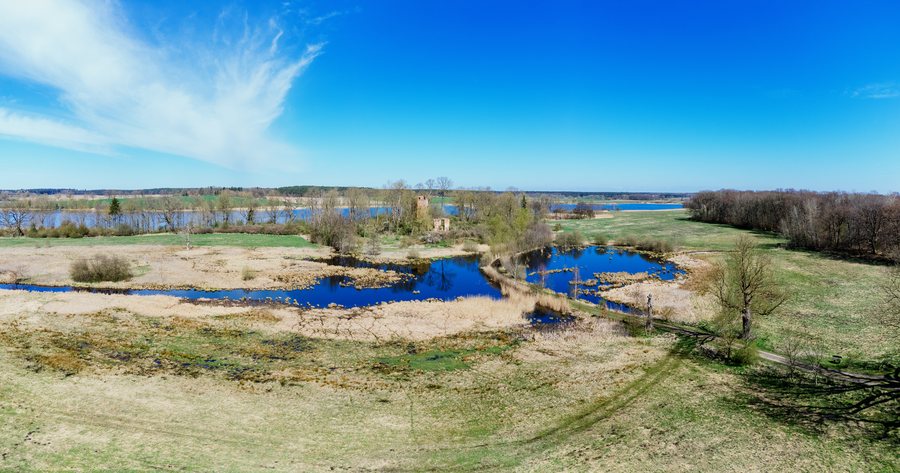 Ausläufer des Stuer Flachwassersees - Luftbild 2022
Photo: Marcus Sümnick via Wikimedia Commons, CC BY-SA 2.0
Ausläufer des Stuer Flachwassersees - Luftbild 2022
Photo: Marcus Sümnick via Wikimedia Commons, CC BY-SA 2.0
Animal Welfare and Nature
A particular highlight is BÄRENWALD Müritz, an animal welfare project run by FOUR PAWS. Rescued bears live there in naturalistic enclosures, where they can rediscover and express their natural behaviours. The project therefore puts the animals’ well-being and their opportunity to display species-typical behaviour at its centre. Those interested in animal welfare will find a different perspective here from the historical records in Stuer: this topic is shaped not by architectural styles or family history, but by the care of rescued animals.
Church Art and Family History
St. Peter’s Church in Stuer brings together several tangible historical records. Its late Gothic winged altar dates from around 1490, is made of oak and stands out for its elaborate carvings.
The church also displays 65 coats of arms. Made between 1680 and 1930, they represent part of the von Flotow family’s history. Their dates span several centuries. Together with the altar, the coats of arms offer two different perspectives on the church: its art and the history of a family. St. Peter’s Church is kept open to visitors during the summer months, and services are held there regularly.
Traces in the Kingfisher Valley
The Kingfisher Valley can be reached on foot or by bicycle. It is home to the ruins of a watermill built from fieldstone, known as the “middle mill”. This name gives the ruins a specific identity, while the fieldstone masonry defines their visible architectural character. For your explorations, an easy comparison presents itself: St. Peter’s Church is kept open to visitors during the summer months, while the Kingfisher Valley can be reached on foot or by bicycle. This lets you combine a cultural stop with an active exploration.
Beyond the middle mill, after crossing the stream, a narrow path leads to a Urdolmen with a long barrow, right beside the B 198.
A Motte East of the Church
A tree-covered motte with remnants of masonry lies in a pasture east of St. Peter’s Church. It is considered the village’s oldest fortification. Unlike the altar and coats of arms, which offer insights into church art and family history, the mound points to Stuer’s earliest fortification.
More village pages: Kieve, Leizen, Buchholz, Bütow, Schwarz, Grabow-Below, Gotthun, Ludorf.
For the overarching travel overview: Amt Röbel-Müritz.

