
Hagenow: Jewish Heritage, Museums and Distinctive Buildings
Accommodation in Hagenow
History and Buildings in Hagenow
Explore Hagenow through its diverse cultural traces: an ensemble recalls the former Jewish community, museums connect the town’s history with regional everyday culture, and distinctive buildings make their own architectural statements. There is also the Hagenower Landpartie, a cycling tour that starts and ends in the town. Depending on whether you are more interested in history, collections, buildings or outdoor activities, you can focus your stay in different ways.
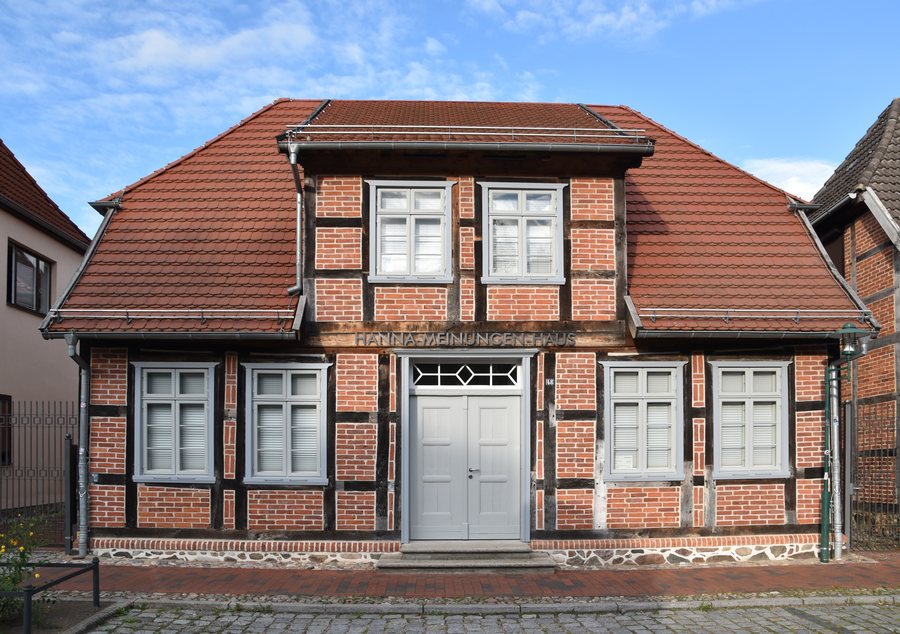 File:Hagenstraße 48 (Hagenow) Hanna-Meinungen-Haus 02.jpg
Photo: Migebert via Wikimedia Commons, CC BY-SA 3.0
File:Hagenstraße 48 (Hagenow) Hanna-Meinungen-Haus 02.jpg
Photo: Migebert via Wikimedia Commons, CC BY-SA 3.0
Jewish Life and Regional History
The ensemble of buildings belonging to Hagenow’s former Jewish community includes the synagogue, built in 1828, a religious school and a ritual bath, the mikveh. Together, they form a thematic focal point that extends beyond a single place of worship: the synagogue, religious education and ritual bathing are represented side by side. Visitors interested in Jewish history can find several distinct elements of community life in this Hagenow ensemble.
Since November 2010, the permanent exhibition “Traces of Jewish Life in Hagenow and West Mecklenburg” has been on display at the Hanna-Meinungen-Haus. The exhibition title itself connects two scales: it names Hagenow specifically while also extending its thematic scope to West Mecklenburg. The exhibition thus complements the ensemble’s specific focus with a broader perspective on Jewish life in the region.
Everyday Culture and Collections
The Museum of Everyday Culture of the GRIESEN GEGEND preserves several thousand objects relating to the town’s history, crafts and the folklore of southwestern Mecklenburg. One of its main focuses is the Jabelheide folklore collection, drawn from villages in the heart of the Griesen Gegend. This brings together several perspectives: the development of a town, craft-related subjects and folklore collections connected with local villages. For culturally minded travellers, this offers a different way of understanding Hagenow than through the town’s architectural history.
Water Tower, Tiny House and Cycling Tour
The Hagenow Water Tower is a brick building with Gothic windows and was built between 1905 and 1908. Hagenow’s smallest house is a side-hall gable house at Königsstraße 15. According to the inscription on a beam, it was built in 1751 and renovated in 1993. The two buildings make different impressions: the water tower is characterised by its brickwork and window design, while the small house also has a recorded construction date and renovation date.
Another way to include Hagenow in your travel plans is the Hagenower Landpartie. The cycling tour starts at the town hall square in Hagenow and ends in Hagenow with a visit to the Catholic Church of St. Elisabeth and the Protestant town church. The tour therefore combines an active outing with two named churches along its route. When planning, you can decide whether to focus your stay more on the individual cultural sites or on the cycling tour.
A Regional Cultural Comparison
The wider destination of Ludwigslust-Parchim also has its own cultural and historical theme: Ludwigslust Palace was the former residence of the Dukes of Mecklenburg and, together with its park and town, forms an ensemble known as the “Little Versailles of the North.” The palace is the centrepiece of an almost completely preserved late Baroque town plan, with a former court church and an English-style landscaped park. While Hagenow’s examples bring individual buildings, collections and an ensemble connected with the former Jewish community into focus, Ludwigslust brings together a palace, a town plan and a park. This is a different cultural focus within the explicitly named destination of Ludwigslust-Parchim.
Choosing the Right Base
If you would also like to include regional culture, Ludwigslust Palace is another attraction that explicitly belongs to the wider destination of Ludwigslust-Parchim.
Discover More Destinations
Discover more destinations: Boizenburg/Elbe, Amt Banzkow, Lübtheen, Amt Ludwigslust-Land, Amt Boizenburg-Land, Ludwigslust, Amt Wittenburg, Amt Eldenburg Lübz.
Back to the regional travel overview: Ludwigslust-Parchim.

_Hanna-Meinungen-Haus_02.jpg)