
Plate on the Stör Waterway
Accommodation in Plate
Plate was first mentioned in 1191 and lies directly on the Stör Waterway, which runs through the heart of the village and the meadow-rich Lewitz lowlands. The waterway is 22 kilometres long and connects Lake Schwerin with the Müritz-Elde Waterway. Water and landscape give Plate its distinctive character: activities include guided boat trips and paddling, while paths along the Stör let you explore the area on foot or by bike. The village church and the parish barn add a cultural dimension.
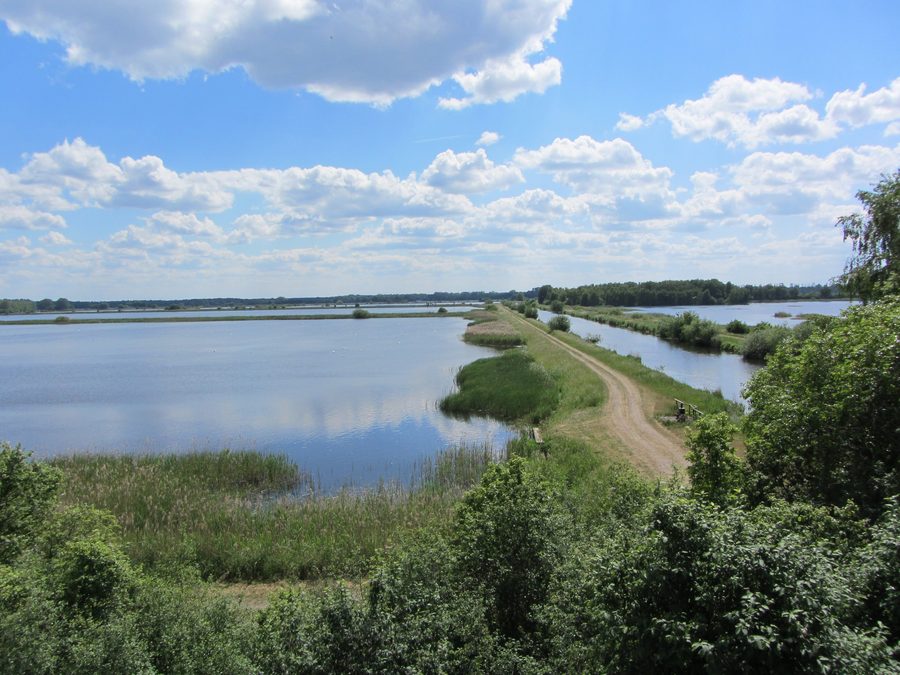 Teiche und Müritz-Elde-Wasserstraße in der Lewitz bei Neustadt-Glewe
Photo: Niteshift ( talk ) via Wikimedia Commons, CC BY-SA 3.0
Boat Trips and Water Sports
The Lewitz-Kieker “Albert” departs from its home port in Plate and offers guided trips on the Stör Waterway, the Müritz-Elde Waterway and Lake Schwerin. The trips pass through the meadows and woodland of the Lewitz Landscape Conservation Area. The Stör Waterway is also used by canoeists and paddlers; there are spacious boat moorings by the bridges in Plate. The Stör bridges are considered a landmark of the village. Bicycles can be taken aboard the “Albert” by prior arrangement. The date, departure, duration and route are arranged individually.
Cycling or Walking Along the Stör
Plate is connected to the well-developed cycle path network leading to the Lewitz Landscape and Nature Conservation Area. The towpath along the Stör is an approximately 13-kilometre cycle and walking route: it runs from Mueß along the Stör to Banzkow, then continues along the Stör Canal through the forested Lewitz to Gaartzer Bridge and in the direction of Plate. The route reaches Plate after passing beneath the railway bridge. This gives you the option of choosing between a guided trip on the water and a route on foot or by bike when planning your visit.
Village Church and Parish Barn
Plate village church was built in 1848 to designs by Schwerin architect Theodor Krüger. It houses a preserved late Gothic Marian altarpiece, made around 1500 and featuring exactly ten carved figures. The organ was built in 1873 by Friedrich Friese, court organ builder to Schwerin. The altarpiece, church building and organ therefore represent different periods: the altarpiece predates the building, while the organ dates from the 19th century.
Next to the village church is the parish barn, a meeting place and event venue whose cultural offerings are also open to tourists. It is located on the Residenzstädterundweg and the Stör Waterway. An Advent market is held there every year; check the specific dates before your trip. Alongside its water and walking experiences, the church and parish barn give your stay a cultural point of interest in the village.
Getting Here and Choosing a Holiday Apartment
Plate has its own railway station on the Schwerin–Parchim line and is easy to reach. Check the current timetable for your specific train journey. When looking for a holiday apartment in Plate, consider what you would like to focus on during your stay: are you most interested in guided boat trips and water sports, cycling and walking routes, or visiting the village church and parish barn? These different themes can help you match your holiday plans to the character of the place.
Discover more destinations: Banzkow, Sukow.
Return to the main travel overview: Amt Banzkow.

