
Discover Mittelnkirchen
Accommodation in Mittelnkirchen
Mittelnkirchen combines a distinctive village history with two very different structures. The Hogendiek Bridge connects the village with Steinkirchen; St. Bartholomew’s Church reveals a layered history of construction and furnishings. Mittelnkirchen Ort and Mittelnkirchen Hohenfelde are also historic linear villages along a dike, typical of the Altes Land region. This gives you several specific themes to consider when planning your trip: the bridge as a structure and a connection, the distinctive settlement pattern, and the church with its location and furnishings. You can focus on whichever themes interest you and get to know Mittelnkirchen from different perspectives.
The Hogendiek Bridge: Connection and construction history
The Hogendiek Bridge is a fixed wooden bridge for pedestrians and cyclists. Built in 1975, it was modelled on old Dutch drawbridges, which were also typical of the Altes Land region. Its dimensions give the structure a clear profile: the bridge is 42 metres long and 1.5 metres wide. The inspiration and the completed structure have different features: the historical inspiration came from drawbridges, while the Hogendiek Bridge itself is fixed. Thus, a regional design tradition and a practical connection between Mittelnkirchen and Steinkirchen come together in a single structure. Those interested in historic construction will find a different way to explore the village’s history here than by looking at church art or settlement patterns.
Two historic linear villages along a dike
Mittelnkirchen Ort and Mittelnkirchen Hohenfelde are historic linear villages along a dike, a settlement type typical of the Altes Land region. The term directs attention beyond individual buildings to the history of the villages. This means the settlement pattern complements the stories of the bridge and the church: it offers its own context for exploring Mittelnkirchen’s historical character. The Mohr'sche Pforte is also one of Mittelnkirchen’s historic landmarks and is associated there with the number 17. Together, these themes offer a range of points of interest for travellers who want to explore not only prominent individual buildings but also the history of the village and its settlements.
St. Bartholomew’s Church on a raised mound
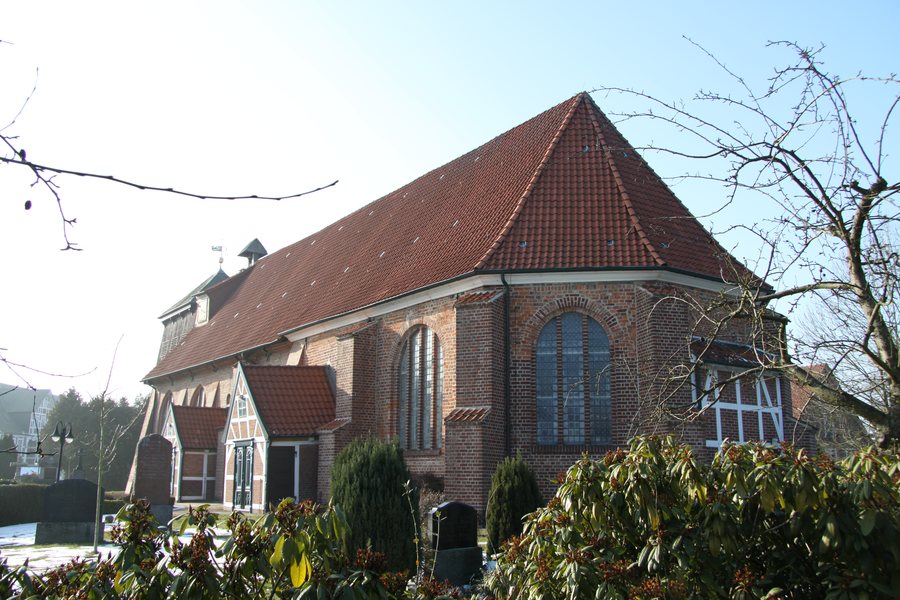
St. Bartholomew’s Church stands east of the Lühe on a raised mound of earth surrounded by a moat. It is also situated in the middle of an old cemetery. The mound protects against flooding and storm surges; its function is as much a part of the site’s description as its position by the river and the surrounding moat. These spatial features are easy to distinguish: the church stands on the raised, man-made ground, while the cemetery and moat define its immediate surroundings. This brings the building’s history together with its distinctive location in the village.
The church’s architectural and art history
The church itself also reveals different historical layers. Its façade is made of brick; originally, it was built of wood and fieldstone. At the end of the 17th century, organ builder Arp Schnitger expanded the organ from one manual to two. In the mid-18th century, Matthias Schreiber enlarged the instrument. The church’s furnishings also include Late Gothic depictions of the Crucifixion and an altar with a pulpit dating from 1800/02. These details span Late Gothic art, alterations to the organ, and the altar from around 1800. In contrast to the Hogendiek Bridge, whose construction date and model tell a clear story of its design, St. Bartholomew’s is defined by the coexistence of several building and furnishing phases.
If you are looking for a particular theme for your stay, Mittelnkirchen offers more than one way to explore its history: you can focus on the connection to Steinkirchen, the traditional linear-village settlement along a dike, or the location and furnishings of St. Bartholomew’s Church. These varied themes help you shape your discoveries around your own interests.
Discover more destinations
Discover more destinations: Krummendeich, Sauensiek, Neuenkirchen, Jork, Guderhandviertel, Horneburg, Estorf, Fredenbeck
Back to the main travel guide: Stade.

