
Raddestorf: Cycling Routes, Mill History and Church Art
Accommodation in Raddestorf
In Raddestorf, cycling routes meet architectural and church history: the town offers starting points for active days and discoveries at Harrienstedt Watermill and Luther Church. When looking for a holiday apartment, you can consider whether to focus your trip more on cycling tours, historic sites or both. The following places each offer a different theme to explore.
Cycling Routes and Places to Stop
A newly built cycle path runs from Raddestorf via Warmsen to Essern. Raddestorf is also connected to the Weser Cycle Route, the Steinhuder Meer–Dümmer See long-distance route and a branch route of the Westphalian Mill Route. When planning, you can first decide which route or destination you would like to focus on.
For cyclists, barbecue huts and covered rest areas make good places to take a break. These are located in Raddestorf, Gräsebilde, Jenhorst, Kleinenheerse and Dierstorf, as well as in Westenfeld by a pond complex, at the hall on Dörpsplatz and at the sports ground in Huddestorf.
Harrienstedt Watermill
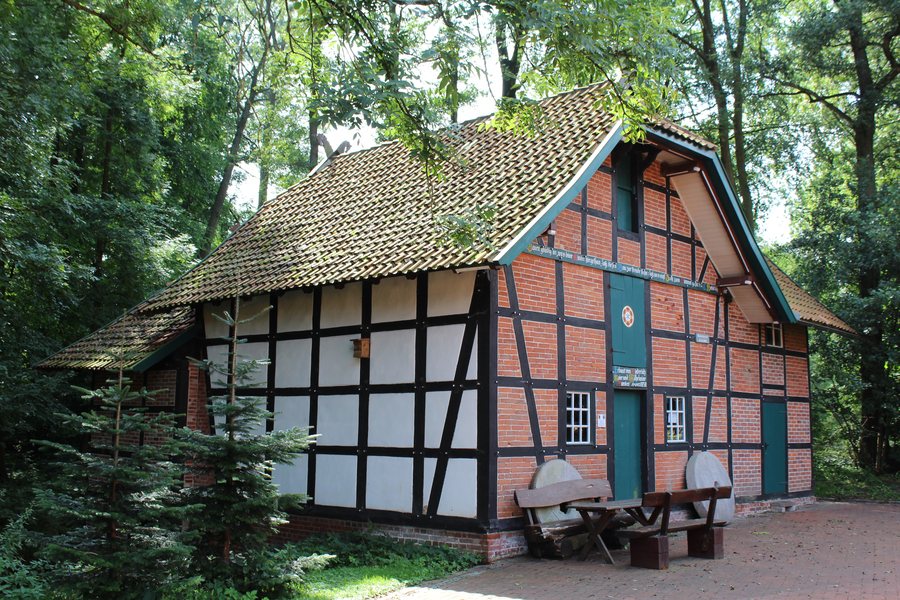
Harrienstedt Watermill, also known as “Woatermöhln,” was first mentioned in writing in 1583; the present building dates from the early 19th century. Its history includes several clearly dated periods: commercial use ended in 1957, and in 1988 the municipality of Raddestorf acquired the mill buildings and the surrounding grounds, including six hectares of alder carr and mill ponds.
The “Woatermöhln” local history association regularly holds demonstration milling and baking days during the summer season. The watermill is open to visitors on milling and baking days and as part of the Westphalian Mill Route; only an exterior visit is possible. If you are planning a visit, check the dates of the demonstration milling and baking days. After weddings at the mill, the surrounding grounds, with their mill ponds and alder carr, can be used for spending time and taking wedding photos.
Church Art in Raddestorf
Another cultural and historical highlight is Luther Church in Raddestorf. It houses a wooden pulpit dating from the 14th or 15th century, one of the oldest in Lower Saxony. The church also has the only pneumatic organ in the church district.
More to Explore in the Wider Nienburg Destination
In the wider Nienburg destination, Nienburg Museum offers a broader look at regional history. Its main building is the Fresenhof, a manor house built for a castle guard in the 16th century. Across three historic buildings, the museum shows the development of the Middle Weser region from the presence of the first humans to the present day. The individual buildings in Raddestorf can thus be viewed alongside a museum theme that covers a long period of regional history.
The Münchehagen Dinosaur Park is another attraction in the wider Nienburg destination. More than 300 dinosaur footprints can be seen there, bearing witness to a time around 140 million years ago. The park offers hands-on activities especially for young children, including the excavation of a 25-metre-long skeleton. When planning your trip, you can therefore take different interests into account, from Raddestorf’s cycling routes and historic buildings to regional museum and dinosaur attractions.
Discover more destinations: Mittelweser, Stöckse, Wietzen, Heemsen, Nienburg, Rehburg-Loccum, Uchte, Steimbke
Back to the main travel overview: Nienburg.

