
Hassel (Weser)
Accommodation in Hassel
Hassel (Weser) offers a range of themes to consider when planning a trip: the history and architecture of St. Cosmae et Damiani Church, the Alhuser Ahe floodplain forest and a stop on the Hoya–Verden Weser Cycle Route loop. When choosing a holiday apartment, you can consider whether culture, nature or a cycling trip will be the focus of your stay. The town’s individual features offer specific points of interest to help you decide.
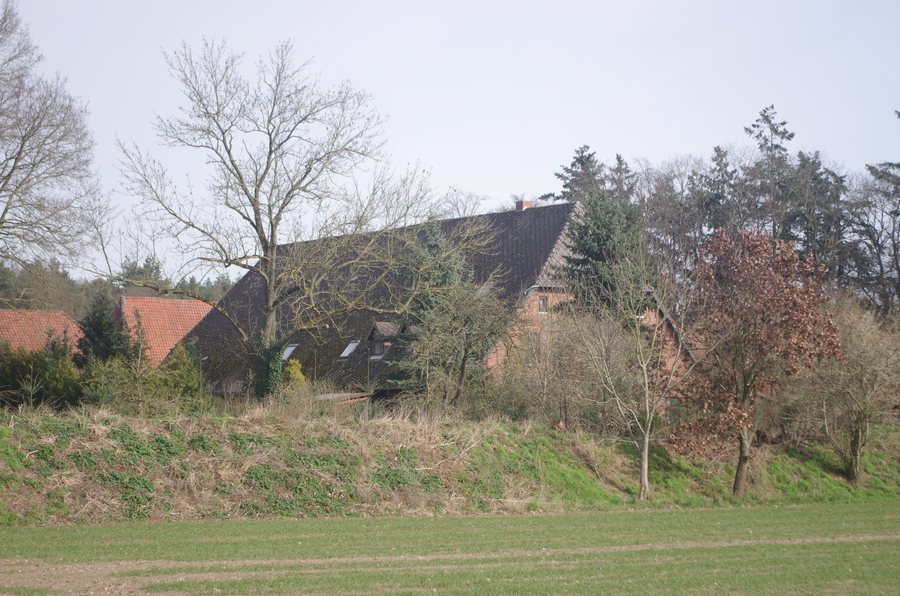 Wohn- Wirtschaftsgebäude, Hassel (Weser) Hope, Verdener Straße 30
Photo: Kiwi05 via Wikimedia Commons, CC BY-SA 4.0
Wohn- Wirtschaftsgebäude, Hassel (Weser) Hope, Verdener Straße 30
Photo: Kiwi05 via Wikimedia Commons, CC BY-SA 4.0
Church history and special details
St. Cosmae et Damiani is one of the oldest churches in the Middle Weser region and one of the oldest sacred buildings in the Syke-Hoya church district. Its history stretches back around 1,000 years. The building’s design also reveals different periods of construction: the two-bay nave is 27 metres long and eight metres wide. It stands on a moulded base and has a narrower western choir bay dating from the 12th century. The eastern bay was probably added at the end of the 13th century. The western choir bay is dated to the 12th century, while the addition of the eastern bay is only presumed.
Notable details inside the church include the pulpit, painted in the peasant Baroque style, and the gravestones. One depicts a bride who was struck down and died in front of the altar at the moment of her wedding ceremony. This unusual motif differs markedly from the architectural description of the building and offers another perspective on the church’s cultural history. Those interested in sacred architecture can consider the dimensions, construction phases and artistic details as different aspects of its roughly 1,000-year history.
Floodplain forest and seasonal nature
The Alhuser Ahe is a 22-hectare floodplain forest between Hassel and Hoya, east of the Weser. Unlike the church, the focus here is not a single building but a continuous natural area. The area can be explored on paths that are not closed; when choosing your route, be sure to avoid any closed sections.
One specific seasonal highlight is the hollow corydalis: in late March and early April, it blooms in large carpets of white and purple flowers. Its flowering season makes this nature outing distinct from a trip focused on the historic church or the cycling tour. If you plan your trip for this time, the corydalis bloom is a special feature of the Alhuser Ahe. At other times of year, the described points of interest are the size and location of the floodplain forest and the possibility of walking on paths that are not closed.
Cycling towards Hoya
The Hoya–Verden Weser Cycle Route loop reaches Hassel’s town sign along the B215. There, the route turns into Jübberweg and then reaches state road 330, which leads directly to Hoya. This describes a specific sequence—B215, the town sign, Jübberweg and state road 330—instead of merely naming a town on the route. If you are looking for a holiday apartment for a cycling trip, you can consider Hassel as one of the points expressly named on this loop; however, the route description does not indicate the distances to individual accommodations.
Another named place in Hassel is the Hassel windmill at Mühlenstraße, 27324 Hassel (Weser). Together with the church and the route, it adds a specific street name to the points of reference. The Alhuser Ahe, in turn, offers a natural setting with its own stated area and a distinctive flowering season. This lets you choose between architectural history, nature and a cycling route as the focus of your trip, rather than limiting yourself to just one way of exploring Hassel.
More town pages: Hilgermissen, Hämelhausen, Schweringen, Gandesbergen, Hoya, Eystrup, Hoyerhagen and Bücken.
For the broader travel overview: Grafschaft Hoya.

_Hope,_Verdener_Stra%C3%9Fe_30.jpg)