
Discover Staudach-Egerndach
Accommodation in Staudach-Egerndach
Staudach-Egerndach can be discovered through very different facets: the Great Moor Circular Trail leads through the Egerndacher and Staudacher Filzen wetlands, while the Atelierfenster art display by C. Lewerentz showcases art in the window of a former grocery shop in the town centre. There is also St. Andrew’s Church in Egerndach, first mentioned in a document in 1260. These contrasts can help guide your search for a holiday apartment: consider whether you would rather spend your days exploring moorland and trails, or connecting with art and local history.
Moorland trails and different kinds of routes
The Great Moor Circular Trail is a circuit through the Egerndacher and Staudacher Filzen wetlands, with several stations devoted to the moor. Their topics include animals and insects, stones and pebbles, water, trees and flowers. The themes thus range from small creatures to water and plants, giving the circular trail a variety of points of interest. The Great Moor Circular Trail is also suitable as a cycling excursion.
The Planet Trail along the Tiroler Ache offers a different kind of route. It is around 2.5 kilometres long and can be explored on foot or by bicycle. Starting at Römerstein, east of the Achenbrücke bridge near Staudach-Egerndach, the trail follows the Tiroler Ache to Marquartstein. This gives you a choice between a circuit through the Filzen wetlands and a route with a named destination. When choosing a holiday apartment, your planned excursions can help you shape your stay.
Art in a shop window and church history
From 1999, the Atelierfenster art display by C. Lewerentz presented works by artists, mostly from the Chiemgau, in the window of a former grocery shop in the centre of Staudach. The Atelierfenster also included a public bookcase. The art in the shop window and the themes explored along the trails offer different ways to discover the town.
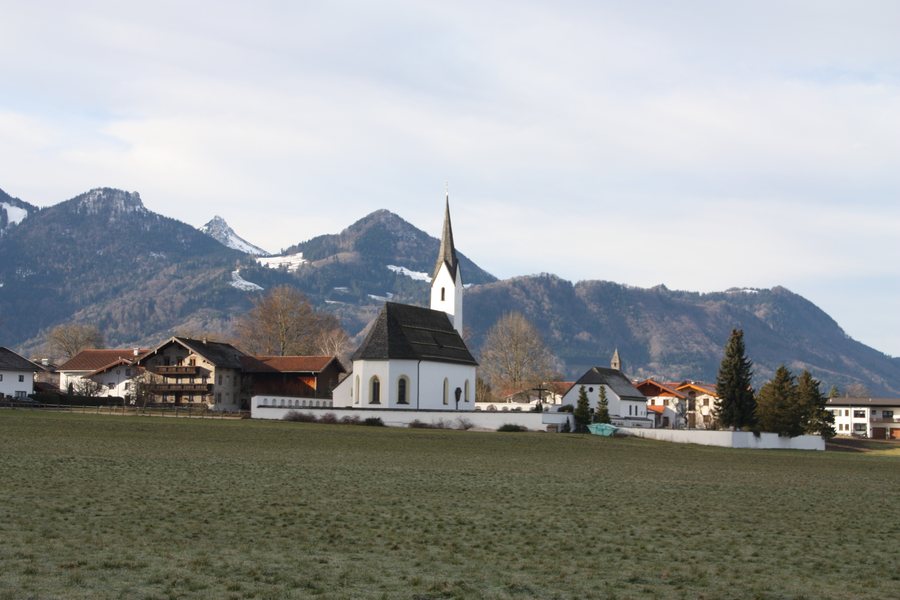
St. Andrew’s Church in Egerndach offers another way to explore local history. It was first mentioned in a document in 1260, but when it was built is unknown. The round-arched portal and an apse window date from the Gothic period. The Baroque interior furnishings were added after renovations in 1867 and 1895. These dates therefore refer to the renovations, not the year the church was built. The first documentary mention and the later construction phases together provide different clues to its history.
Walking destinations nearby
Two trails lead from the Staudach-Egerndach hiking car park (timber storage yard) to the Staudacher Alm: one follows the Aiblbach stream, while the other takes the Schnappensteig trail. Each takes around 1.5 to 2 hours. The approximate duration is the same for both options, but the routes differ. Before planning a specific excursion to the Alm, it is worth checking the latest information on its operating hours.
The Schnappenkirche, on the Schnappenberg in Marquartstein, is also nearby. Several hiking trails lead up to the church from Marquartstein and Staudach-Egerndach through dense mountain forest. From the snack bench in front of the Schnappenkirche, you can look out over the Chiemgau and Lake Chiemsee. This is a different direction for an excursion from the trails through the Filzen wetlands or along the Tiroler Ache: here, the forest ascent and viewpoint are part of the destination described.
The wider region: Traunstein
Looking at the wider travel destination of Traunstein brings the district into view. The Chiemsee and Lake Waginger are located there; the Chiemgau Alps have more than 170 alpine pastures and peaks reaching up to 2,000 metres. The district of Traunstein also lists the Seeoner Seen as a nature reserve and Lake Waginger and Lake Tachinger as a landscape conservation area. This regional perspective complements Staudach-Egerndach’s moorland and cultural themes with further natural and landscape features to consider when planning your trip.
Discover more destinations
Discover more destinations: Traunstein, Obing, Marquartstein, Altenmarkt an der Alz, Waldhausen, Schleching, Nußdorf, Palling.
Back to the overview of the wider destination: Traunstein.

