
Habach – Village History, Church Art and Nature
Accommodation in Habach
In Habach, Baroque church art, a historically shaped village centre and natural ponds come together. The village also has local festival traditions and wetlands with moors and species-rich meadows. When planning your stay, you can decide whether village history, nature, seasonal customs or travel by public transport should be your main focus. The holiday apartment is a base for a stay that you can tailor to your interests.
Local history along Hauptstraße
The protected Habach village centre ensemble covers the central area of the former collegiate monastery village, situated along Hauptstraße. Six larger houses along the street can be identified as former canon houses belonging to the monastery. Anyone interested in the village’s former role will find concrete traces of this history in its streetscape. The listed Mesnerhaus at Hofbichlweg 2, formerly known as the Moserhaus, is a Werdenfels farmhouse of the Mittertenn type: the living quarters are on the left and the stable on the right.
The former Altwirt at Hauptstraße 5 also reflects a different use of the building. The listed former inn with accommodation dates from 1626 and was renovated in the early 18th century and again in the second half of the 19th century. It is a historical former inn, not a current place to stay. The historical village walk runs along Hauptstraße, beside the Heubach and over Kirchhofbichl; its route provides a distinct spatial setting for the village’s history.
Churches and art history
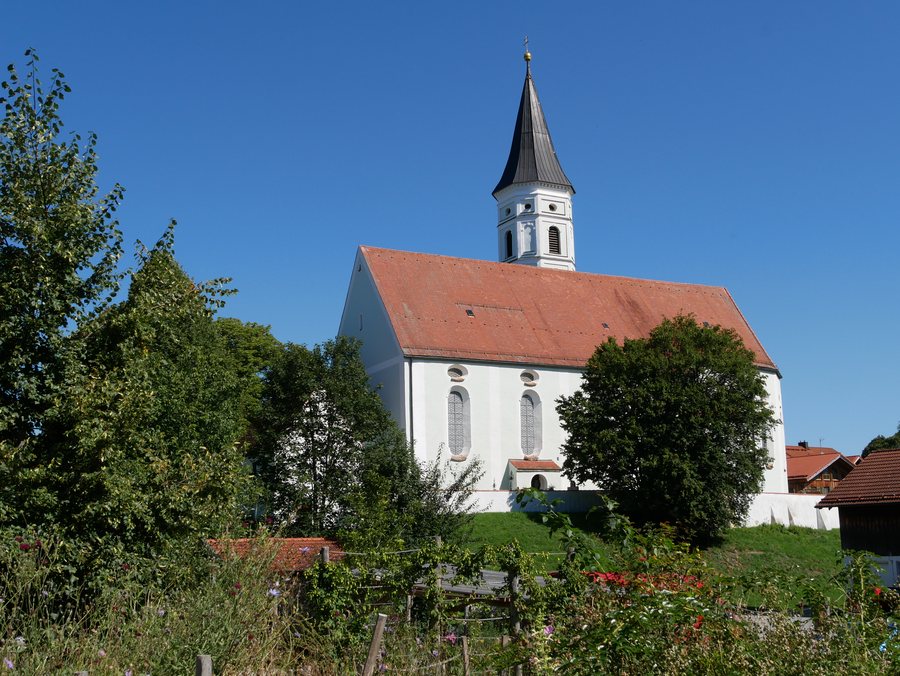
Today’s Baroque parish church of St. Ulrich was built between 1662 and 1668. On 14 October 1668, Kaspar Zeiler, auxiliary bishop of Augsburg, consecrated the church. Inside are two works of art from different artistic contexts: the high altar was created by the Weilheim artist Ambros Degler, while the altarpiece was painted in 1681 by Simon Bernhard of Murnau. It depicts St. Ulrich and the Battle of Lechfeld. Southwest of the church is the Ulrichsbrunnen, considered one of the oldest fountains dedicated to St. Ulrich in the Diocese of Augsburg.
In Dürnhausen, within the municipality, stands the Catholic branch church of St. Martin. Its Romanesque nave dates from 1063, while the choir and tower are from the 15th century; it was given a Baroque makeover around 1670. The municipality thus brings together architectural and decorative elements from several centuries—an interesting point of reference for travellers interested in church architecture and its development.
Customs and nature through the seasons
Habach maintains several recurring traditions, each with its own schedule. The carnival parade winds through the streets every five years on Shrove Tuesday. Habach also celebrates its traditional harvest festival with a parade every five years. Independently of these events, the Easter bonfire is lit every year on the evening of Easter Sunday at Hinterfeld. If one of these events is important to your trip, take its date into account when planning your stay.
The landscape also offers a variety of ways to spend your time. In the fields around Habach, Wiesleitenweiher is one of the ponds with particularly natural surroundings and rich biodiversity. The municipality also has natural wetlands with moors, species-rich meadows, ponds and waterside areas. Koppenbergweiher can be reached on foot from the village centre; swimming is possible in Habach in summer. Keep these details distinct: the stated walking distance applies to Koppenbergweiher, while swimming opportunities are mentioned for Habach in general.
Food and getting here
Eichbichl-Stüberl serves traditional Bavarian cuisine, hearty snacks and offers a beer garden. This lets you include a culinary focus alongside local history and nature in your plans. Travelling together can involve different interests, which you can take into account when choosing a holiday apartment, without assuming a particular location or set of amenities.
Habach can be reached via the A95 and B472, as well as by public transport. You can factor these options into your plans depending on how you wish to travel. You can also discover Sindelsdorf, Antdorf and Obersöchering as other destinations in the area.
For the wider travel overview: Weilheim-Schongau.
More destinations
More places in the same destination:

