
Winklarn: Discover reverse glass painting and circular trails
Accommodation in Winklarn
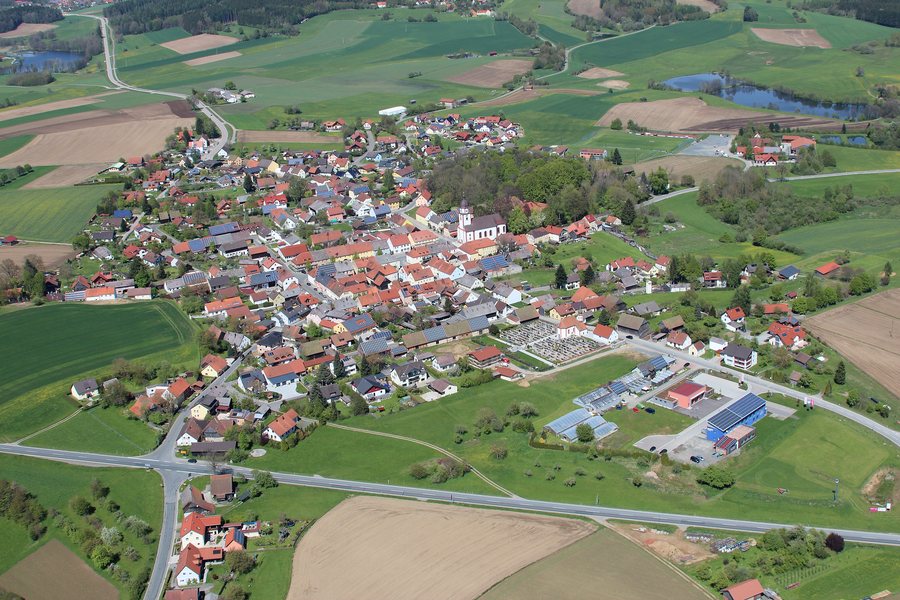
Winklarn combines a distinctive artistic tradition with traces of history and two circular hiking trails that differ in difficulty rating, length, elevation gain and starting point. The town is part of the Upper Palatinate Forest Nature Park. This gives you a mix of cultural discoveries and practical opportunities to add some exercise to your stay when planning your trip.
Reverse glass painting and history in Winklarn
From the mid-18th century to the early 20th century, reverse glass painting was practised as a local tradition in Winklarn. Members of the Roth, Ruff and Wellnhofer families pursued it as a sideline. The paintings from Winklarn mainly depict religious subjects. This offers a way to explore the town’s artistic history over an extended period and through a specific local school, rather than treating it as just one historical event.
Another chapter in the town’s history is the Catholic parish church of St. Andreas. After the fire of 1822, the church was rebuilt in 1826, incorporating the Baroque west tower. The building thus brings together reconstruction after a specific event and an older structure. Visitors interested in religious art or the history of church buildings will find another cultural point of interest here, alongside reverse glass painting.
The Winklarn Reverse Glass Painting Documentation Centre is a free exhibition at the Thomas-Aquinus-Rott Primary School in Winklarn–Thanstein. It is located in the hometown of the reverse glass painters of the Winklarn school. Alongside the parish church, it provides a second, clearly defined way to explore the town’s history: the exhibition focuses on the artistic tradition, while St. Andreas illustrates the town’s architectural history.
Two circular trails with different details
For an active stay, you can compare two circular hiking trails based on their published details. The Winklarn Marterlweg 2 is rated moderate. It is 11.3 kilometres long, has 213 metres of elevation gain and a stated duration of 2 hours and 49 minutes. Its starting point is in Winklarn-Schneeberg.
The Winklarn Marterlweg 3 is rated easy and covers 10.9 kilometres with 165 metres of elevation gain. Its stated duration is 3 hours and 10 minutes, and its starting point is in Winklarn-Muschenried. The details show a difference between the difficulty rating and elevation gain on the one hand, and the stated duration on the other. When planning your day, you can therefore consider the specific figures together instead of deciding based on distance alone.
Both options are circular hiking trails, but they differ in starting point and difficulty rating. If you include the trails in your trip, note the starting point for each one: Schneeberg is the starting point for Marterlweg 2, and Muschenried for Marterlweg 3. The stated elevation gains and times can also help you coordinate your planned hike with your other travel interests. This does not automatically make one trail preferable to the other; what matters is which route details suit your plans for the day.
Choose culture or exercise as your focus
Winklarn is part of the Upper Palatinate Forest Nature Park. Together with the local reverse glass painting tradition, the parish church of St. Andreas and the two circular trails, the town offers a range of themes for planning your trip, without requiring you to focus on just one way of exploring. When choosing a holiday apartment in Winklarn, you can consider whether you would like to focus your stay on art history and the church, or make more room for hiking. The named starting points and route details give the trails their own distinct character; the exhibition and architectural history offer a cultural counterpoint.
More local pages: Oberlangau, Teunz.
For the overarching travel overview: Oberviechtach.

