
Schwabach: Goldsmithing, Culture and Nature
Accommodation in Schwabach
Schwabach combines the history of goldsmithing with distinctive museums, a Late Gothic town church, and nature experiences close to town. When planning your trip, it’s worth considering in advance which aspects of the town interest you most: vivid craft history, Jewish history, art, or a stroll in the countryside.
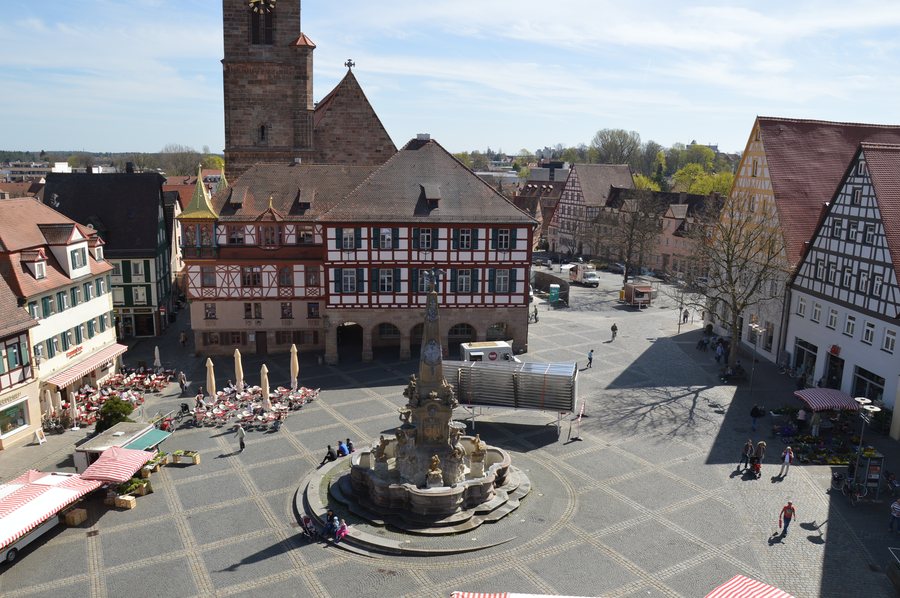 File:Schwabach Königsplatz von oben.JPG
Photo: Stadt Schwabach via Wikimedia Commons, CC BY-SA 3.0 de
File:Schwabach Königsplatz von oben.JPG
Photo: Stadt Schwabach via Wikimedia Commons, CC BY-SA 3.0 de
Goldsmithing at the Museum and Demonstration Workshop
At the heart of the permanent exhibition on Schwabach’s internationally significant craft and industrial history is the Goldbox. Its focus is gold leaf beating; it also houses a demonstration theater with a historic gold-beating workshop. This lets you experience the subject not only through finished gold leaf, but also in the context of the craft that shaped the town.
At the gold-beating demonstration workshop, the individual stages of the process are shown behind a shop window: from the gold bar to the wafer-thin gold leaf, including trimming and packaging. The workshop is near the market square and pedestrian zone. On special occasions, a master gold beater still beats gold there, for example during the civic festival, the parish fair, or the Christmas market. These demonstrations take place only on such occasions. Gold-beating demonstrations are also scheduled at the town museum on the first Saturday of each month at 2 p.m. and 4 p.m.; advance registration is not required.
Families also have a hands-on way to explore the subject: by appointment, the town museum offers the 60-minute children’s tour “From Gold to Gold Leaf” for a maximum of 25 participants. The same museum also displays a collection of eggs from natural history and ethnography that is unique in Europe. So alongside goldsmithing, visitors can discover entirely different objects in the collection.
Town Church, Jewish History, and Historic Courtyards
The Protestant Church of St. John and St. Martin is one of Schwabach’s landmarks. It preserves mostly original art treasures dating from its construction in the 15th century. Particularly striking is the high altar from the workshop of Michael Wolgemut: it is one of the largest double-winged altarpieces of the Late Gothic period in Bavaria. Those interested in church art will find a vivid glimpse of Late Gothic furnishings here.
The Jewish Museum Franconia in Schwabach explores both the building and the history of its residents. Exhibition sections, animated films, and audio stations present Jewish life in Schwabach and the festival of Sukkot. A free app also enables a self-guided tour of Synagogengasse and Schwabach’s former Jewish center. The tour complements a museum visit by highlighting the site’s historical significance.
Another historical trace leads to the Mönchshof, Schwabach’s largest historic courtyard complex. The complex has been known as the Mönchshof since 1195. Places like this offer a different emphasis from the exhibitions: the focus here is the long history of a historic farmstead.
Nature Walk and Routes Through the Town
If you would like to spend some time outdoors between visits to museums and cultural attractions, the nature walk close to town offers 14 information boards, seating, and children’s playgrounds. The stops and places to rest provide different points of interest along the walk. The town is also home to the sand pits of Wolkersdorf, the only habitat in Schwabach’s urban area of statewide significance.
The Schwabach educational trail runs across the Wöhrwiese, along the Nadlersbach stream, up Gartenstraße, and back into town through Weingässchen. In 2010, it received four new interactive stations and new signs. This route offers a distinct way to discover different parts of Schwabach; it is not the same as the nature walk.
The Goldsmiths’ Night is also part of Schwabach’s tradition: for more than 20 years, it has been celebrated every two years as a “golden festival.” If you’re looking for a holiday apartment in Schwabach, you can choose your destination based on your interests: goldsmithing and museums, the town church and Jewish history, or the nature walk and educational trail. These subjects offer different perspectives on the town without requiring you to focus on just one.
Discover More Places
More pages about local destinations: Greding, Heideck, Schwanstetten, Rohr, Georgensgmünd, Rednitzhembach, Spalt, Allersberg.
Back to the main travel overview: Roth.

