
Heroldsberg: Castles, Art and Forest Trails
Accommodation in Heroldsberg
Heroldsberg combines a rich castle history with art and forest trails. The medieval White Castle presents permanent and changing exhibitions on three levels, featuring works of art from seven centuries. There are also historic buildings and hiking options, offering different ways to spend your stay. When looking for a holiday apartment, you can consider whether you would like to focus mainly on discovering the town’s cultural history or spend more time on forest trails.
Four Castles and Their History
From the late 15th century onward, the Nuremberg patrician Geuder family had four castles built at Oberer Markt. The individual buildings tell their stories in different ways: Martin III Geuder built the Red Castle in 1489. Albrecht Dürer was a guest there in 1510. The Yellow Castle was built in the second half of the 16th century as Hieronymus Geuder’s manor house, on the foundations of an older residence. The different dates and building histories give the castle ensemble a long historical perspective, although not every building dates from the same period.
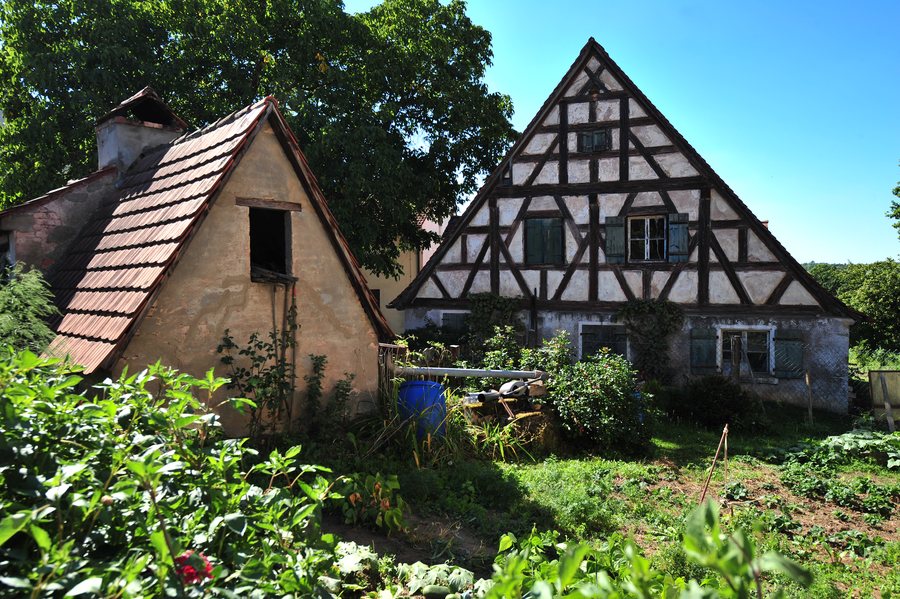
Art enthusiasts can also make the White Castle a focus of their visit: its permanent and changing exhibitions are spread across three levels and feature works of art from seven centuries. St. Matthew’s Protestant Church houses a crucifix from the early work of Tilman Riemenschneider. The rectory opposite the church is one of the oldest in Germany. This picturesque half-timbered building is first mentioned in 1427 and was most recently renovated in 1983. In this way, the history of the exhibitions and buildings is complemented by a work of art in the church.
Discover Local History Along the Way
The approximately 3 km-long cultural trail passes numerous listed buildings. Information boards explain their history and distinctive features. The route combines exercise with historical insights, while the boards provide more context about individual buildings. Three medieval draw wells at Oberer Markt recall another facet of the town’s history. You can choose this trail as a cultural activity or include the individual historical themes in your travel plans independently of one another.
Historical traces can also be found beyond the town center. In the woods south of the Tuspo Heroldsberg sports complex stand two medieval atonement crosses dating from 1587. They bear the initials E.V.V.G.S. and S.O., respectively, and commemorate the murder of Nuremberg horsemen. Their location in the woods makes these memorials a different destination from the buildings at Oberer Markt.
Forest Trails and Other Destinations
For hikes, the permanent IVV hiking trail “4-Schlösser Gemeinde” offers forest routes of 5 km, 10 km and 16 km. The different route lengths make it easier to decide in advance how far you want to hike. One destination nearby is the Teufelsbrünnlein in the “Hermannswinkel” forest between Heroldsberg and Kleingeschaidt, near Reigelsberg. From the Johnnisthal hiking car park, the path leads about one kilometer east to a signpost. From there, it is a ten-minute walk to a large rock with a devil carved into the face and painted over in red.
A permanent AOK fitness trail is located at the Johannisthal car park on the B2. Heroldsberg is easily accessible from Nuremberg by the Gräfenbergbahn railway and has good road connections to the BAB A3. When planning your trip, you can therefore take into account both the rail connection from Nuremberg and the link to the motorway. The historical sites, forest hiking trails and destination in Hermannswinkel offer different reasons to choose Heroldsberg as a holiday destination, depending on your interests.
If you would like to explore more places, you can also find Weisendorf, Wachenroth, Kalchreuth, Erlangen, Höchstadt An Der Aisch, Röttenbach, Gremsdorf and Marloffstein.
For the regional travel overview: Erlangen-Höchstadt.

