
Trogen: Margrave’s Church and Via Imperii
Accommodation in Trogen
Trogen is especially appealing to travelers who want to get to know a place through its architecture, ecclesiastical artworks and a specific pilgrimage stage. The focus is the Protestant parish church: the Baroque hall church was built in 1747 under the patronage of the city of Hof and, as the Margrave’s Church, forms the center of the community. It also contains furnishings with their own histories of creation and provenance. If you would rather use a route than a single building as your guiding theme, Trogen is also on the Burgstein–Trogen–Hof pilgrimage stage of the Via Imperii Way of St. James.
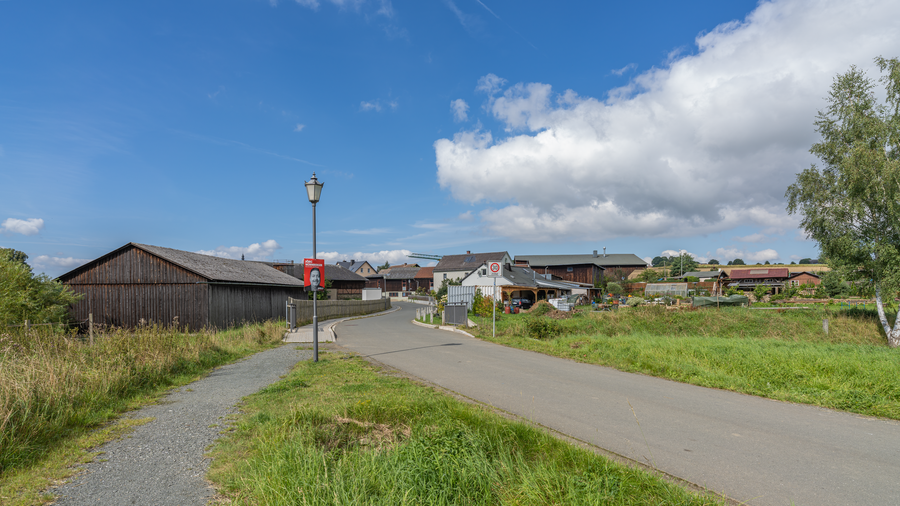 File:Ortsrand von Trogen 20210825 HOF04682cens.png
Photo: PantheraLeo1359531 via Wikimedia Commons, CC BY 4.0
File:Ortsrand von Trogen 20210825 HOF04682cens.png
Photo: PantheraLeo1359531 via Wikimedia Commons, CC BY 4.0
Margrave’s Church and Artworks
The parish church brings together works from different periods. An old crucifix hangs to the right of the altar, created by Peter Breuer of Zwickau around 1500. Breuer was a student of Tilman Riemenschneider. The altar cross on the table of the pulpit altar was added later: Wolfgang Adam Knoll carved it in 1748/49. This means that visitors can discover both a work from around 1500 and a piece from the 18th century in a single building.
Another focal point is Knoll’s baptismal angel. Wearing a colorful robe and large golden wings, it holds a baptismal bowl in its hands. The organ case is decorated with striking gold ornaments. Its history also includes an instrument made by the Heidenreich company, from the Silbermann school, which was originally housed inside it. During the church renovation of 1888/89, the former mother church, Hof-St. Lorenz, gave the instrument to the parish church.
The Protestant church offers a 3D tour of the church interior on the parish website. You can explore the church digitally; the artworks and furnishings described here offer specific points to look out for. The building’s history, individual works and the baptismal angel’s colorful details provide different ways to appreciate the Margrave’s Church, rather than seeing it only as a historic building.
Pilgrimage Stage and Cemetery
The Burgstein–Trogen–Hof pilgrimage stage of the Via Imperii Way of St. James also passes through Trogen. This offers a different focus from exploring the artworks in the parish church: here, the focus is a named stage, while there it is the architecture and furnishings of a single place. When planning your trip, you can therefore first consider whether you want to discover Trogen primarily through the Margrave’s Church and its art, or in connection with this pilgrimage stage. These two themes provide a clear focus for your stay without turning them into a single attraction.
The Trogen cemetery, with its Neo-Romanesque tomb, is also part of the town’s historic character. It adds another building with its own architectural classification to the picture of ecclesiastical art. Together with the Margrave’s Church, it creates a cultural theme that extends beyond the furnishings of the church interior.
Choose Trogen as a Holiday Destination
When looking for a holiday apartment, the reason for your trip may help you decide: if you are most interested in the history of the Margrave’s Church, its construction period and artworks take center stage. If you would like to include a pilgrimage stage in your plans, the Via Imperii offers another point of interest. The 3D tour also provides a digital way to explore the church. Trogen thus combines tangible examples of ecclesiastical art and architectural history with a named pilgrimage stage—two distinct perspectives to help guide your choice of holiday destination.
Discover More Destinations
Discover more destinations: Geroldsgrün, Zell Im Fichtelgebirge, Hof, Schwarzenbach An Der Saale, Berg, Feilitzsch, Lichtenberg, Issigau.
Back to the main travel overview: Hof.

