
Discover Roßtal: Archaeology, Church and Local Life
Accommodation in Roßtal
Roßtal’s local history can be explored from different perspectives: at stops along the Archaeological Trail, in the details of St. Lawrence’s parish church and during a break at the Spitzweed. These themes are presented in different ways. The trail tells the story at several stops, while the church and pond each bring their own details into focus. You can decide which impressions you would like to shape your stay.
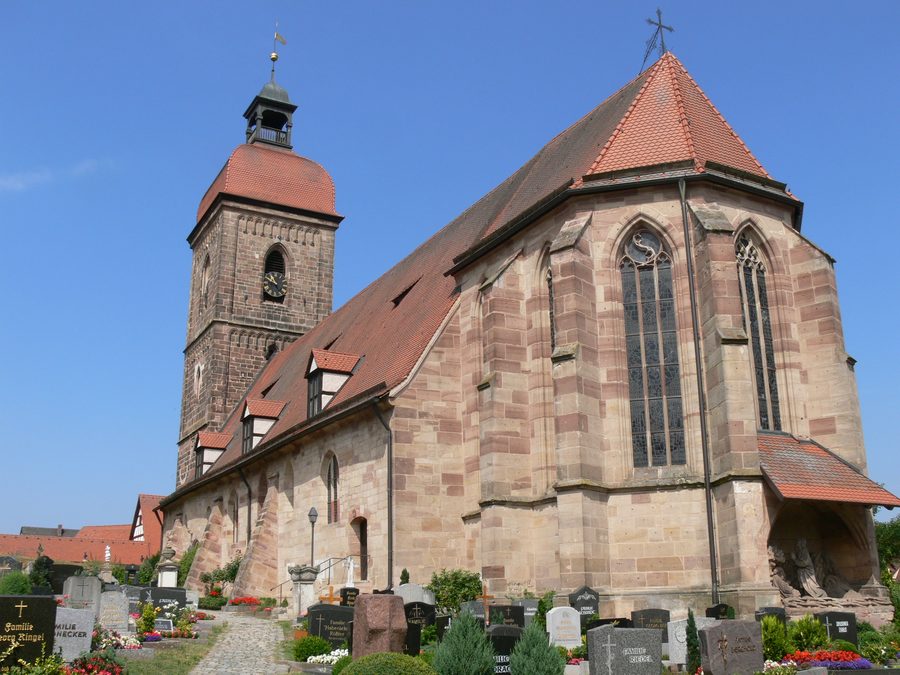 Die St.-Laurentius-Kirche prägt das Ortsbild von Roßtal.
Photo: Wolfgang Sauber via Wikimedia Commons, CC BY-SA 3.0
Die St.-Laurentius-Kirche prägt das Ortsbild von Roßtal.
Photo: Wolfgang Sauber via Wikimedia Commons, CC BY-SA 3.0
Archaeological traces at the Upper Market
The Roßtal Archaeological Trail runs past several stops at the Upper Market in the town centre. It reopened in 2023 and also includes the former margraves’ court office in Roßtal. The trail therefore focuses not only on individual places, but also on a chapter in the history of law and justice. If you are interested in the history of the market town, you will find several stops here that offer different ways to explore Roßtal.
Each information board is divided into two sections. The lower section features child-friendly texts and illustrations. This gives families a practical starting point when adults and children would like to take in information in different ways. The design also makes the trail accessible to young readers without requiring a separate theme.
A guided tour offers a different emphasis: tours in Roßtal tell stories about the buildings and squares of the old market town. While the trail includes archaeological stops and the former court office, these stories focus on the history of the buildings and squares. If this guided format suits your plans, check availability with the local organiser.
Church history in architecture and coats of arms
St. Lawrence’s parish church offers several specific details through which to explore Roßtal’s history. Its tower is 52 metres high. On its south side, above the apex of the Gothic window, is a frieze decorated with heads. One of the heads is believed to depict Elisabeth, Burgravine of Nuremberg. This remains a possible interpretation; distinguishing it from the confirmed description of the feature’s location and design is part of what makes it worth a closer look.
The gallery also bears historical symbols: in its lower section, nearest the choir, are the Hohenzollern and Brandenburg coats of arms, the Wittelsbach coat of arms brought by Burgravine Elisabeth, and the coat of arms of the Burgrave of Nuremberg. These coats of arms add another layer of local history to the frieze. This also highlights a clear distinction between the trail, architecture and stories about the old market town: history unfolds through stops in the town centre in one case, and through individual architectural and heraldic details in another.
Another historical point of interest is the monastery garden in the outdoor grounds of the Museum Courtyard. It is laid out in the style of the early Middle Ages. The combination of a garden and a historical model offers a different approach from the trail’s information boards or the church’s coats of arms: here, the garden’s design takes centre stage.
A break at the Spitzweed
At the Spitzweed, benches invite you to relax and watch the fish in the pond. It offers a different pace from the trail with its several stops or a closer look at the church’s details. If you like to plan your days around a variety of interests, you can weigh up the archaeological trail and the historic architecture and garden against a quieter moment by the water. In early summer, you can also hear a “Forschkonzert” at the Spitzweed.
When looking for a holiday apartment in Roßtal, these different themes can provide a helpful starting point: consider whether you would like to connect your stay mainly with the Archaeological Trail, the historical details of St. Lawrence’s and the Museum Courtyard, or a break at the Spitzweed. Tours of the buildings and squares of the old market town offer another way to explore the area; check their availability with the local organiser in advance.
Discover more destinations: Veitsbronn, Großhabersdorf, Langenzenn, Cadolzburg, Stein, Zirndorf, Puschendorf, Oberasbach.
Return to the main travel overview: Fürth.

