
Weißenohe: Lillach, Hiking Trails and St. Boniface Monastery Church
Accommodation in Weißenohe
Weißenohe combines hiking destinations along the Lillach with a distinctive landscape and cultural history centred around St. Boniface Monastery Church. Contemporary art is also on display in the former malt house of the monastery brewery. When planning your visit, consider whether you would prefer to focus on hiking trails and nature or on history and art.
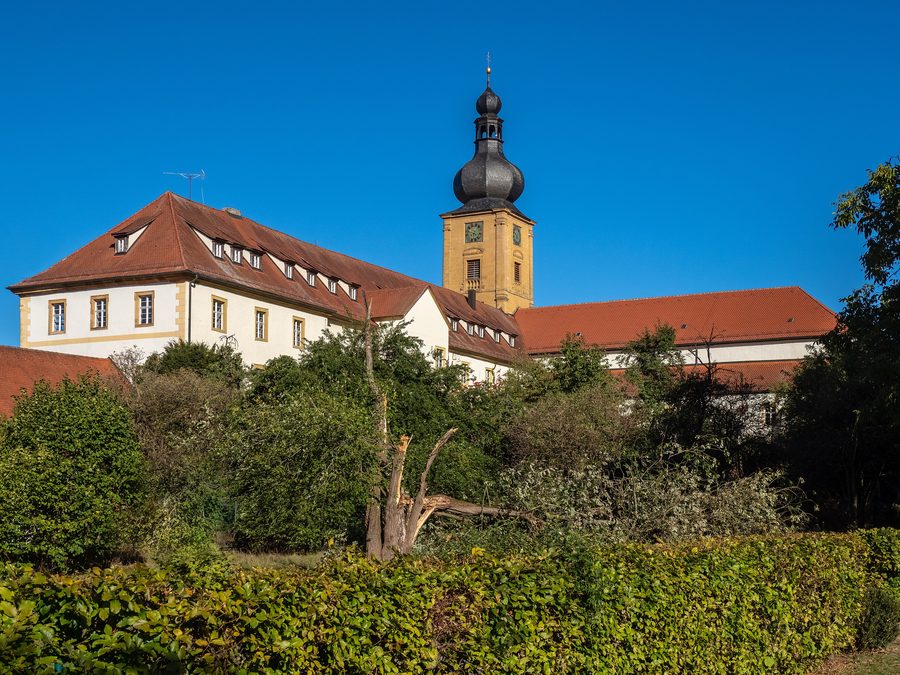 Das ehemalige Benediktinerkloster prägt zusammen mit der Pfarrkirche St. Bonifatius den historischen Ortskern von Weißenohe.
Photo: Ermell via Wikimedia Commons, CC BY-SA 4.0
Das ehemalige Benediktinerkloster prägt zusammen mit der Pfarrkirche St. Bonifatius den historischen Ortskern von Weißenohe.
Photo: Ermell via Wikimedia Commons, CC BY-SA 4.0
Hiking destinations between Dorfhaus and the Lillach
From Dorfhaus, a district of Weißenohe, a yellow-marked hiking trail leads through the Teufelsgraben to the Lillach spring, just over two kilometres away. The route described thus links a specific starting point with a named destination. As conditions on the route may change, check the latest information before setting out.
There are numerous marked hiking trails around Weißenohe and Dorfhaus. The Franconian Way passes directly through Weißenohe; the village is also a starting point for the brewery hiking trail “5-Seidla-Steig®”. There is also an educational trail along the Lillach that introduces visitors to the distinctive features of the Lillach Valley. These options offer different approaches to planning your hike: a walk to the spring, trails in the surrounding area or a route along a named hiking trail. The educational trail adds a focus on the landscape and valley to the walk.
The Lillach landscape and natural monument
The sinter terraces in the Lillach near Weißenohe play a special role. Because of their beauty and distinctive character, they were designated an area natural monument in 1976. Since 1995, they have been within a protected zone of the Franconian Switzerland Nature Park. Both the striking landforms and their history of protection are therefore among the features that shape an outing along the Lillach. If you enjoy taking a closer look at the landscape as you explore, this offers a different focus from simply choosing a hiking route.
The monastery church and contemporary art
The architectural history of St. Boniface Monastery Church also offers a concrete way to explore the history of the village. The plans for the present-day church were drawn up by Wolfgang Dietzenhofer (1648–1706), a member of an Upper Bavarian family of master builders. It was consecrated on St. Boniface’s Day in 1707 by Johann Werner Schnatz, Auxiliary Bishop of Bamberg. The architect, his family background and the date of the consecration bring the building’s history to life and offer visitors interested in cultural history a focus of their own during their stay.
Every year, KunstRaum Weißenohe presents exhibitions of contemporary art featuring a range of artists in the former malt house of the monastery brewery. The historic church architecture is thus complemented by an annual art programme. If you are planning a visit, check the current exhibition dates and access arrangements in advance.
Franconian hospitality and choosing where to stay
After a long hike, Weißenohe’s inns invite you to stop for a meal featuring typical Franconian cuisine. As individual businesses and offerings may change, it is worth checking current dining options in advance. When looking for a holiday apartment, your travel interests may help you decide: would you like to focus on the hiking trails and the Lillach, or are you particularly interested in church history and art? Weißenohe offers specific points of interest for both, without requiring you to devote your entire stay to just one theme.
More to explore in the wider Forchheim destination
The wider Forchheim destination also offers its own cultural and hiking attractions. In Forchheim District, the Kulturerlebnis Fränkische Schweiz hiking trail connects pioneering cultural projects over a distance of more than 280 kilometres. Schloss Wiesenthau is privately owned, used as a restaurant and available to visit by arrangement; make arrangements before your visit. The ruins of Neideck Castle and Neideck Archaeological Park are accessible at any time. Follow the local safety and nature conservation notices there.
Discover more destinations: Hiltpoltstein, Dormitz, Igensdorf, Wiesenthau, Hallerndorf, Gößweinstein, Gräfenberg, Obertrubach
See the wider travel overview: Forchheim.

