
Donau-Ries: Crater Landscape and History
Accommodation in Donau-Ries
A massive impact, a completely preserved town wall and museums with unusual exhibits: Donau-Ries combines the history of a distinctive landscape with engaging discoveries on site. The Donau-Ries district counts the Ries Geopark, with the Ries Crater formed by a meteorite impact, among its tourist attractions. When planning your holiday, it is worth focusing above all on the places and topics that interest you most together.
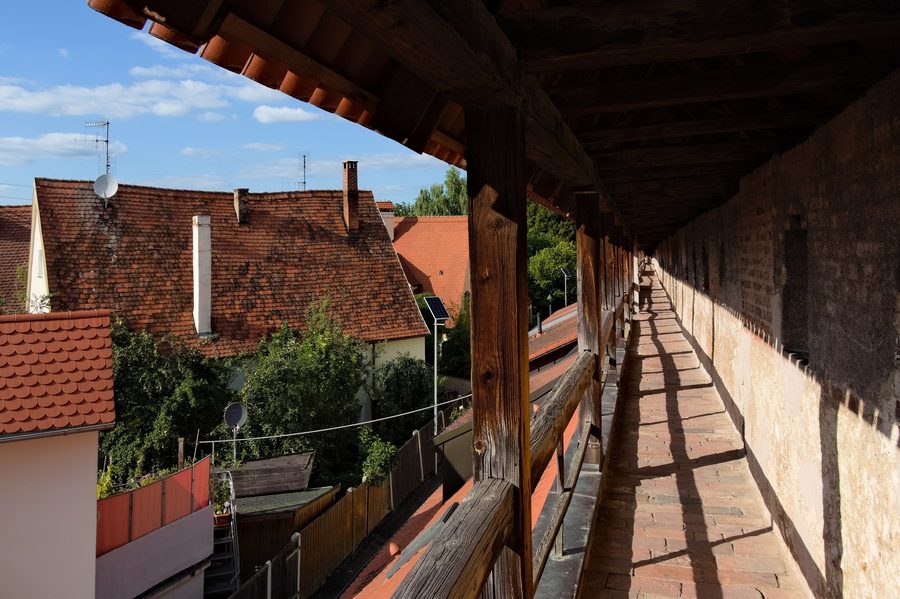 Blick entlang des Wehrgangs der vollständig erhaltenen Stadtmauer von Nördlingen.
Photo: Johannes Robalotoff via Wikimedia Commons, CC BY-SA 4.0
Blick entlang des Wehrgangs der vollständig erhaltenen Stadtmauer von Nördlingen.
Photo: Johannes Robalotoff via Wikimedia Commons, CC BY-SA 4.0
Understanding the Formation of the Ries Crater
14.5 million years ago, an asteroid struck Earth and created the crater of the Nördlinger Ries. The basin is about 25 kilometres in diameter; the crater rim is up to 150 metres high. These dimensions give a first impression of what defines the landscape. The RiesKraterMuseum explores the impact, its cosmic background and its effects to this day. Meteorites, fossils and a piece of real moon rock are among the exhibits, alongside information panels and multimedia offerings. The Ries event is also presented there in terms of its planetary origins and effects on Earth, in a carefully renovated medieval barn building dating from 1503.
You can also explore the history of its formation outdoors: at eight event panels, the Kühstein Geopark educational trail explains the processes involved in the impact. From Buchberg, there are panoramic views of the Ries and its inner and outer crater rims. The Wemding Geopark information centre uses several display panels to show which vantage points give visitors particularly good views of the crater structure in the landscape. This means different ways of exploring can feature in your own itinerary: exhibits and explanations in the museum, information along an educational trail, and views of the landscape.
Town History and Distinctive Buildings
In Nördlingen, you can walk the entire medieval town wall; it has been completely preserved. The Town Museum complements this experience with a collection more than 150 years old, spread across four floors. Its topics range from the life and beliefs of the people of Nördlingen to the changes brought about by the Reformation, the Thirty Years’ War and the 1634 Battle of Nördlingen. A model featuring around 6,000 tin soldiers illustrates the battle. Those interested in town history will find several historical perspectives here, while walking along the wall offers another way to engage with the medieval town.
A tour of Harburg Castle offers a glimpse into almost 900 years of history. Features include the Baroque castle church, loopholes, prison cells, gates and towers. Religious art and architecture take centre stage at the Maria Brünnlein pilgrimage basilica: the Rococo church was built between 1748 and 1782 to designs by Franz Joseph Roth, as the flow of pilgrims grew. Its altar of grace is designed as a fountain altar and houses the miraculous Virgin Mary by Johann Joseph Mayr, dating from 1755. The altar table with its fountain basin was created by Ernst Steinacker in 1953. In 1998, Pope John Paul II elevated the basilica to the status of a Basilica minor; around 150,000 pilgrims visit it every year.
Places to Suit Different Interests
In Donauwörth, Fugger-themed guided tours can be arranged on request through the town’s tourist information office. The Fugger House was the former residence of Anton Fugger, the imperial administrator, and today houses a permanent exhibition on the history of the house on the first floor. In Wemding, the legend trail begins at Johannisweiher. Its eleven event panels, developed with scientific input, provide information on geology, history and stories. These examples offer different starting points for planning a holiday: you can focus on the crater landscape, town history, architecture or themed guided tours, rather than trying to fit all your interests into a single day’s visit.
The Ries Panorama Trail requires a more substantial time commitment: the circular route is 128 kilometres long and is laid out in seven daily stages, each no more than 21 kilometres. If you are looking for individual themed stops rather than a multi-day hike, the museums mentioned above, the educational trail and the legend trail each offer ideas for a separate visit.
Places to Explore Further
To explore individual places, you can also take a closer look at Wemding, Oettingen in Bavaria, Nördlingen, Ehingen am Ries, Donauwörth, Rain, Marxheim, Mertingen, Wallerstein, Asbach-Bäumenheim, Oberndorf am Lech, Ries, Monheim, Tapfheim, Fremdingen, Kaisheim and Harburg.
For the broader travel overview: Bavaria.

