
Discover Wehringen
Accommodation in Wehringen
Wehringen lies on the Singold, close to the Wertach and at the edge of the Augsburg-Western Forests Nature Park. The town combines river landscapes and traces of history: from a walking path by the stream to the architectural history of its churches, there are many reasons to get to know Wehringen. When planning your holiday, the main question is whether you would like to focus on nature, local history, or both.
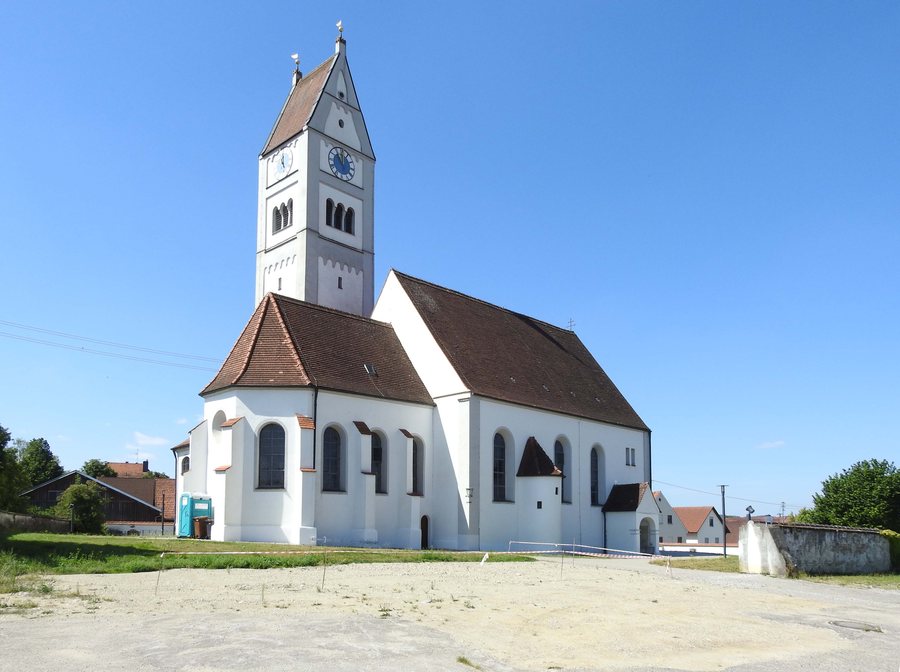 File:Wehringen, A - Kirche St Georg v NO 160722.jpg
Photo: Flodur63 via Wikimedia Commons, CC BY-SA 4.0
File:Wehringen, A - Kirche St Georg v NO 160722.jpg
Photo: Flodur63 via Wikimedia Commons, CC BY-SA 4.0
River Landscapes and Paths
A walking path along the Singold winds through fields and meadows. The “educational bridge” there offers a nature experience by the stream and gives the path a special destination. Two gently sloping sections of riverbank on the Wertach invite you to linger; at the same time, they form ecologically valuable shallow-water areas. These riverbank zones and the walking path along the Singold offer different impressions of the water, without needing to be combined into one route.
In western Wehringen, at the edge of the western forests, you’ll find the water-treading facility and the barefoot path right next to it. Access to the area is via a paved farm track and is possible only on foot or by bicycle. Keep this restriction in mind when planning your day. If you would rather visit a green space in town, the Pfarrgarten Generations Park is in the town centre, right by the Singold.
Churches and Traces of the Past
The parish church of St. George includes the wall of the former fortified cemetery. Loopholes, buttresses, two gates and a figure niche dating from the 16th century give it a distinctive historic character. The church itself also brings together different periods of construction: the choir was built in the Gothic period, in the 14th or 15th century; between 1741 and 1747, the interior was redesigned with ceiling frescoes, stucco and a high altar. If you are interested in architectural history, you can distinguish these different periods when looking at the parish church.
Other sacred buildings add to the picture. The Catholic Chapel of the Holy Cross is a rectangular building with a three-sided end and a roof turret topped by an onion dome. It was built around 1700 and enlarged in 1751. The Catholic St. Anthony’s Burial Chapel, in turn, is a rotunda with a domed roof in the post-Art Nouveau style, created in 1918/20 by Heinrich Düll and Georg Petzold.
Local history reaches far back beyond the churches, too. Some 85 mining pits from an early to High Medieval ore-mining area can be found in the Wehringen high forest. Excavations on the southern edge of town near the Singold uncovered finds in 2004 from an early medieval craft settlement where textiles were processed on a larger scale. Wehringen also had the “Leitenbad” spa from around 1490 until the 17th century, and it was considered an important health spa in 16th- and 17th-century bathing literature. Its decline is thought to have occurred in the 17th century.
Green Spaces and Local Traditions
The Pfarrgarten Generations Park, covering just under 3,000 square metres, offers seating and outdoor fitness equipment. You can also play boules, chess and table tennis there, whether for a shared break or some activity. Visitors are welcome to help themselves to herbs from the herb garden. During your visit, you can choose between exercise, games, a sit-down break and the herb garden.
One of Wehringen’s living traditions is the pilgrimage to the Holy Mountain at Andechs, which dates back to a vow made during the plague in 1717. The Historic Wehringen Village Festival was first held in 1990 to mark the municipality’s 1,000th anniversary and takes place every five years. The festival features artistic and craft demonstrations, as well as numerous stalls offering food and drink. These special occasions are another part of local life; plan around their respective dates.
If you are looking for a holiday apartment in Wehringen, you can choose your holiday destination based on which of these aspects appeals to you most: the landscapes along the Singold and Wertach, nature experiences on the western edge of town, or the historic buildings and traditions. Continue your search here for other places: Untermeitingen, Bobingen, Ustersbach, Ehingen, Nordendorf, Fischach, Welden and Lechfeld.
For the wider travel overview: Augsburg.

