
Lauingen (Danube): Schimmelturm, Roman era and DonAUwald
Accommodation in Lauingen
Lauingen (Danube) reveals different facets of its history: the Schimmelturm, a landmark in the city center; the ancient site in Faimingen; and Brunnental, shaped by waterways. There is also an 8.1-kilometer section of the DonAUwald Premium Hiking Trail, which runs from Lauingen to Dillingen. This gives you a choice when planning your trip between historical discoveries and a specific hiking route.
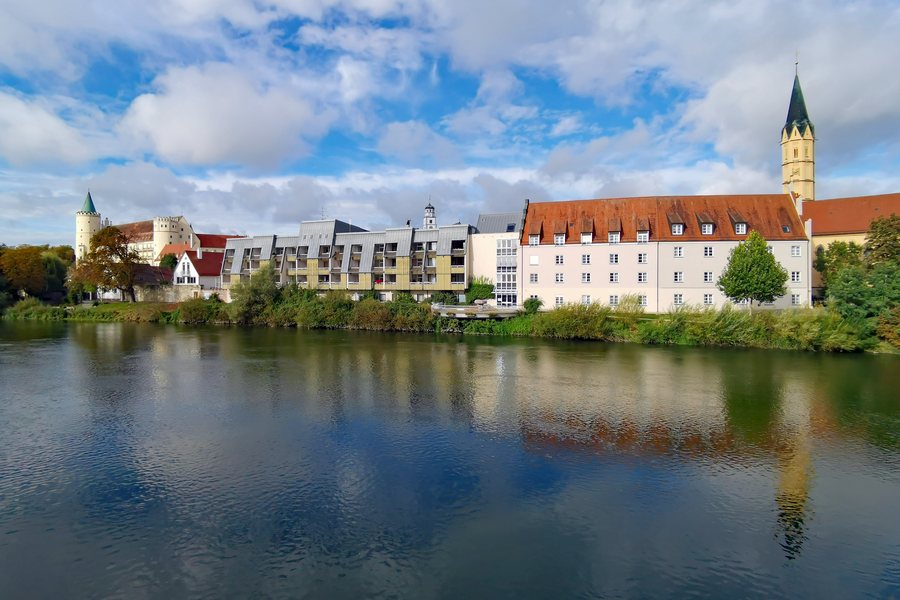
The Schimmelturm and the city's history
The Schimmelturm is a striking landmark in the center of Lauingen. It was built between 1457 and 1478. Its clearly documented construction dates provide a specific historical reference point for the city; its central location makes it a defining feature of Lauingen's cityscape.
Roman history in Faimingen
Faimingen is now a district of Lauingen. The temple precinct of the Apollo-Grannus Temple was built there toward the end of the 2nd century AD. You can explore the ancient site in person through a partial reconstruction or visit it virtually. Four panels in the temple area provide information about the province of Raetia, Roman Faimingen, the sanctuary and the god Apollo Grannus.
Several themes come together here: the Roman province, the history of the settlement, the site's role as a sanctuary and the worship of Apollo. The partial reconstruction and virtual tour offer different ways to explore the ancient site. The panels complement these impressions with information on precisely these four aspects.
Brunnental: Water and crafts
Brunnental tells a different story. It developed from a craftspeople's settlement between the Staufer city wall and the banks of the Danube. The waterways there shaped the settlement. Thus, the city wall, riverside location, crafts and waterways are all connected to its origins—a perspective on the development of the place that differs from the Schimmelturm and Faimingen's Roman history.
A hiking stage or a longer route
If you'd like to include some activity in your travel plans, consider the 8.1-kilometer section of the DonAUwald Premium Hiking Trail. It runs from Lauingen to Dillingen.
Dillingen on the Danube: Routes and regional experiences
In the Dillingen on the Danube region, the DonAUwald Hiking Trail runs for just under 60 kilometers through the floodplain forests along the Danube; 40 kilometers of it lie within the Dillingen district. It is Bavarian Swabia's first premium hiking trail. By comparison, the 8.1-kilometer Lauingen–Dillingen stage is a shorter, clearly defined section. All five classic stages of the DonAUwald Hiking Trail can be reached easily by train, making for a climate-neutral journey. If you plan your stages around train travel, check the timetable for your travel dates.
The Donautal-Radelspaß is another reason to plan a trip to the Dillingen district: it takes place every two years on a weekend in September, with the main event held in the district. Three signposted routes, closed to cars, lead participants on culinary and cultural tours. Check the event dates if this is important for your trip.
Over many years, gravel extraction has transformed the landscape along the Danube in the Dillingen district into a unique landscape of water and lakes. The seven chapels offer another regional highlight: they aim to create an architectural statement and a landmark in the landscape, while developing the tradition of chapel building in a contemporary style. Together, these themes contrast with Lauingen's urban and Roman history without blending into a single impression of the place.
Discover more destinations: Bissingen, Finningen, Holzheim, Wertingen, Buttenwiesen, Bachhagel, Gundelfingen on the Danube, Dillingen on the Danube.
Go to the main travel overview: Dillingen on the Danube.

