
Roßhaupten: Trails, Water and the Via Claudia Augusta
Accommodation in Roßhaupten
Roßhaupten connects Lake Forggensee with circular trails, viewpoints and a local history that reaches back to the Roman Via Claudia Augusta. This gives you a good basis for deciding whether you are mainly looking for time by the water, walks in the surrounding area or historical insights during your holiday. The different experiences can help you choose a suitable holiday apartment in the village.
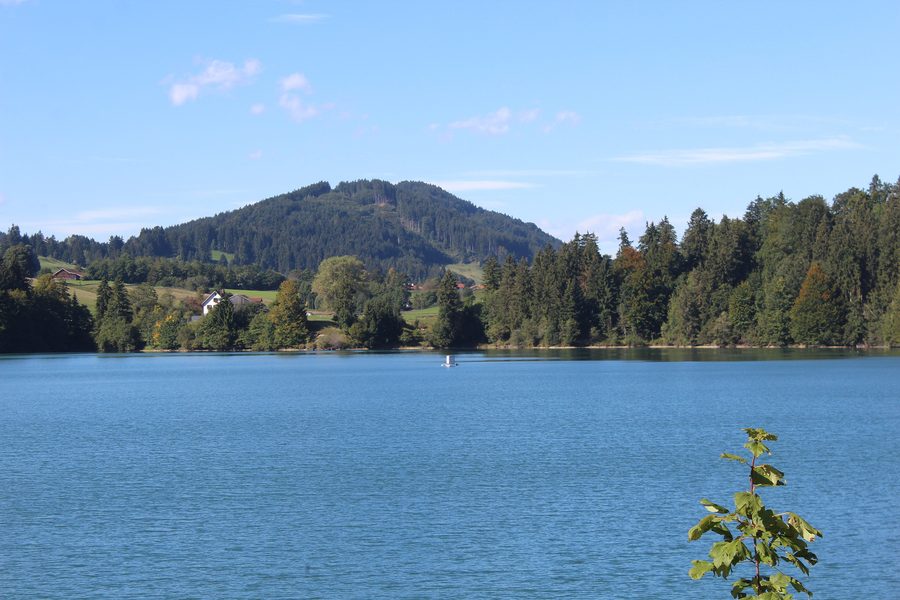 Blick von der Staustufe über den Forggensee auf den nördlichen Seebereich und Ufer von Roßhaupten.
Photo: Richard Mayer via Wikimedia Commons, CC BY 3.0
Blick von der Staustufe über den Forggensee auf den nördlichen Seebereich und Ufer von Roßhaupten.
Photo: Richard Mayer via Wikimedia Commons, CC BY 3.0
Lake Forggensee and trails for different kinds of days
According to the local tourism website, the bathing beach in Roßhaupten on Lake Forggensee is suitable for swimming, snorkelling and diving. From the beach, you can look across the lake to the royal castles, the peaks of the Ammergau Alps and Säuling. There is also a landing stage for Forggensee boat trips at the Roßhaupten power station. If you want to make water activities the focus of your holiday, this offers a different emphasis from a trip shaped mainly by culture and hiking.
For a short circular hike, the Moosenweg runs from the church in the village centre to the edge of the village and back. The route is 2.8 km long, takes about 45 minutes and has an elevation difference of 15 m. These details can help you fit the walk into your day. If, on the other hand, you are looking for a longer circuit with local-history stops, you can take the Drachenweg: allow about 1 to 1.5 hours for the circular route. You can start from the car park by the Kurpark on the southern edge of Roßhaupten, the Forggensee boat landing stage or the village centre, with a short additional walk to the route.
Local-history discoveries and views
The Drachenweg is designed as an experience trail for adults and children. Along the route, stops tell stories about the legend of St Magnus, the stone cross, the stone bridge dragon at Tiefental and the Drachenbrünnle spring in the stream valley. These themes connect the walk with local stories and notable points along the way, rather than focusing solely on the distance covered.
For a view across the hiking region, take the trail to the Buch-Zwieselberg viewpoint. The climb takes about an hour and starts on the western edge of the village. It goes steeply uphill along forest roads, a narrow footpath and a bridge; sturdy footwear and sure-footedness are required. There is a cross and a panoramic information board at the viewpoint. This tour is quite different from the short loop on the Moosenweg: the steep climb and the view across the hiking region are key features of the route.
The Senkele nature trail is also in the area around Roßhaupten. It starts at a forest car park on the district road between Roßhaupten and Seeg and leads to the Senkele Waldhaus. The walking time is about 30 minutes, not including stops. Child-friendly information boards along the way share interesting facts about forests, wood, water and geology.
Museum, chapel and Roman road
At the village museum in the Pfannerhaus, you can discover village life in days gone by and traditional crafts. The exhibition also covers the history of four notable sons of Roßhaupten, as well as the production of artificial flowers by entrepreneurs who were expelled from the Sudetenland after the Second World War. A permanent exhibition on the Via Claudia Augusta explains the historic Roman imperial road between Donauwörth, Altino near Venice and Ostiglia on the River Po. Roßhaupten also has an information centre about the Via Claudia Augusta; the tourism website describes it as the only information centre in Germany dedicated to this Roman road.
The Via Claudia is also a theme beyond the museum: the Via Claudia circular trail commemorates the old Roman road with a milestone at the Hartenberg viewpoint and the eponymous art park on Forggenseestraße. A short detour from the circular trail leads to the renovated St Ulrich Fish House Chapel; the key is available next door on request. Another historical stop is the Maria Steinach Chapel. The small Baroque chapel was built around 1650 by Matheis Holl, rebuilt soon afterwards to designs by Johann Jakob Herkomer and completed in 1706 by Joseph Miller of Rettenbach. Its altar, dating from around 1710, depicts the Visitation of Mary; the interior also contains wooden figures from the 18th century. From Maria Steinach, 14 Stations of the Cross lead to the summit of Roßhaupten’s Calvary Hill.
For information about cycling and hiking trails and maps, you can contact the Tourist Information Office in Roßhaupten. For other places to stay: Rieden am Forggensee, Oberostendorf, Pforzen, Lamerdingen, Biessenhofen, Eisenberg, Kaufbeuren and Halblech.
For the broader travel overview: Ostallgäu.

