
Gestratz: Water Worlds, Hiking Trails and Living History
Accommodation in Gestratz
Gestratz lies between gentle hills, the Upper Argen and the Kaplaneibach stream. This Westallgäu village combines experiences in the countryside with a long ecclesiastical history and craft traditions. When choosing your holiday apartment, it is therefore worth considering what you would most like to experience on your vacation: trails through the surrounding area, insights into local history or time by the water.
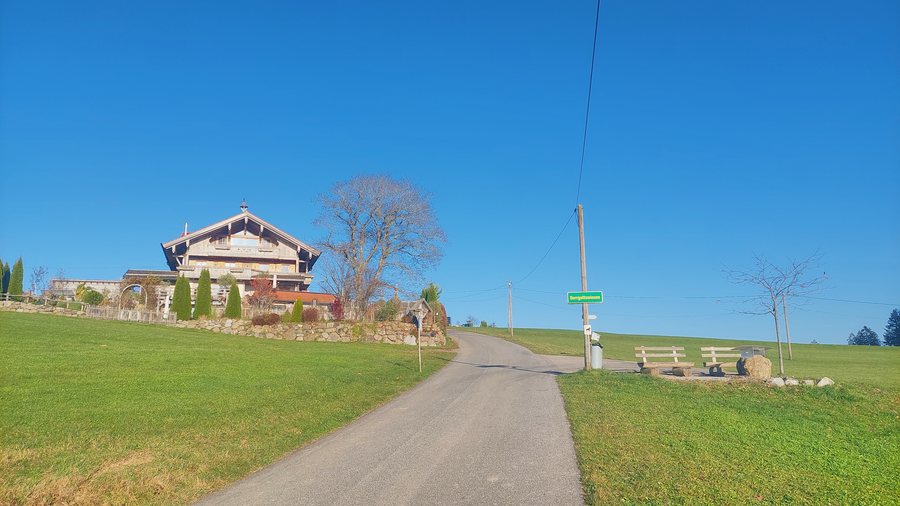 Hermitage Herrgottswiesen in Gestratz from southwest
Photo: Harald Hetzner via Wikimedia Commons, CC0
Hermitage Herrgottswiesen in Gestratz from southwest
Photo: Harald Hetzner via Wikimedia Commons, CC0
Hiking with sweeping views
Gestratz has 40 km of signposted hiking trails. One destination accessible from the trails is the hamlet of Schweineburg, which you can reach via the Gestratz hiking network on Route 1. The Schweineburg–Gestratz circular trail also offers clear directions: it starts and ends at the Argenhalle in Gestratz and leads to a viewpoint overlooking the heights of the Westallgäu and the Alpine ranges. The circular trail follows paved paths and is suitable for pushchairs.
From Schweineburg, high above Gestratz, the view stretches across the Oberallgäu and the Austrian and Swiss mountains all the way to Lake Constance. When planning your vacation, you can choose between an excursion along the circular trail and a visit to the Schweineburg viewpoint. If you enjoy exploring on foot, the marked trail network also offers a wider range of routes, so you do not have to commit to just one.
Water and local history
In the village square, the Gestratz Water Worlds bring together an easily accessible village stream, an artificial stream and a village fountain. The three features invite you to play and relax. This offers a different focus from hiking in the hills: here, spending time by the water takes centre stage. If you are travelling with children, you can plan to spend time here and combine your visit with other discoveries in Gestratz.
St. Gallus Parish Church was built between 1435 and 1437 and served as a pilgrimage church until the Thirty Years’ War. Gothic frescoes adorn the choir walls. The Gestratz parish was founded in the 8th century by the Abbey of St. Gall. Those interested in ecclesiastical art and history can encounter several different periods here: from the parish’s beginnings and its time as a pilgrimage church to the construction of the present-day church in the Middle Ages.
The Gestratz Heritage House offers a glimpse into the history of crafts. It is housed in a 250-year-old smithy, which was converted into a centre for living history. The ground floor contains a working forge and an exhibition room used for changing displays. At the annual Heritage House Festival in September, craftspeople demonstrate almost-forgotten traditional crafts. The festival adds a special seasonal highlight for anyone interested in traditional crafts.
The Malleichen bathing inn in the nearby area has an outdoor skittle alley and a notable history of bathing: sulphur baths were given there in zinc tubs until 1933. The bathing inn’s history stretches back more than 400 years. Alongside the church and smithy, local traditions also add to the character of the area.
Active days in every season
Cycling routes in Gestratz follow roads that are steep in places, with climbs and descents; cycling is varied but also very strenuous. This may help you decide whether you would rather spend your vacation days cycling or hiking. In winter, there are 8 km of groomed cross-country ski trails in total. The trail from Schweineburg leads towards the Waldbad in Isny and connects to the Maierhöfen–Isny trail network.
These different experiences may help you choose your accommodation: would you like to focus on hiking, views and local history, or are you particularly interested in cycling or cross-country skiing? Gestratz offers several distinct starting points for these activities, without any one of them defining the village’s character.
More places to explore: Grünenbach.
Back to the main travel overview: Argental.

