
Neenstetten between St. Ulrich and Eschental
Accommodation in Neenstetten
Neenstetten combines a distinctive church building with a landscape of ridges and valleys. At the Protestant parish church of St. Ulrich, the history of a building can be traced through several construction phases. A circular hike leads from the village through the Eschental valley down to the Lone Valley and back via Börslingen.
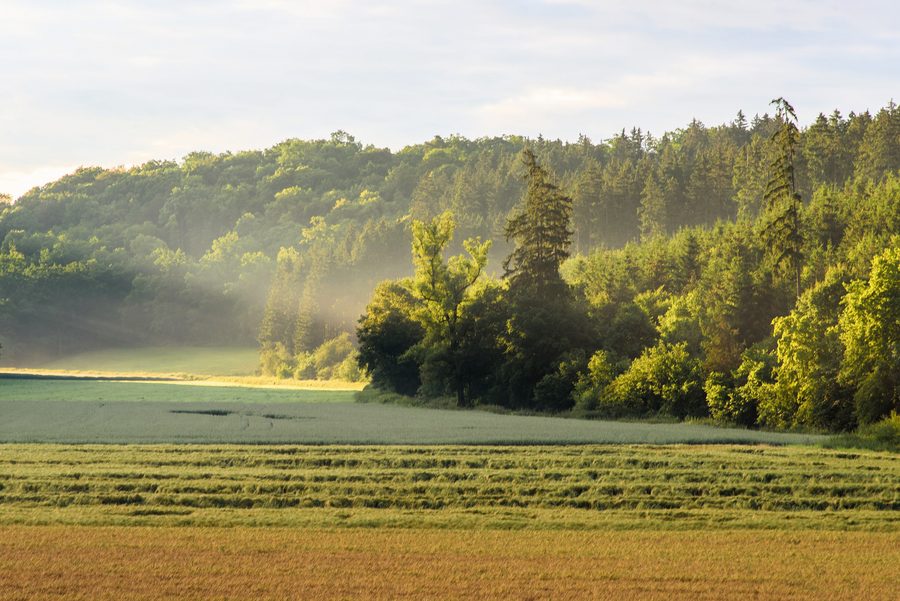 Landschaft im Mittleren Lonetal – ein Natur- und Wandererlebnis in der näheren Umgebung von Neenstetten.
Photo: Barockspot via Wikimedia Commons, CC BY-SA 4.0
Landschaft im Mittleren Lonetal – ein Natur- und Wandererlebnis in der näheren Umgebung von Neenstetten.
Photo: Barockspot via Wikimedia Commons, CC BY-SA 4.0
St. Ulrich and its architectural history
The Protestant parish church of St. Ulrich is a walled hall church with a gabled roof. The recessed, vaulted rectangular chancel is located in the eastern tower. This combination of nave and tower already gives the building its distinctive form: the chancel is inside the tower, which also reveals several different construction periods.
The Early Gothic chancel tower dates from the mid-13th century. The nave dates from the 15th century at the latest and was extended westward in 1603. The upper tower levels and the spire were added in 1730. Rather than associating the church with a single date, you can see a sequence of construction phases here: from the medieval chancel tower through the extension of the nave to the later parts of the tower. For a visit focused on architecture and local history, St. Ulrich is a specific place to visit in Neenstetten.
Ridges, karst and valleys
The municipal area lies on a ridge above the Lone Valley and is part of the Lower Flächenalb natural region. At its core is a gently rolling, karstified eroded plateau that slopes from northwest to southeast. The eastern edge is formed by the box-shaped to ravine-like Eschental-Eisental-Märklestal valley; to the south, the Lower Trutteltal valley marks the municipal boundary. This description characterizes the area as a whole and relates the village’s elevated position to the valleys that define its edges.
The landscape cannot therefore be reduced to a single valley: ridges, slopes and several valley areas are all part of the description of Neenstetten. This is also helpful for orientation if you want to picture where the Eschental circular trail fits in. The trail leads from Neenstetten down through the Eschental valley to the Lone Valley, connecting the village’s elevated position with the valley.
A circular hike through the Eschental valley
The circular hike starts in Neenstetten, leads through the Eschental valley down to the Lone Valley, and returns to Neenstetten via Börslingen. Its route is therefore clear: start and finish in the village, with the path through the Eschental valley and down to the Lone Valley in between. Börslingen is part of the described return route. This makes it possible to plan the hike as a loop rather than mistake it for a route that ends elsewhere. Check current trail conditions before setting out.
When choosing the focus of your holiday, you can weigh up Neenstetten’s two main attractions: St. Ulrich offers an architectural perspective on local history, while the Eschental circular trail is a specific hiking route connecting the village with the Lone Valley. If you want to focus on either one, this gives you a straightforward guide when looking for a holiday apartment in Neenstetten. The stated trail sections are the basis for planning the hike; the route described starts and ends in the village.
More cultural and hiking destinations in the Alb-Donau district
The Alb-Donau district offers a wider range of cultural and hiking destinations. The Hohle Fels cave near Schelklingen is a UNESCO World Heritage cave and the findspot of the “Venus of Hohle Fels” and the “Geierknochenflöte” (“Vulture-bone flute”); both finds are about 42,500 years old. The Obermarchtal monastery complex stands directly above the Danube and took on its present form between 1686 and 1795.
There is also a wider choice of hikes across the Alb-Donau district: the 20 “Eiszeitpfade” (Ice Age trails) circular routes are 6 to 14 kilometres long and are suitable for day hikes. There are also the family-friendly “Eiszeitspuren” (Ice Age tracks), ranging from 1 to 6 kilometres, as well as the Besinnungsweg (Contemplation Trail) for multi-day hikes. These options vary in length and format. By contrast, the Eschental trail is a single circular hike that starts and ends in Neenstetten. When deciding on the focus of your holiday, you can distinguish between this specific local loop and the region’s hiking options.
Discover more destinations: Erbach, Setzingen, Berghülen, Breitingen, Amstetten, Rottenacker, Ballendorf, Merklingen.
For the main travel overview: Alb-Donau district.

