
Discover the history and culture of Shumen Province
Accommodation in Shumen Province
In Shumen Province, you can encounter important chapters of Bulgarian history at a variety of historic sites. The UNESCO World Heritage Site Madara Rider, the former capitals of Pliska and Veliki Preslav, and Shumen Fortress give the region a distinctive cultural identity. If you enjoy exploring history, collections and special places on holiday, you’ll find a range of ways to shape your stay here.
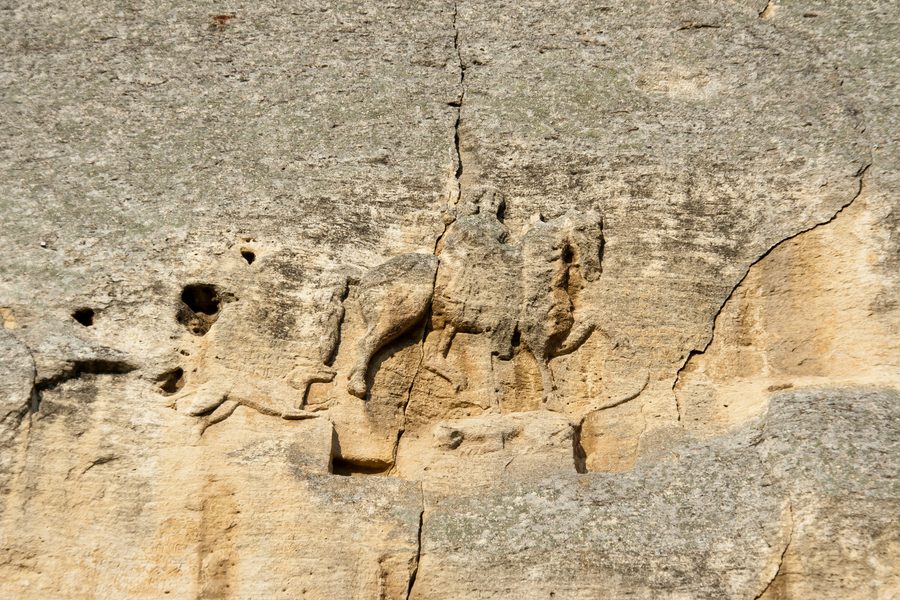 Der Madara-Reiter ist ein mittelalterliches Felsrelief am Madara-Plateau im Nordosten Bulgariens.
Photo: Feradz via Wikimedia Commons, CC BY 3.0
Der Madara-Reiter ist ein mittelalterliches Felsrelief am Madara-Plateau im Nordosten Bulgariens.
Photo: Feradz via Wikimedia Commons, CC BY 3.0
From the early capitals to the museums
Pliska was the capital of the First Bulgarian Empire from 681 to 893. In 893, following the Council of Preslav, Veliki Preslav was declared the capital of the Bulgarian state. The National Historical and Archaeological Reserve of Veliki Preslav preserves the remains of numerous churches, monasteries, workshops, studios and palaces. At the Archaeological Museum of Veliki Preslav, you can see the Preslav Gold Treasure, a ceramic iconostasis and a unique collection of lead seals, among other exhibits. These stops offer different ways to explore history: from the historic site and its architectural remains to the artefacts on display.
The museums also each have their own focus. The Regional History Museum in Shumen holds more than 150,000 museum objects dating from the 5th millennium BC to the 20th century. The Pancho Vladigerov Museum Complex traces Shumen’s musical history, from the founding of the first European music orchestra in the Bulgarian lands in 1850 to the achievements of Shumen’s musicians today. At the Lajos Kossuth House Museum, the restored interior of a prosperous Bulgarian home from the National Revival period is paired with a documentary exhibition about the Hungarian Revolution of 1848–1849.
Fortress, monument and UNESCO site
The first fortification at the site of Shumen Fortress is thought to have been built about 3,200 years ago. The Founders of the Bulgarian State Memorial Complex stands on a hill at an altitude of 450 metres. It forms a visual centre for the Bulgarian antiquities of Pliska, Preslav, Madara Rider and Shumen Fortress, and presents Bulgaria’s cultural and social development from the 7th to the 10th century. Together with the Madara Rider, which has been on the UNESCO World Heritage List since 1979, these sites offer a range of historical themes to consider when planning your trip.
Practical directions are also provided for visiting Shumen Fortress: an asphalt road leads to the fortress from the direction of the Tombul Mosque, with signposts along the way. Guided tours at the fortress are available in Bulgarian, Russian and English. If you enjoy learning more about a historic site with a guide, you can take this option into account.
Opening times and special experiences
Opening times vary from place to place. The Madara National Historical-Archaeological Reserve is open from 8:30 to 20:00 from April to October, and from 8:30 to 17:00 from November to March; it has no weekly closing day. The Shumen Garrison Military-Historical Exhibition is open from 10:00 to 17:00 and closed on Sundays and Mondays. If you are considering visiting both, factor their different opening times into your day’s plans.
Other experiences cater to different interests: Tsarev Brod Winery offers wine tours, which can be booked and paid for through its website. Visits to Kabiyuk Stud Farm are possible only with an advance reservation by telephone. Bear these conditions in mind before planning an outing. When choosing your holiday rental and planning your stay, you can focus on historic sites, museum visits or one of these special activities, without trying to fit everything into a single itinerary.
Places in Shumen Province
For further orientation within the province: Shumen, Kaspichan, Preselka, Veliki Preslav, Venets, Varbitsa, Shumen, Veliki Preslav and Kaspichan.
For the broader travel overview: Bulgaria.

