
Plovdiv Province
Accommodation in Plovdiv Province
In Plovdiv Province, ancient urban history, important religious sites and diverse landscapes come together. The region includes the Upper Thracian Plain, parts of the Rhodope Mountains and Sredna Gora, Sub-Balkan valleys and the Balkan Mountains. This gives you a range of ways to shape your trip: city and culture, nature or religious sights.
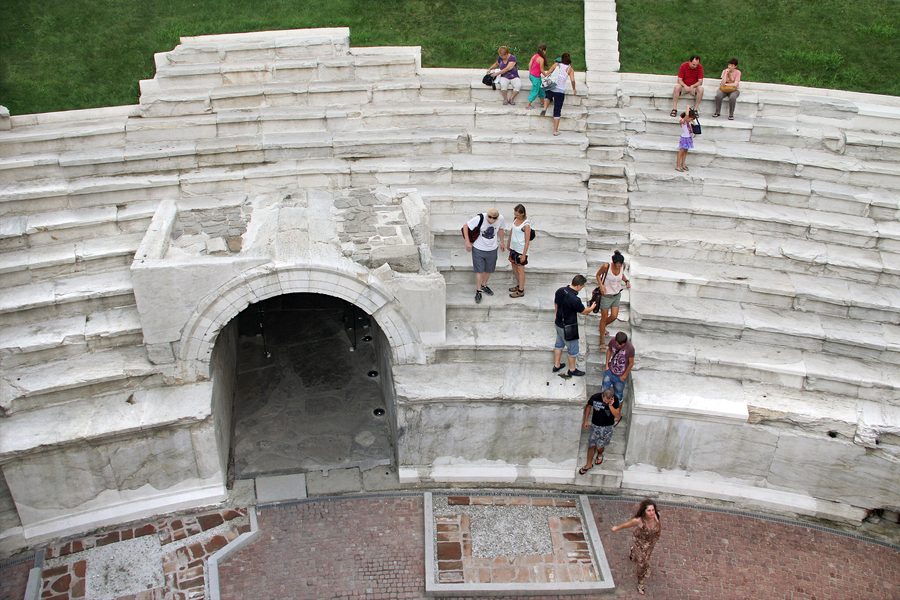 Das antike Römische Stadion von Philippopolis in Plowdiw.
Photo: BrankaVV via Wikimedia Commons, CC BY-SA 4.0
Das antike Römische Stadion von Philippopolis in Plowdiw.
Photo: BrankaVV via Wikimedia Commons, CC BY-SA 4.0
Plovdiv: history in a vibrant city
Plovdiv is the geographical and logistical centre of the Thracian tourism region. At the Ancient Plovdiv architectural and historical reserve, walks lead through different historical periods. Ancient buildings have been adapted to modern life. The reserve is located on a natural rise formed by three closely spaced hills: Dzhambaz Hill, Nebet Hill and Taksim Hill. It is designated for year-round visits; admission fees apply at some sites.
The Roman Stadium is also part of the city’s history: it lies on Plovdiv’s main pedestrian street, between Sahat Tepe and Taksim Tepe. The Ancient Theatre of Philippopolis is one of the best-preserved ancient theatres in the world and was built in the 90s of the 1st century AD. Today, it is a working venue for opera, music and drama. If you are interested in ancient structures and their later use, these sites offer different insights into Plovdiv’s past and present.
Religious sites and historic buildings
The Bachkovo Monastery of the Dormition of the Mother of God is one of the region’s important religious attractions and one of Bulgaria’s 100 national tourist sites. Krastova Gora is a sacred place in the region and offers opportunities for religious tourism. These destinations give a trip a different cultural focus from Plovdiv’s historic buildings.
Near Perushtitsa stands the Red Church of the Holy Mother of God, a Late Antique and Early Medieval basilica that was in use from the 4th to the 14th century. The Small Early Christian Basilica in Plovdiv dates from the 5th or 6th century. Those interested in early sacred architecture can include these buildings as stops in their own right. Another historic site is the Asen Fortress: its church and feudal castle can be reached by a narrow path, and there is a car park at the fortress.
Landscapes, rivers and nature
The rivers also help define the region: the Maritsa and its tributaries cross the province, as do the Pyasachnik, Stryama, Vacha and Chepelarska rivers. The landscape also includes a variety of designated natural areas. Belintash is a natural monument in Asenovgrad Municipality, near the village of Sini Vrah; Chervenata Stena is a nature reserve in the Plovdiv region.
The Rhodope Mountains in the region are suited to mountain, eco, hunting and fishing tourism. Which of these activities you want to pursue during your stay may influence your choice of holiday location within the province. Mineral springs can be found in several parts of the region, including Hisarya, Klisura, Asenovgrad and Banya. Alongside urban history and nature, places with mineral springs are another possible focus for your trip.
Getting there and places to explore
The Trakia motorway runs through the Plovdiv region. Plovdiv is also an important international railway hub and part of European transport corridors of national and international importance. If you want to focus your stay on the city, its historic sites offer a clear cultural focus; places elsewhere in the province are also worth considering for other interests.
For further inspiration, you can also consider these places in the province: Belitsa, Brestnik, Krichim, Maritsa, Kuklen, Hisarya, Karlovo, Hisarya, Borovo, Kalofer, Asenovgrad, Bresovo, Laki, Rhodope Municipality, Vinitsa, Plovdiv, Sopot, Parvomay, Stamboliyski, Parvomay, Perushtitsa, Rodopi, Brezovo and Kaloyanovo.
For the broader travel overview: Bulgaria.

