
Holiday apartment in Vrith: Nature, Trails and History
Accommodation in Vrith
Vrith combines impressive natural formations with visible traces of the past. A roughly 200-year-old tree of the Celtis australis species reaches a height of 10 m and has a trunk diameter of 1 m. It stands in the vicinity of Vrith at an elevation of about 900 m above sea level.
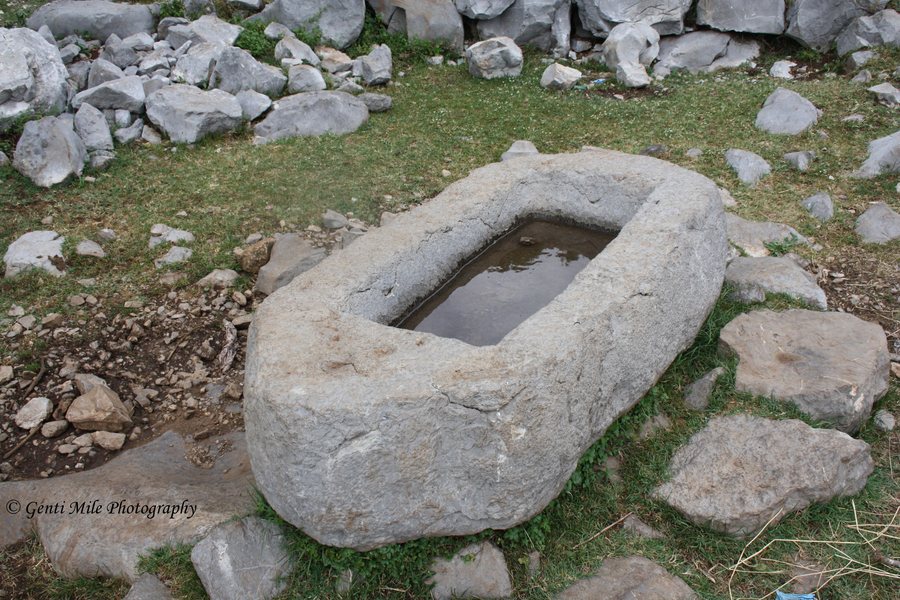 File:Lug uji për bagëtitë (Vrith, Shkrel, Shkodër).jpg
Photo: Genti Mile via Wikimedia Commons, CC BY-SA 4.0
File:Lug uji për bagëtitë (Vrith, Shkrel, Shkodër).jpg
Photo: Genti Mile via Wikimedia Commons, CC BY-SA 4.0
Nature
The defining landscape formations include the moraines of Razëm, known in Albanian as Morenat e Razmës. They consist of Quaternary ice deposits from the Gropa e Karikjeve cirque. The deposits form hills 50–80 m high, 1.7 km long and 1.2 km wide. Karst sinkholes and depressions shape their surface, while beech and spruce forests cover the moraines. The moraines are located in the villages of Vrith and Razëm in the municipality of Shkrel, at 1,050 m above sea level.
The area between Razëm and Vrith also reveals geological processes: the deposits there show traces of intense tectonic and erosional activity. Historically, Razëm served as grazing land for the surrounding population of Vrith.
Trails and Activities
The area around Razëm offers a range of landscape-based activities. The Veleçik ridge, at around 1,724 m, and Kunora, at around 1,713 m, offer landforms of tourist interest, for example for mountaineering and picnics. In the vicinity of Vrith, Razëm also offers opportunities for hiking and winter activities.
Further trails and landscape experiences can be found in Shkreli Park. There are numerous hiking trails, caves and opportunities for agrotourism. The Dedaj–Vrith–Razëm route, described as a horse-riding trail, also runs through the park. This means that hiking trails, caves, agricultural attractions and a designated horse-riding route come together in the same landscape.
Rural routes also lead to the individual natural attractions: Carraca e Vrithit can be reached via the Koplik–Dedaj–Vrith route, while the moraines of Razëm can be reached via Koplik–Dedaj–Razëm.
Culture and History
A cave in Vrith served as a hiding place for Dom Nikollë Gazulli for around 14 months during the communist persecution. The cave of Dom Nikollë Gazulli was discovered by a local shepherd and contained several items that Gazulli had used. Dom Nikollë Gazulli was a lexicographer and priest; he remained hidden in a cave in Vrith for more than a year from the communist regime and was executed by communists in 1946.
Faded graffiti can also be seen on almost derelict buildings in Vrith. They bear old slogans used by the formerly ruling political party during the period of communist rule.
Those comparing holiday apartment offers in Vrith can check the exact location, type of accommodation and possible occupancy on the respective offer pages. It is also worth reviewing the included services, price components, as well as the booking and cancellation conditions. Differences in the stated terms can likewise be checked directly there. The selection therefore remains oriented towards the specific information provided for each offer: what matters are the fields that can actually be checked before booking, not a general expectation of the accommodation. This makes it possible to compare different offers objectively based on the visible offer details.
For the higher-level travel overview: Malësi E Madhe.

.jpg)