
Aleppo: Citadel and Culture
Accommodation in Aleppo
Aleppo brings together the city’s distinctive buildings and a broader cultural heritage across the governorate. At the heart of Aleppo’s Old City stands the citadel, an example of Arab-Islamic military architecture. Its remains include mosques, palace buildings, and bathhouses. Together with the Great Mosque, Khan al-Wazir, and regional UNESCO sites, these offer a multifaceted picture: you can explore the city’s history, archaeological and landscape connections, and local cuisine as distinct focuses for your trip.
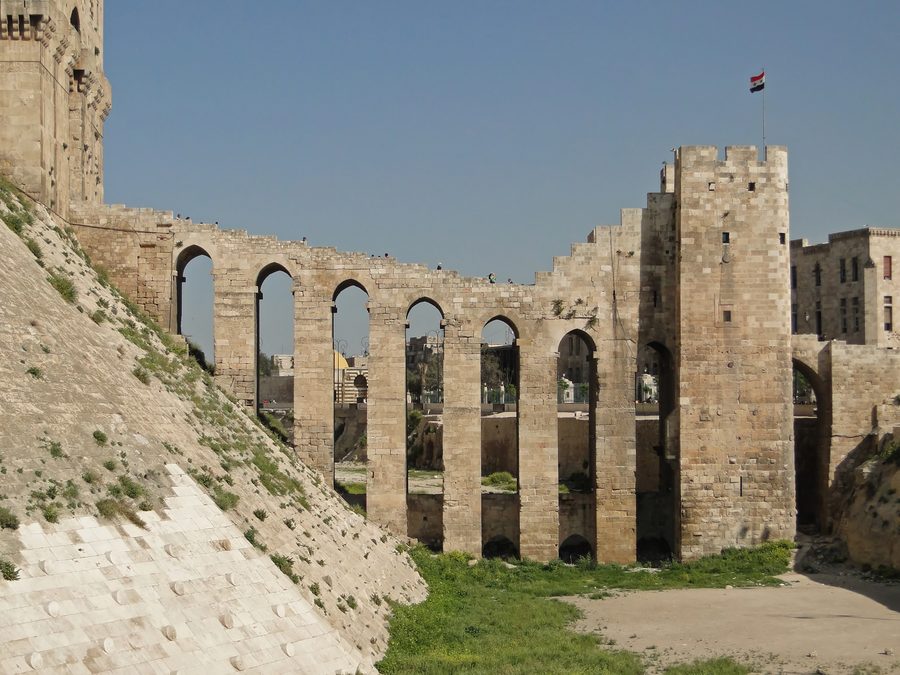 The entrance bridge of the Citadel of Aleppo.
Photo: Bernard Gagnon via Wikimedia Commons, CC BY-SA 3.0
The Citadel and the City’s History
The term “military architecture” draws attention to the citadel’s design as a military complex. At the same time, it preserves the remains of mosques, palace buildings, and bathhouses. This diversity makes it interesting not only as an example of Arab-Islamic military architecture: it combines a military-architectural perspective with other types of historic buildings within the same complex.
The Great Mosque of Aleppo was founded under the Umayyads and rebuilt in the 12th century. Its founding and reconstruction mark different historical periods; the mosque thus represents a history spanning a long period.
Khan al-Wazir offers another clearly dated point of reference: it was built in Aleppo in 1683, during the Ottoman period. In contrast to the Great Mosque, its construction can be linked to a specific year and the Ottoman era, while the mosque’s founding and reconstruction take center stage. This contrast offers two different ways to approach the city’s history: through historical periods on the one hand and a specific year on the other.
UNESCO Heritage on a Regional Scale
Beyond the city, the focus expands to the UNESCO World Heritage property “Ancient Villages of Northern Syria.” It comprises around forty villages in the Limestone Massif in northwestern Syria and extends across the governorates of Aleppo and Idlib. The villages were selected for the remarkable preservation of their architecture and landscape. Their approximate number and spread across two governorates show a different scale from that of a single urban building: the focus is on preserving village architecture and landscape across a larger region.
Qal’at Sem’an, an archaeological park in Aleppo Governorate, is part of this World Heritage property. Alongside the preservation of the villages, a specifically named archaeological park thus represents another facet of the region’s heritage.
A Culinary Connection
Aleppo kebab offers a different focus. Its variations include versions made with eggplant or yogurt, as well as grilled varieties. The different ingredients and cooking methods make kebab a culinary subject in its own right, alongside the historic buildings. If you would also like to experience culture through food while traveling, this local dish adds a culinary perspective to the exploration of architecture and history.
Choose Your Travel Focus
When searching for a holiday apartment in Aleppo, your preferred focus for the trip can help guide you: would you like to focus on the Old City and its architectural history, are you interested in UNESCO heritage on a regional scale, or would you also like to explore the local cuisine? These focuses appeal to different interests.
Discover more destinations: Aleppo, Tartus, Damascus, Latakia.
View the broader travel overview: Syria.

