
Pilgrimage Routes in Germany
Find accommodation
Pilgrimage routes in Germany connect religious destinations, historic towns and varied landscapes. You do not need to choose the longest route for a meaningful journey: an accessible section with realistic stages, suitable accommodation and a reliable return trip is often easier to plan.
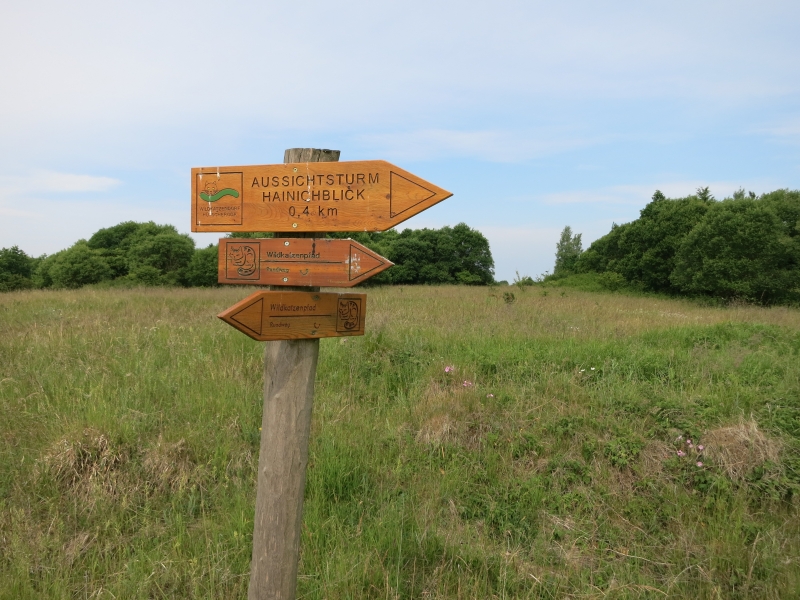 Guide with the viewing tower Hainichblick and other hiking trails on a meadow.
Photo: Markus Lenk
Guide with the viewing tower Hainichblick and other hiking trails on a meadow.
Photo: Markus Lenk
Routes and starting points
- German Camino routes form regional networks that can connect with the wider Camino de Santiago.
- The Elisabethweg is associated with routes towards Marburg; choose a current, clearly marked section before booking.
- The Via Regia follows historical connections through central Germany and has different regional sections.
- The Lutherweg 1521 links places associated with Martin Luther between Worms and the Wartburg area.
- Jakobskirche at Jakobsplatz 1, 90402 Nuremberg, is a useful reference point for regional routes in Franconia; the exact route must be checked for the chosen section.
Choose a manageable section
Start and destination addresses matter more than the maximum total distance. Compare elevation, surface, heat, luggage, rest days and public transport. Churches, pilgrimage offices and railway stations are useful map anchors, but they do not guarantee a uniform route or opening time.
For a first journey, two to four hiking days with a fixed return connection can be easier than committing to a complete long-distance route. Check current markings, diversions and seasonal conditions shortly before departure.
Accommodation, luggage and return travel
Accommodation directly on the route is useful for early starts. Apartments can be practical for several nights, self-catering or a rest day. Accommodation near a railway station may simplify arrival and departure, even if it is not directly on the path.
Confirm the walking route to the accommodation, late-arrival arrangements, luggage options and the return connection before booking. A short transfer at the end of a stage can be more reliable than extending the stage beyond your limits.
Questions about German pilgrimage routes
Which route is suitable for beginners?
Choose a clearly defined section with moderate climbs, manageable daily distances, accommodation and a dependable return connection. The best route depends on your starting point and condition.
Must a pilgrimage begin at a church?
No. A church may be a meaningful starting point, but transport, route marking and a realistic first stage are equally important.
How many kilometres should a day stage have?
Set the distance according to elevation, surface, weather, luggage, breaks and personal condition rather than a fixed target.
Are apartments suitable for pilgrims?
They can be useful for several nights, self-catering and recovery days. Check the route from the path, arrival time, luggage access and transport before booking.
