
Gwda Wielka: Kayak Route and Local History
Accommodation in Gwda Wielka
Gwda Wielka combines a direct connection to the river with a remarkable historical trace. A section of the Gwda is part of the “Pętla Szczecinecka” kayak route, while the local church history dates back to around 1590. When planning your trip, you can therefore focus on different things: the kayak route and river landscape, or the history of the village and other nature and cultural topics in the wider Szczecinek destination.
By the river: the “Pętla Szczecinecka”
The section of the Gwda from Lake Studnica to the confluence of the Dołga in Gwda Wielka is part of the “Pętla Szczecinecka” kayak route. This makes Gwda Wielka part of a named kayak route. In addition, a kayak landing stage on the river was developed in the village as part of a leisure and tourism infrastructure project. If you would like to include the route in your plans, check the current conditions along the route before setting out. The information highlights the river as an important activity, without implying any particular itinerary for your stay.
When choosing a holiday apartment, it may help to first decide what you want to focus on during your trip: should the river in Gwda Wielka be the main attraction, or would you also like to include nature and cultural sites in the wider Szczecinek destination?
A historical trace in the village
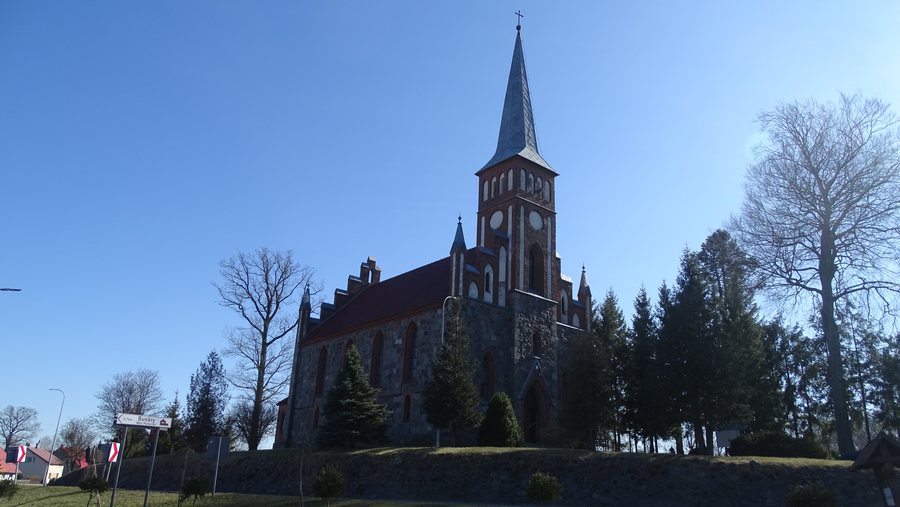
A half-timbered church already stood in Gwda Wielka around 1590; at that time, Jakobus Matthäi was appointed the first pastor. These two recorded facts offer a concrete insight into the village’s history at the time. They attest to an early church tradition, but do not tell us whether the building from that period has survived. For travellers who appreciate history as well as the river, this connection adds another perspective to the picture of Gwda Wielka.
Nature and landscape in the wider Szczecinek destination
In the wider Szczecinek destination, the “Wielkie Błoto” nature and forest educational trail offers a clearly defined glimpse of the peatland landscape. It is on the southern shore of Lake Wierzchowo, southeast of Wierzchowo. Its features include five information boards, a wooden footbridge across the peatland and an observation tower. As the condition of the infrastructure may change, it is advisable to check locally before visiting.
Protected areas also offer different points of interest. “Jeziora Szczecineckie” is a landscape protection area within the Szczecinek municipality. The Bagno Kusowo raised bog is described as one of Poland’s largest and best-preserved Baltic raised bogs and covers about 300 hectares. The wider destination also includes the 49.4-hectare “Jezioro Kiełpino” water and flora protection area, which protects relict aquatic plants. Each of these areas has its own landscape focus; their sizes and protection designations help distinguish them from one another.
Distinguishing routes by activity and length
For cyclists, the red-marked “Szczecineckie Jeziora” cycle route is described as 65.1 kilometres long. It passes through Spore, Stare Wierzchowo, Wierzchowo, Trzebiechowo, Kusowo and Dalęcino in the Szczecinek municipality. The red-marked, 161-kilometre “Szlak Wzniesień Moreny Czołowej” runs through the municipality as a hiking route. These figures refer to two different routes and activities: one is a designated cycle route, while the other is a considerably longer hiking trail. When planning a specific trip, it is advisable to check the current route and markings.
Cultural history in several places
The historic buildings in the wider Szczecinek destination offer further points of reference for culture-focused travel decisions. In Trzebiechowo, the heritage includes a palace complex from the second half of the 19th century and a church dedicated to Our Lady of Częstochowa, dating from the third quarter of that century. The Church of the Assumption of Mary in Wierzchowo dates from the 18th century. The Holy Family Church in Spore was built between 1859 and 1865, and the All Saints’ Church in Wilcze Laski in 1894.
More recent history is also represented: the “Przewodzi Partia” mural in Wierzchowo was created in 1975 and is still visible. As its visibility may change, it is best to check before visiting. An aviation picnic is held every year during the summer holidays in Wilcze Laski; the exact dates vary. If you are weighing up culture, nature and activities, these places and events may appeal to different travel interests. When searching for a holiday apartment in Gwda Wielka, the key is which themes you want to prioritise during your stay.
Discover more destinations: Nowe Gonne, Szczecin, Pogodno, Malechowo, Dziki.
Go to the wider travel overview: Szczecin.

