
Olszanica: Palace Ensemble and Park History
Accommodation in Olszanica
Olszanica offers several distinct points of interest for a stay: a historic palace ensemble, a landscape park with visible traces of fortifications, and three Nordic walking routes in the municipality. A majestic pedunculate oak provides another notable feature. Those interested in architectural history will find different highlights from travellers who want to compare route length, route type and starting point.
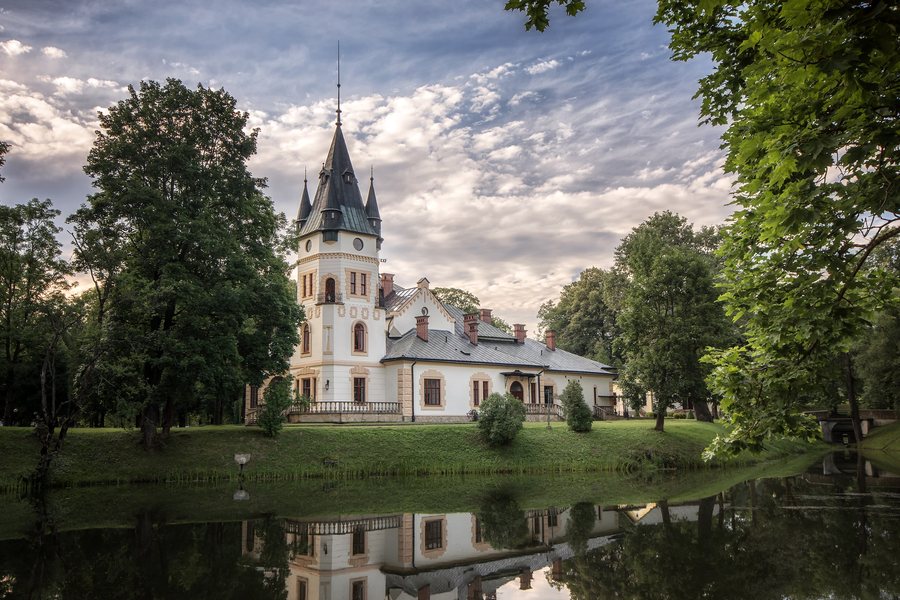
Palace Ensemble and Architectural History
The palace complex in Olszanica comprises a stately eclectic palace, an outbuilding, a bridge and a park with remains of fortifications. The well-preserved ensemble is one of the few complexes of its kind in Lesko County. Eclectic describes a design that combines elements from different styles; the term offers an accessible way to understand the palace’s architectural language.
The ensemble dates back to the 17th century. The palace itself was built towards the end of the 19th century on an island surrounded by a moat. In 1905, the Juścińskis remodelled it, giving it its present appearance; they were Olszanica’s last owners. The ensemble and the palace thus represent different periods in the site’s history.
Local History and Landscape
The area’s history stretches back further: in the 15th century, the village of Olszanica belonged to the Kmita family. The first archival references to a manor house in Olszanica date from 1580. These two details address different matters—the ownership of the village and the first archival mention of a manor house. Thus, 1580 is not the year the palace was built, but the earliest written reference to the manor house.
The landscape park in Olszanica was laid out in the 19th century on the site of an older fortification. Traces of ramparts, dams and moats are visible there. These features give the park a historical dimension: its design dates to the 19th century, while the visible lines point to the older fortification. The most impressive pedunculate oak grows on the ramparts around the upper ponds; its circumference is 610 centimetres.
Nordic Walking: Routes and Starting Points
The “Gmina Olszanica” Nordic Walking Park has three routes in the municipality: the green route is a 4.9 km loop, the red route is a 9 km out-and-back route, and the black route is a 9.3 km loop. The green loop is the shortest; the black one is 4.4 km longer. At 9 km, the red route is only 0.3 km shorter than the black route, but differs from both loops in being an out-and-back route. This makes it possible to compare the routes by length and type.
The starting points also differ: the starting points for Routes 1 and 3 are in Zwierzyń, near a bend in the San River; the starting point for Route 2 is in Orelec. When planning a route, the starting locations mentioned here are also worth considering alongside the route itself.
Plan Your Stay Around Your Interests
When looking for a holiday apartment or holiday home, you can take the different highlights into account when choosing where to stay. The palace ensemble and the historical background of Olszanica are the main attractions for those interested in architectural and local history. If Nordic walking is part of your plans, also consider your preferred route and its starting point in Zwierzyń or Orelec.
Discover more destinations: Roztoki Dolne, Lesko, Myczków, Manasterzec, Werlas, Bóbrka, Zwierzyń, Terka
See the wider travel overview: Leski.

.jpg)