
Discover Kłanino
Accommodation in Kłanino
Kłanino combines a historic palace complex with parkland, a museum and a roadside shrine on the edge of the village. The different themes offer starting points for exploring the place according to your interests: architectural history, rare trees and a religious monument each add a different emphasis.
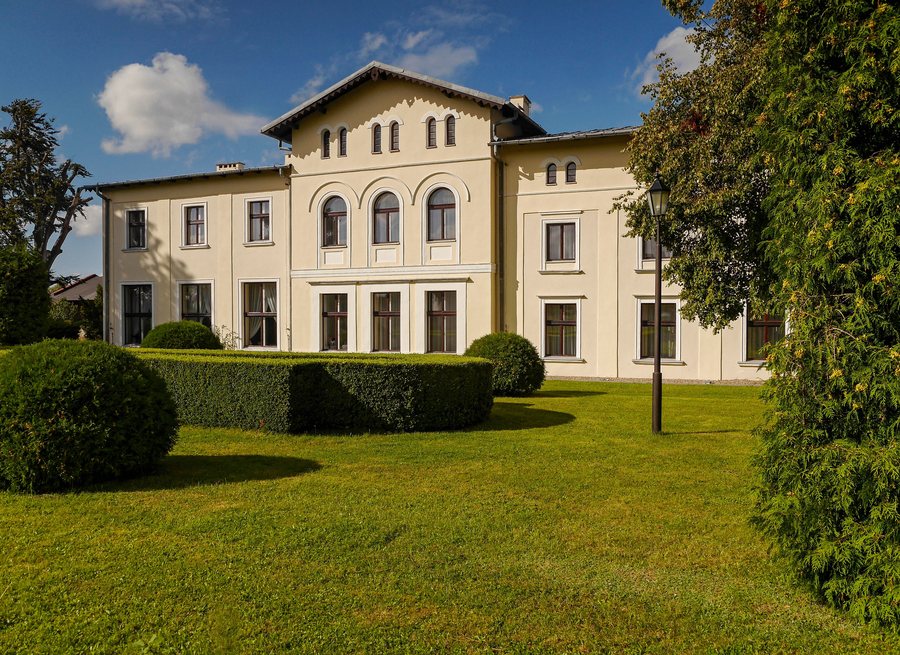
Palace, Park and Museum
Pałac w Kłaninie comprises the palace, the park and the buildings of the former estate. The palace was originally built in the mid-17th century. It acquired its present eclectic appearance following a renovation at the end of the 19th century. Its architectural history therefore brings together an early construction date and a much later transformation. “Eclectic” here describes a design that combines elements from different styles.
A park of more than two hectares lies directly beside the palace. Its features include numerous natural monuments and rare trees, including Japanese arborvitae and ginkgo. This gives Kłanino a distinct landscape attraction alongside its architecture. If you are particularly interested in trees and parkland, focus on the grounds; if you are interested in architectural history, you can start with the palace’s development.
The Muzeum Techniki Militarnej i Historii Pomorza is based in Pałac Kłanino. It is also known as Muzeum Pancerne w Kłaninie. If you plan to visit the museum, check its location before you travel. The palace and museum together form a cultural point of interest, while the park draws attention to the surrounding landscape.
Avenue, roadside shrine and other cultural traces
A surviving lime-tree avenue leads through a 19th-century gate to Pałac Kłanino. The avenue and gate add a historic approach to the palace’s architectural story. When choosing what to explore, you can distinguish between the building’s development and the design of the route leading to it: the lime-tree avenue is itself a named feature of the cultural landscape, not simply another description of the palace.
The historic roadside shrine Matka Boska Siewna stands on the edge of Kłanino. It is dedicated to Our Lady of the Sowing and is located on the road towards Świecina and Wejherowa. The shrine offers a different focus from the palace and park: here, a single religious memorial is at the centre. Its location on the edge of the village and the stated road direction help you identify it as a distinct landmark in the area.
For 2026, historical demonstrations titled “Pancerne Lato w Kłaninie” were listed in Kłanino. If these demonstrations are important to your travel plans, check the event dates in advance.
Which themes suit your stay?
When looking for a holiday apartment, you can start by considering which aspects of Kłanino matter most for your stay. The palace and museum appeal to travellers interested in architectural and cultural history; the park, natural monuments and rare trees offer a green focus. The lime-tree avenue and roadside shrine add further distinctive features of the area. If you are planning a family trip, you can decide together whether architectural history, trees or a single cultural landmark is likely to spark the most curiosity.
Discover more destinations: Rekowo Górne, Puck, Mechelinki, Lebcz, Darzlubie, Minkowice, Karwia, Rzucewo.
For the wider travel overview: Putzig.

