
Brusy
Accommodation in Brusy
Brusy offers a range of starting points for a trip focused on local history and Kashubian culture: a Neo-Romanesque church with distinctive towers, historic brick buildings and a cultural centre with a library. There are also exhibitions, concerts, craft workshops and folklore. Choosing a holiday destination based on travellers’ interests can make it possible to discover architecture, literature and events as different facets of the place.
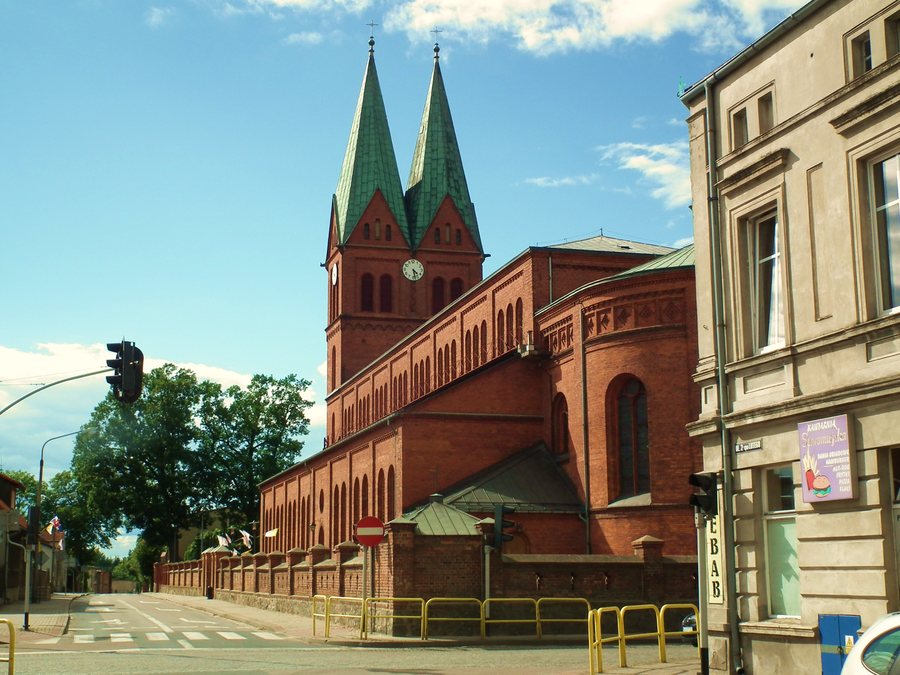
Church and historic houses
The Church of All Saints (“Kościół pw. Wszystkich Świętych”) was built in Brusy from 1876 to 1879, on the site of a wooden church that had previously been demolished. Its Neo-Romanesque style and three-aisled design give the building a clear architectural character. Its two connected, pointed towers are also striking. Visitors interested in church architecture can see a specific building here where the style, layout and tower design can be considered together.
Residential buildings are also part of the town’s historic heritage. One of the oldest surviving brick buildings in Brusy is the house at ul. 2-go Lutego 10, which dates from around 1873. The tenement building at ul. 2-go Lutego 3 dates from the 19th century.
Kashubian culture and events
The Jan Karnowski Centre for Culture and Libraries (Centrum Kultury i Biblioteki im. Jana Karnowskiego) organises exhibitions, concerts, workshops and author meet-ups in Brusy. Its programme brings together different ways of experiencing culture: visitors may be interested in visual art, music, hands-on activities or literary gatherings. The associated library has an extensive collection, with a particular focus on Kashubian literature. Those interested in the region through its books and language will find a distinct cultural point of reference there.
The centre also offers craft workshops that promote Kashubian traditions. These put a different emphasis on culture than exhibitions or concerts: the focus here is on craftsmanship as an expression of regional heritage. When planning a stay, you can therefore decide whether you mainly want to explore architecture and local history, or whether cultural events and traditional crafts are just as important to you.
The International Folklore Festival offers another special opportunity. During the last week of July, Brusy hosts performances by folklore groups from around the world. Its fixed dates make the festival a seasonal consideration when planning a trip; its international programme also sets it apart from the cultural centre’s events and their focus on Kashubian traditions. If you visit Brusy during this time, you can make the folklore performances a distinct part of your stay.
Historic traces in the townscape
An historic cobbled surface remains on Gdańska Street. It adds another way to experience local history alongside the church and older houses: the layout of a street, not just individual buildings, is among the visible traces of the past. The railway building complex in Brusy, in turn, is a group of red-brick buildings. It was built around 1904 and comprises the railway station, two residential buildings and two utility buildings. The approximate date and the size of the complex give it a distinct place alongside the ecclesiastical and civic buildings.
More places
Krzyż, Swornegacie, Czersk, Leśno, Pawłowo, Charzykowy, Rytel, Parszczenica.
For the broader travel overview: Chojnice.

.jpg)