
Siennica: Monastery Complex and School History
Accommodation in Siennica
Siennica offers a cultural focus that can be read in its buildings and school history. The town is home to the former Reformed Franciscan church and monastery complex, whose church, four-wing monastery, and rectangular courtyard form a cohesive ensemble. A statue of the Immaculate Virgin Mary adds a distinctive feature to the courtyard. The Siennickie Muzeum Szkolne also explores topics ranging from local history to educational traditions. Architecture, religious art, and personal school memories offer different historical perspectives on a visit.
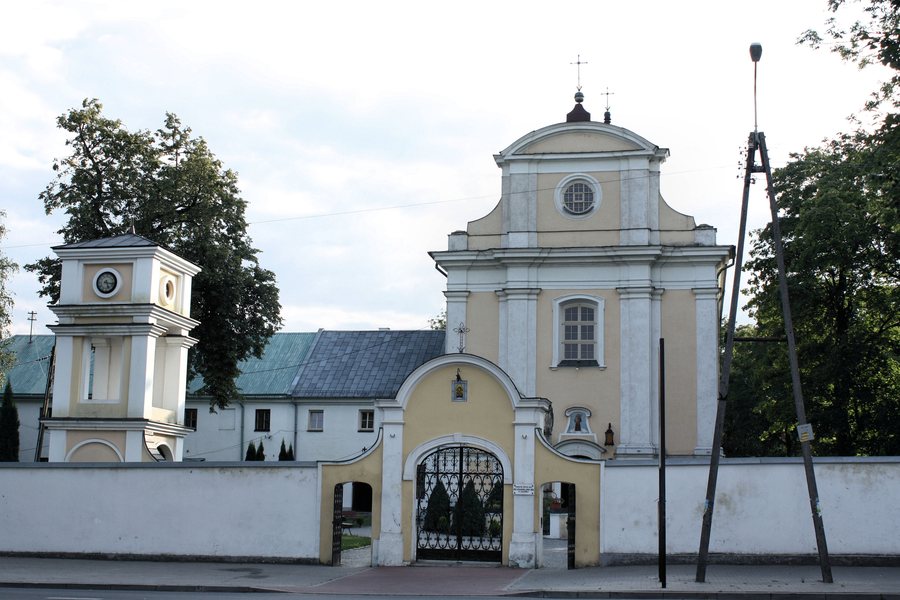 File:Zespół klasztorny reformatów, kościół par. pw. Ofiarowania NMP i dzwonnica, Siennica, KK.JPG
Photo: Katarzyna Koszewska via Source, CC BY-SA 3.0 PL
File:Zespół klasztorny reformatów, kościół par. pw. Ofiarowania NMP i dzwonnica, Siennica, KK.JPG
Photo: Katarzyna Koszewska via Source, CC BY-SA 3.0 PL
Church, Monastery, and Courtyard as an Ensemble
The Church of the Presentation of the Blessed Virgin Mary dates from the 18th century. The four-wing monastery stands directly beside it; the brick and plastered buildings together enclose a rectangular viridarium courtyard. “Four-wing” describes the arrangement of the building’s wings around this courtyard. The courtyard is therefore not merely an addition beside the buildings, but the center of their spatial layout. This makes the complex understandable as a unified work of architecture: the church and monastery remain distinct, yet stand within a shared rectangular frame.
In the municipality’s account, the former Reformed Franciscan church and monastery complex is considered the municipality’s most valuable historic site. This recognition covers the main building, the monastery building, and the immediate surroundings. It therefore applies to the ensemble as a whole, not just to the church.
In the courtyard, a statue of the Immaculate Virgin Mary stands on a Tuscan column. It dates from the first half of the 19th century. The complex thus brings together different historical dates: the church belongs to the 18th century, while the statue dates from the first half of the 19th century. This comparison offers a way to consider different parts of the ensemble and their respective dates.
Founding and Historical Context
The Baroque church and Reformed Franciscan monastery complex in Siennica was founded between 1749 and 1754 by Kazimierz Rudziński, Antonina z Nowosielskich, and their son Michał. These years indicate the period in which the complex was founded; the church is dated to the 18th century. Together, these details provide a timeframe for the complex and its church.
School History and Memories
The Siennickie Muzeum Szkolne offers another perspective. Its collection comprises hundreds of exhibits on local history, Siennica’s educational traditions, the struggle for Polish identity and independence, and the region’s material culture. The collections include old textbooks and encyclopedias, as well as numerous recollections and memoirs by teachers, former students, and others associated with the school.
Textbooks and encyclopedias are a different kind of evidence from recollections and memoirs: the former are educational and reference works, while the latter are personal accounts by people connected with the school. This shift between objects and personal memories makes the focus on school history tangible. At the same time, the range of topics extends beyond the school to local history, regional material culture, and questions of identity and independence.
Cultural Interests for Planning Your Trip
For planning what to see, two themes stand out: the historic complex focuses on architecture and religious art, while the museum explores educational traditions, local history, and personal memories. If both interest you, you can consider them as different perspectives on Siennica. Those traveling together can also compare different kinds of history: buildings convey a sense of the site’s layout, while textbooks and memoirs offer another way to explore school life and personal memories.
When looking for a holiday apartment in Siennica, these interests can help shape your choice of location. Consider whether architectural history, school traditions, or the combination of both will be the main factor in your stay.
Discover more destinations: Stanisławów, Łęka, Sulejówek, Halinów, Dębe Wielkie, Starogród, Grebiszew, Grabina.
View the wider travel guide: Miński.

