
Bardo: River Gorge and Pilgrimage History
Accommodation in Bardo
Bardo brings together a river landscape, pilgrimage history, and traces of medieval settlement. The Nysa Kłodzka shapes both the famous gorge and a water route through the town. Churches and historic buildings also offer very different perspectives on Bardo. You can therefore plan your stay around what matters most to you: the landscape and water, religious history, or active excursions.
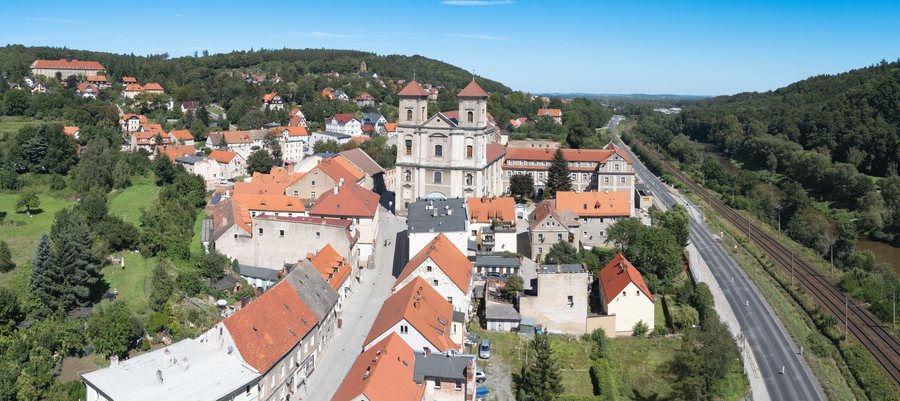
River and Gorge
Przełom Bardzki, also known as Cud Sudetów, is a 14-kilometer middle section of the Nysa Kłodzka between Ławica (Młynowo) and Bardo. The viewpoint at Obryw Skalny offers a panorama of Bardo and the river gorge. The view from there and a paddling trip offer different perspectives: one presents the landscape in a panorama, while the other lets you experience the Nysa Kłodzka on the water.
The water route runs from Bystrzyca Kłodzka via Kłodzko and Bardo to the village of Topola. While paddling on the Nysa Kłodzka, you may encounter mouflons, salamanders, grey herons, or brown trout; such encounters are possible but not guaranteed. Since water levels can affect paddling conditions, it’s a good idea to check the current situation before setting out.
Pilgrimage and Religious History
The Góra Bardzka summit chapel, Kaplica Górska, was built from 1617 to 1619. The summit lies 583 meters above sea level and is now called Kalwaria. The Maryi Spring is on the way up. A small brick chapel encloses it; this chapel was built in 1893 and lies halfway to the summit.
The present-day Church of the Visitation of the Blessed Virgin Mary was built from 1686 to 1704. The Redemptorist monastery stands beside the church and houses the Museum of Sacred Art, founded in 1967. Its collection includes paintings, sculptures, liturgical vessels and vestments, other liturgical objects, and publications about the cult of Our Lady of Bard.
The moving panoramic nativity scene is also part of Bardo’s religious history: it was created to commemorate 700 years of pilgrimage to Bardo, covering the period from 1270 to 1970. Together with the church buildings and the chapel at the spring, it illustrates the different ways pilgrimage is reflected in the town.
Historic Traces in the Town
Well-preserved remains of an early medieval castle settlement dating from the 10th to the 13th century lie along Noworudzka and Główna streets. They are among Bardo’s oldest monuments and reflect a different period from the religious buildings constructed later.
Another landmark in the town’s history is the stone bridge over the Nysa Kłodzka. Its construction was completed in 1589. After being rebuilt in 1909, the bridge took on its present-day Gothic appearance. Here, the history of its construction meets the river that also shapes the gorge and paddling route.
Plan Activities and Accommodation
The singletrack routes in Bardo extend across seven municipalities in the Kłodzko Valley. This adds another way to plan your stay alongside the river and cultural attractions. When looking for a holiday apartment or holiday home in Bardo, you can start by considering how you’d like to spend your days: would you rather focus on the river landscape and a possible paddling trip, explore the religious history, or include the singletrack routes?
Travel by Train
Bardo Śląskie station is on the Wrocław–Międzylesie and Wrocław–Kudowa railway lines. The nearest station is Bardo Przyłęk. Check the latest timetables before travelling to plan your connection.
Discover more destinations: Frankenstein, Srebrna Góra, Budzów, Kamieniec Ząbkowicki, Złoty Stok
Return to the main travel overview: Frankenstein.

