
Szalkszentmárton – Petőfi’s Legacy and Historic Sites
Accommodation in Szalkszentmárton
Szalkszentmárton brings together the literary legacy of Sándor Petőfi and a town centre whose squares and buildings reveal different facets of its history. The memorial exhibition, an artesian well, a church and a former inn each offer a different perspective. You can decide whether to focus your trip mainly on Petőfi’s work and local history or include other themes in the wider travel destination of Bács-Kiskun.
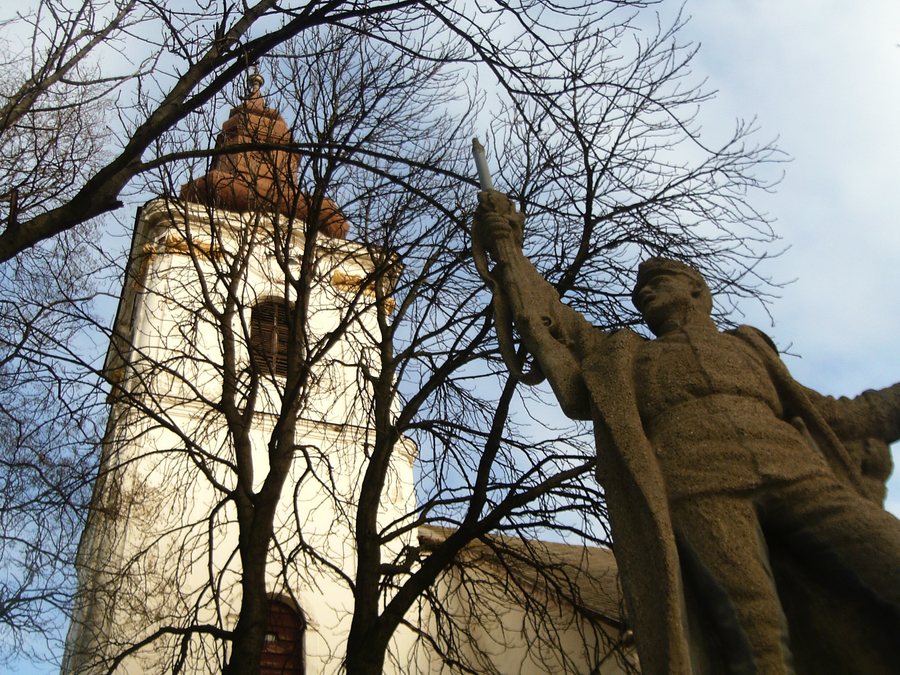 I. világháborús emlékmű és Református templom (1767), Petőfi tér, Szalkszentmárton
Photo: DF1977 via Source, CC BY-SA 3.0
Petőfi’s Legacy and the Memorial Exhibition
Sándor Petőfi wrote the poem “Fekete kenyér”, two dramas and a novel in Szalkszentmárton. The town is listed as the place of composition for 112 of his poems. The Szalkszentmárton Sándor Petőfi Memorial Exhibition adds a vivid dimension to this literary focus, with historical costumes, a hand mill and a cimbalom on display. There is also a screening room where an animated short film can be shown.
The memorial exhibition also offers educational programmes for museum visitors. They cater to groups of different ages and include literature, arts and crafts, and a demonstration kitchen. If you are planning a group event, confirm the arrangements with the museum before your visit. This lets you make the town’s literary heritage a distinct focus of your trip, extending beyond the exhibition itself.
Squares, Buildings and Changing Eras
A square enclosed by buildings in the town centre has retained its centuries-old character through renovations and rebuilding. Another historic landmark is the artesian well on Petőfi tér: it was first built in 1928 and renovated in 2012 with donations from local residents. The two squares tell different stories—one of a historic urban space whose character has been preserved, the other of a well’s construction and subsequent renewal.
The town centre is also home to a former inn with a butcher’s shop. Count György Festetics, the local landowner at the time, had the building constructed in 1810 in the Neoclassical style. Its whitewashed walls are part of its traditional appearance. The Reformed Church, by contrast, has a consistent Baroque design and brings together furnishings from different building periods. These include a baptismal font set into the communion table and the “Sick Woman’s Pew”, described as exceptional nationwide.
Another monument commemorates a historical figure: a bronze statue of Saint Martin, the bishop, stands in Szent Márton tér. Created by sculptor György Benedek, it was unveiled in 2000. Together, these historic sites offer a variety of points of interest—from the architecture of the former inn and the church’s furnishings to Petőfi’s literary legacy.
More Themes in the Wider Travel Destination of Bács-Kiskun
In Tiszaalpár, the Tiszaalpár, Földvár nature trail tells the story of a Bronze Age fortification and the way of life of Bronze Age people. Tiszaalpári Földvár is a specially protected archaeological site in Bács-Kiskun; it was designated as such under Regulation 3/2003. (I. 25.) NKÖM. Also in Tiszaalpár, a reconstruction of an Árpád-era village, built to mark the Millennium, depicts the settlement layout discovered during local excavations.
A focus on traditional crafts can be found at the Kiskunhalas Lace House and Lace Museum. There, you can learn about the history of Halas lace, which began in 1902, view lacework dating back centuries and see the process of lace embroidery. Cifrapalota currently serves as an exhibition venue for the Kecskemét Katona József Museum.
Those who enjoy spending time outdoors will find a variety of nature trail themes in the wider travel destination of Bács-Kiskun. The Boróka nature trail in Bugac is 1,100 metres long and features information boards and activity stations, including a forest xylophone and a play telescope. At Lake Szelidi, a natural oxbow lake formed from a branch of the Danube after the Ice Age, a nature trail focuses on blue-green algae. It is accessible on foot and by bicycle year-round; local conditions may change, so check them before your visit. Its twelve information stations cover the lake’s development, the properties of its water, the organisms that live there and the wildlife of the surrounding area.
Visitor information is another topic in its own right: Természet Háza in Kecskemét is the visitor centre of Kiskunság National Park. It provides information about the park’s nature trails, visiting conditions for protected areas, ecological programmes and forest schools. Pásztormúzeum can be reached on foot from the Puszta Kapuja Information Centre via a dirt road; it is about 1.5 kilometres away.
When looking for a holiday rental in Szalkszentmárton, use your preferred focus as a guide: would you like to centre your trip on local history, Petőfi and the historic buildings, or explore other places and landscapes in the wider Bács-Kiskun destination?
Discover More Destinations
Discover more destinations: Szabadszallas, Apostag, Tass
Back to the wider travel overview: Kunszentmiklósi.

